Sequel logo

Sequel

Freemium
訪問

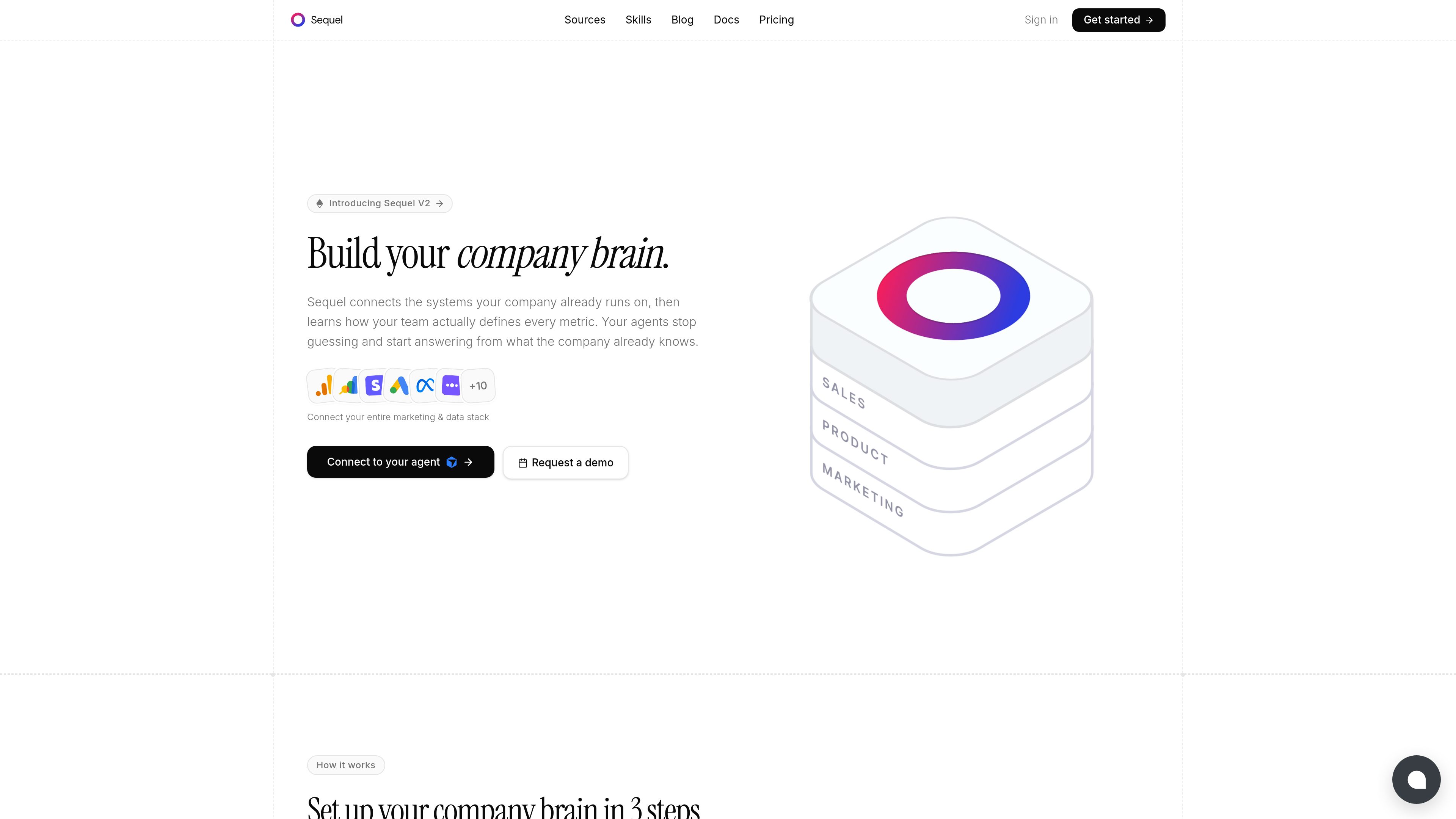
Sequel is an AI data analyst and secure data layer for agents. It connects databases, warehouses, analytics platforms, spreadsheets, and SaaS tools so Claude, Cursor, ChatGPT, and other MCP-capable agents can answer questions using shared data connections and definitions.

Sequelとは?

Sequel is an AI data analyst and data layer for AI agents. It connects cloud databases, warehouses, analytics platforms, spreadsheets, and SaaS tools, then lets MCP-capable agents query those sources in plain English. Teams authorize connections through Sequel rather than giving each agent separate database passwords or API keys.

The product is intended for data questions that span multiple systems. Agents can combine information such as Postgres revenue, Google Analytics sessions, and Stripe payments in one thread, while Sequel manages source access and joins. It retains schemas, metric definitions, and team terminology so connected agents can work from shared business context.

Sequel also provides a controlled Python environment with pandas and matplotlib for calculations, charts, and exports based on connected data. Queries and actions are logged, attributed, and reviewable, and teams can use shared workspaces to collaborate around connections and query history.


Sequelでできること

Natural-language queries across sources

Ask questions in plain English across connected databases, warehouses, analytics tools, spreadsheets, and SaaS systems. Sequel identifies relevant sources and can join information from multiple systems in one thread.

MCP access for AI agents

The Sequel MCP connects the service to Claude, Cursor, ChatGPT, and other MCP-capable agents. The same connections can also be used through the CLI, allowing teams to add agents without repeating source setup.

Credential and access management

Sequel stores and encrypts database passwords, connection strings, and SaaS API keys. Agents request work through Sequel and do not receive the underlying secrets; access can be authorized and revoked through the service.

Agent-based analysis and visualization

A controlled Python sandbox with pandas and matplotlib lets agents compute on real source data, create charts, and export results. The product also provides sortable, filterable data tables and automatic chart selection.

Persistent business context

Sequel keeps schemas, metric definitions, and team terminology available across questions, giving agents a shared reference for how the organization describes and measures its data.

Shared workspaces and auditability

Team plans provide shared workspaces, connections, and query history. Queries and actions are logged, attributed, and reviewable, while read-only access and audit logs support controlled data use.

利用シーン

“Cross-source marketing analysis”

Marketing teams can ask about campaign performance, blended ROAS, conversions, landing pages, or attribution across platforms such as Google Analytics, Google Ads, Meta Ads, and product analytics tools without exporting separate reports.

“Revenue and subscription reporting”

Revenue or finance teams can combine application or warehouse data with Stripe, Polar, or other payment data to investigate MRR, churn, refunds, pipeline measures, burn, or margins in a shared analysis.

“Product usage investigation”

Product managers and analysts can query event, funnel, and retention data from tools such as PostHog, Mixpanel, or Amplitude, then use tables or charts to explore changes in product behavior.

“Engineering and operator data access”

Engineers can explore schemas and query managed PostgreSQL, MySQL, ClickHouse, BigQuery, or similar sources from an editor or CLI. Operators and founders can ask for operational numbers in ChatGPT or Claude without writing every query by hand.

“Team-wide agent enablement”

Organizations can connect sources once and give multiple MCP clients access through scoped permissions, shared connections, and query history instead of distributing credentials separately to every AI tool.

よくある質問

How does Sequel connect AI agents to company data?

You install the Sequel MCP in an MCP-capable agent, authorize data sources in Sequel, and ask questions through the agent. Sequel handles authentication, credentials, and execution between the agent and the connected sources.

What kinds of data sources does Sequel support?

The site lists databases such as PostgreSQL, MySQL, ClickHouse, BigQuery, and Cloudflare D1; analytics and SEO tools including Google Analytics, Amplitude, Mixpanel, PostHog, Google Search Console, and Ahrefs; SaaS tools such as HubSpot, Apollo, Intercom, and Stripe; Google Sheets; and MCP-compatible servers. The integrations directory describes more than 100 integrations and MCP servers, with some listed sources marked as coming soon.

What does an agent receive from Sequel?

Agents can receive answers from connected data, data tables, charts, and exported analysis. Sequel's controlled Python sandbox supports calculations and visualizations using pandas, matplotlib, and other tools. Queries and actions are logged for review.

Can a team use Sequel together?

Yes. The Team plan includes unlimited users and a shared team workspace, while the product describes shared connections and query history for collaboration. Free and Pro plans are limited to one user.

Is there a free plan?

Yes. The Free plan includes three data sources, 50 queries per month, one user, use in any AI agent through MCP, and community support. Paid plans include Pro at $19 per month and Team at $99 per month; Enterprise pricing is custom.

クイック情報

Category
AI data analyst and data layer for AI agents
Primary interface
MCP clients, CLI, and natural-language questions
Supported agent examples
Claude, Cursor, ChatGPT, and other MCP-capable agents
Source coverage
100+ integrations and MCP servers, including databases, warehouses, analytics tools, spreadsheets, and SaaS APIs
Team features
Shared workspace, shared connections, and query history on the Team plan
Pricing
Free tier; Pro $19/month; Team $99/month; Enterprise custom pricing

Sequelの代替品

Workato logo

Workato

workato.com

エージェント型AI向けのエンタープライズ統合・オーケストレーション

Blender Agent Bridge logo

Blender Agent Bridge

callmejones.github.io

Blender Agent Bridge is a Blender extension and localhost MCP server that lets MCP-capable AI clients inspect Blender scenes, collect visual evidence, and make reversible edits. It is intended for users who want agent-assisted Blender workflows with explicit controls over trust and changes.

ora logo

ora

ora.ai

oraはドメインやMCPサーバーURL、MCPアプリURLをスキャンし、AIエージェント対応度を採点します。

Model Context Protocol TypeScript SDK logo

Model Context Protocol TypeScript SDK

modelcontextprotocol.io

The official TypeScript SDK for building Model Context Protocol servers and clients. It provides a repository-organized foundation for MCP development, with separate client, server, core, middleware, documentation, and example areas.

Docker MCP Enterprise Gateway logo

Docker MCP Enterprise Gateway

www.docker.com

Docker MCP Enterprise Gateway governs how MCP-compatible clients access approved servers and tools. It applies identity-aware policy, supplies credentials from an approved secret store, and records tool-call decisions for enterprise teams.

Zapier MCP logo

Zapier MCP

zapier.com

Zapier MCP connects AI clients such as Claude, ChatGPT, and Cursor to actions across Zapier’s app ecosystem. It lets an agent discover an appropriate action, request missing details, and execute it with authentication and permissions managed through Zapier.