
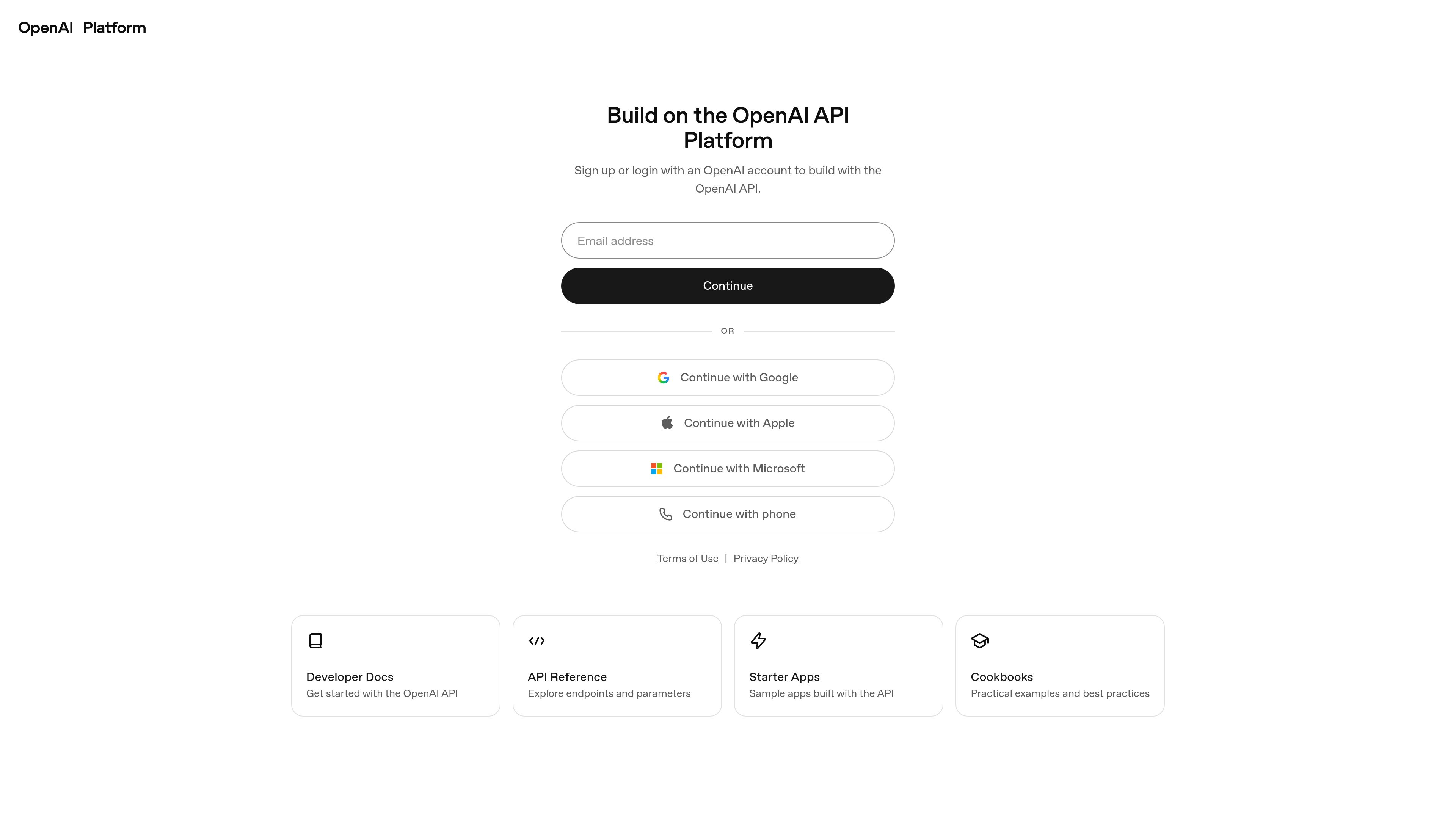
OpenAI API platform
Provides the developer-facing platform for building applications with the OpenAI API. Users sign up or log in with an OpenAI account before getting started.

OpenAI Platform is a developer platform for building applications with the OpenAI API. It provides API access, model and pricing information, technical documentation, starter apps, and cookbooks for implementation guidance.
OpenAI Platform is a developer platform for building applications with the OpenAI API. It provides account-based access to the API alongside documentation for getting started, endpoint and parameter reference material, model information, starter apps, and implementation cookbooks.
The platform is designed to support both initial development and technical evaluation. Developers can use the quickstart and examples to begin an integration, consult the API Reference during implementation, and review the models and pricing pages when choosing an API option and estimating usage costs. The source material does not establish specific third-party integrations or broader team and workspace features.
Provides the developer-facing platform for building applications with the OpenAI API. Users sign up or log in with an OpenAI account before getting started.
Includes a quickstart and API Reference with endpoint and parameter information to support implementation and troubleshooting.
Documents model offerings across categories such as flagship, cyber, multimodal, tools, specialized, and fine-tuning, with pricing tables organized by model and processing option.
Offers sample applications built with the API, giving developers concrete starting points for exploring implementation patterns.
Provides practical examples and best practices that can help developers move from general documentation to working API implementations.
A developer can use the quickstart and starter apps to begin building an application with the OpenAI API rather than starting from an empty project.
During integration work, developers can consult endpoint and parameter documentation to understand the interface they are coding against.
A team evaluating API choices can review the model catalog and pricing tables, including token-based pricing and the listed processing modes, before selecting an option.
Developers can use the cookbooks to study practical examples and best practices when a general API description is not enough for a particular build task.
The supplied site content is aimed at developers building applications with the OpenAI API, including people who need setup guidance, endpoint reference material, examples, and model information.
Sign up or log in with an OpenAI account, then use the Developer Docs quickstart and related API resources to begin building with the OpenAI API.
The platform links to a quickstart, API Reference, model documentation, starter apps, and cookbooks with practical examples and best practices.
The pricing page lists prices by model and processing option. Many model tables use per-1-million-token pricing, while the source also shows separate per-minute pricing for GPT-Live sessions and distinct modality rows for some models.
No. The supplied pages establish API documentation, examples, models, and pricing, but do not provide enough evidence to describe specific third-party integrations, team workflows, or workspace features.

ai.google.dev
Gemini API is a developer API for integrating Google’s generative AI models into applications. It supports text and image generation, multimodal analysis, conversational agents, structured outputs, tool use, and related media workflows through SDKs or REST.

aistudio.google.com
Google AI Studio is a browser-based development environment for experimenting with Google’s generative models and moving prompts into applications through the Gemini API. It supports developers building text, image, video, audio, and agent experiences.

googleapis.github.io
A Python SDK for integrating Google’s generative models into applications through the Gemini Developer API and Gemini Enterprise Agent Platform APIs. It provides client libraries, typed request helpers, and synchronous or asynchronous workflows for developers building with Google’s generative AI services.

platform.claude.com
Claude Platform gives developers programmatic access to Claude models and managed agent infrastructure for building agents and applications. It includes a REST API, official client SDKs, a web Console, and documentation for direct integrations.

cortexdocs.dev
Cortex Docs is an open-source API tooling workflow that turns API specifications and Markdown into interactive documentation, typed SDKs, and MCP servers. It helps developers publish API interfaces for human users, applications, and AI agents from a shared project.

python.useinstructor.com
Instructor is a developer library for extracting structured, validated data from large language models. It uses Pydantic schemas, automatic retries, streaming, and a consistent interface across cloud, local, and routed LLM providers.