
LLM-based text transformation
The pipeline is designed to extract meaningful, structured data from unstructured text using language models.

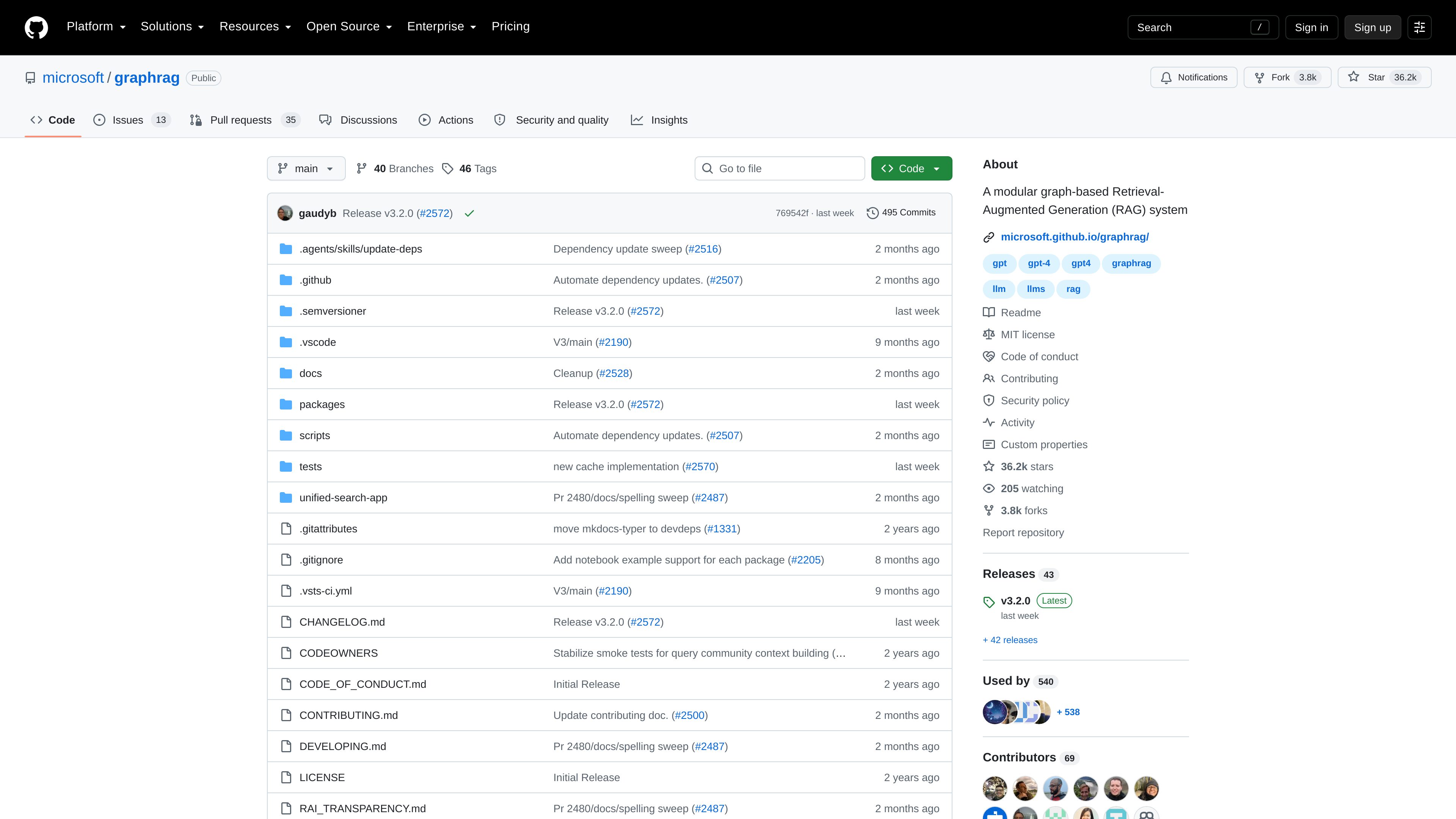
GraphRAG is a research project and data pipeline for extracting structured information from unstructured text with language models, then using graph-based context to support question answering over private data.
GraphRAG is a research project and data pipeline that uses language models to extract structured information from unstructured text. It explores knowledge-graph memory structures as a way to form targeted context for question answering, particularly when working with private data.
The repository presents a methodology and demonstration code, not an officially supported Microsoft offering. The project is largely in maintenance mode, with no new features or pull requests planned; bug fixes and dependency updates may be made as appropriate.
The pipeline is designed to extract meaningful, structured data from unstructured text using language models.
Knowledge-graph memory structures are used to form targeted context intended to help language models answer questions about a data collection.
The README directs users to a command-line quickstart as the entry point for trying the system.
The project recommends fine-tuning prompts for the user's data because default prompts may not produce the best results.
The repository and linked documentation explain an approach to using graph structures to enhance LLM outputs; the code is presented as a demonstration.
Evaluate whether graph-structured context can help a language model reason about an organization's own text collection; the project explicitly frames private-data question answering as a target.
Use the demonstration pipeline to investigate transforming unstructured text into structured data with language models.
Researchers and developers can examine the repository's methodology for applying knowledge-graph memory structures to LLM outputs.
It is a data pipeline and transformation suite designed to extract structured information from unstructured text with language models, and a research method for using graph structures to provide context for question answering.
The README recommends following the command-line quickstart and reading the documentation. It also recommends starting small because indexing can be expensive.
No. The repository says the code is a demonstration and is not an officially supported Microsoft offering.
The README says GraphRAG is largely in maintenance mode and will not accept new pull requests or implement new features. Bug fixes and dependency updates may be made as appropriate.
The project recommends prompt tuning for your data, noting that using GraphRAG out of the box may not yield the best results.

www.diffbot.com
Diffbot transforms unstructured public web content into structured data for AI applications. Its APIs and agent skills support web search, page extraction, crawling, entity resolution, natural-language processing, and Knowledge Graph research.

quantifind.com
AML-KYC審査、調査、レポート作成を自動化する純SaaS基盤。

www.browseract.com
BrowserAct is a no-code AI web scraping and browser automation platform that builds reusable Bots from plain-language data requests. It helps teams collect structured, refreshed web data in the cloud or give local AI agents a browser layer for web tasks.

trypolygraph.com
Polygraphは複数リポジトリを1つのグラフに統合し、AIコーディングエージェントの引き継ぎ時もコンテキストを保持します。

wellapp.ai
業務ツール、文書、データを統合し、チームやエージェント向けのコンテキストグラフを構築。

graphlit.com
AIエージェント向けのコンテキストレイヤーで、根拠ある検索と対話を実現