
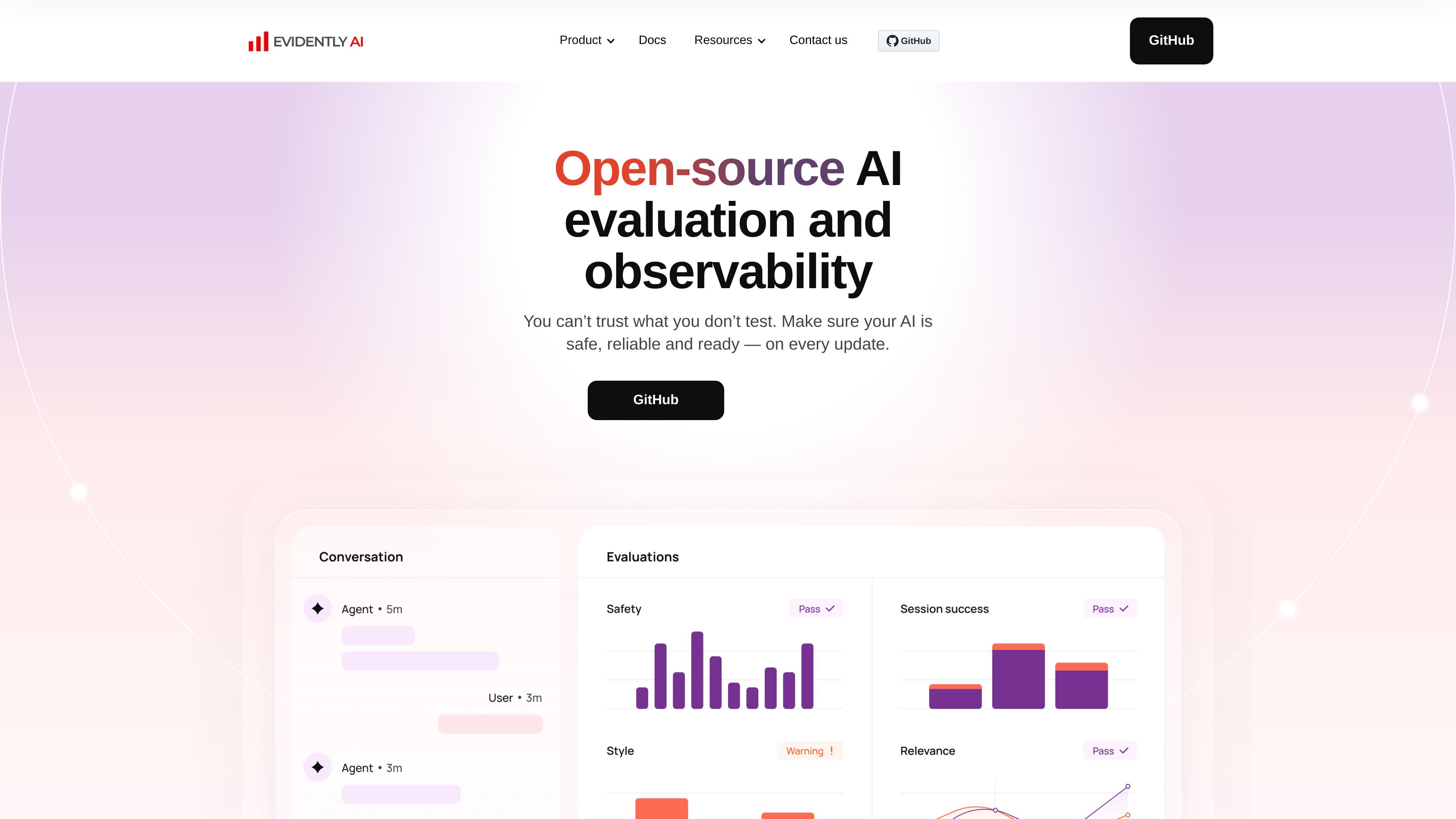
Automated evaluations
Measure AI output quality, safety, and reliability, and run evaluation workflows as part of a pipeline.

Open-source framework for evaluating and monitoring LLM applications, AI agents, and ML models.
Evidently AI is an open-source framework for evaluating, testing, and monitoring LLM applications, RAG systems, AI agents, and predictive machine-learning models. It helps teams assess output quality, safety, and reliability during development and track changes after deployment. Evaluations can combine built-in metrics with custom rules, classifiers, prompts, or models, while reports and monitoring views make results available for review.
Measure AI output quality, safety, and reliability, and run evaluation workflows as part of a pipeline.
Use a library of more than 100 built-in metrics or define evaluations with custom prompts, models, and rules.
Generate realistic, edge-case, or adversarial inputs tailored to an application, including benign and hostile prompts.
Explore evaluation results in visual reports that can be shared with others.
Track evaluation results and quality checks in a live dashboard to identify drift, regressions, and emerging risks.
Evaluate LLM behavior, retrieval quality, and safety alongside predictive performance, data drift, and data quality.
Assess retrieval quality and context relevance, and check generated answers for factuality or hallucinations before release.
Use edge-case and adversarial inputs to evaluate agent responses and expose risks such as unsafe output or prompt-based attacks.
Run quality and safety checks during application updates, then review results in visual reports.
Track model performance, data quality, and data drift as production data changes.
It supports LLM-powered products such as chatbots, RAG applications, AI agents, and copilots, as well as predictive machine-learning systems.
Yes. The framework offers more than 100 built-in metrics and supports custom evaluations using prompts, models, or rules, including combinations of rules, classifiers, and LLM-based evaluations.
Yes. Evidently describes running evaluations in a pipeline and reviewing the results through shareable visual reports.
Examples include guideline and format adherence, hallucinations and factuality, PII detection, retrieval quality and context relevance, sentiment, toxicity, tone, and trigger words.
トラフィックデータは参考情報としてご利用ください。

langfuse.com
LLMアプリケーションとエージェントの追跡・評価・改善を行うオープンソースAIエンジニアリング基盤。

hamming.ai
Testing, red teaming, and production monitoring for teams building voice and chat agents.

akto.io
AI security platform for discovering, testing, governing, and protecting LLMs, agents, MCPs, and GenAI applications.

futureagi.com
Evaluation, simulation, and monitoring tools for teams building AI agents.

dynamo.ai
Enterprise AI controls for evaluating, securing, monitoring, and governing generative and agentic AI.

opensearch.org
OpenSearch is a community-driven, Apache 2.0-licensed open source search and analytics suite for ingesting, searching, visualizing, and analyzing data. It supports application search, observability, security analytics, and machine learning workflows.