
MCP endpoint for AI agents
Chiplab is exposed as an MCP platform that can be connected to agent hosts such as Cursor, Claude Code, and Windsurf. The site describes one endpoint through which agent requests are routed.

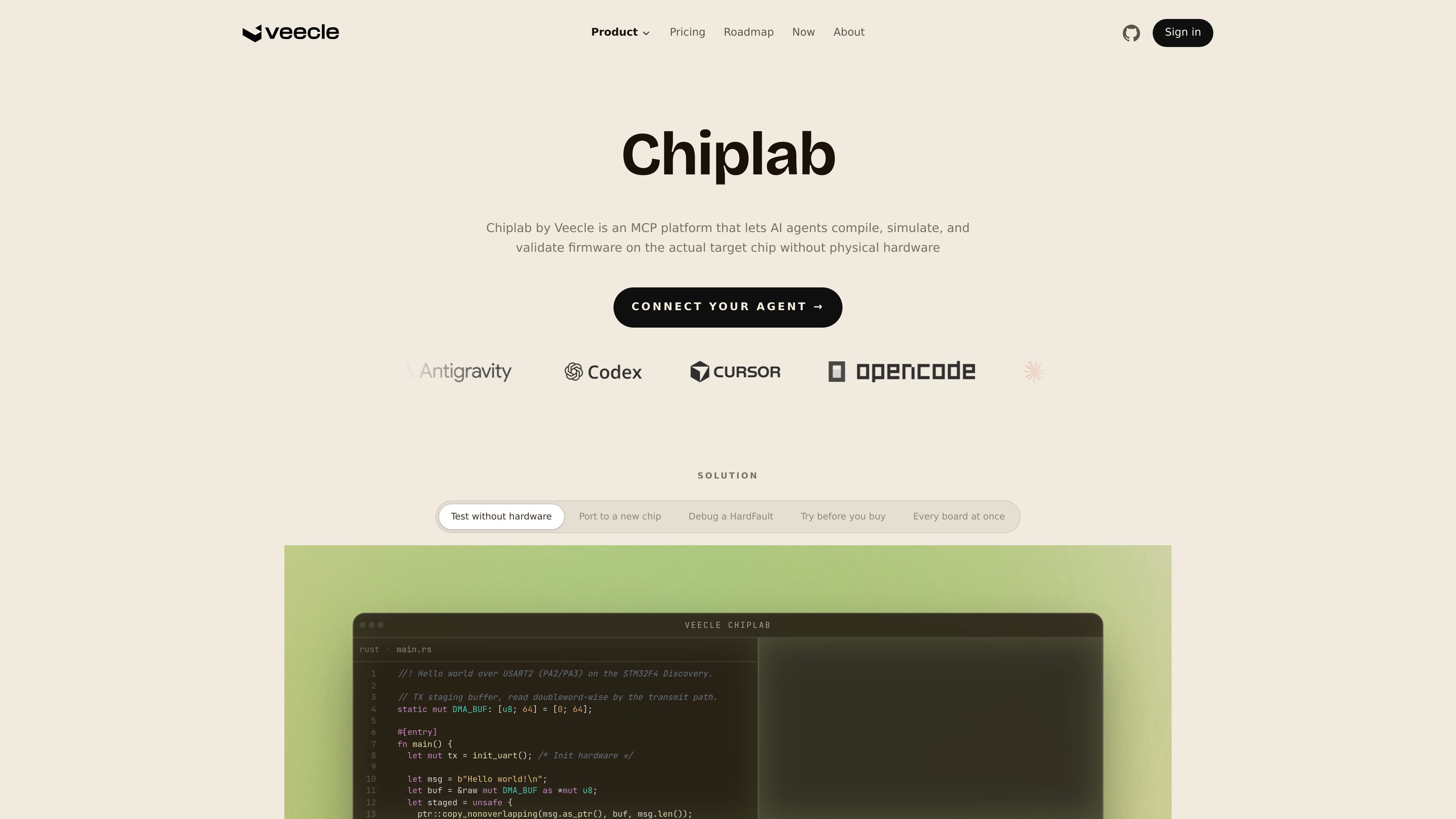
Chiplab is an MCP platform that lets AI coding agents run firmware against virtual instances of target chips instead of waiting for physical hardware. It provides chip-aware execution and searchable embedded-development knowledge through a single endpoint.
Chiplab is Veecle’s MCP platform for connecting AI coding agents to embedded-silicon workflows. Its current shipped surface includes ask for searching a shared embedded-development corpus and run for executing firmware on a virtual chip through Renode or QEMU.
Instead of requiring a physical board for every iteration, an agent can submit firmware and a target chip, then receive execution results including output, telemetry, GPIO or register state, and panic or fault traces. Chiplab is aimed at shortening feedback loops for firmware development and making chip-specific behavior available to agent workflows.
Veecle presents additional verbs—such as build, test, bench, simulate, generate, and automate—as roadmap capabilities. Their availability and chip coverage should be confirmed for a specific project.
Chiplab is exposed as an MCP platform that can be connected to agent hosts such as Cursor, Claude Code, and Windsurf. The site describes one endpoint through which agent requests are routed.
The shipped `run` verb executes firmware on a virtual target through Renode or QEMU, without requiring local hardware or a local toolchain. Returned data can include stdout, stderr, telemetry, GPIO or register state, and panic or fault traces.
The shipped `ask` verb searches indexed firmware tests, validated fixes, architecture decisions, and chip-specific gotchas. Results are ranked and include confidence and provenance information.
Runs and embedded-development findings contribute to a shared corpus that subsequent agent calls can query, allowing later workflows to reuse chip-specific observations and fixes.
Veecle lists remote build, unit and integration testing, benchmarking, full-system simulation, input generation, and autonomous orchestration as work in progress. These capabilities are not presented as universally available today.
An embedded team can use virtual-chip execution to run firmware and inspect behavior before physical prototypes are available, helping identify issues earlier in the development cycle.
When an agent encounters a hard fault or unexpected peripheral behavior, it can run the firmware on a virtual target and query the corpus for related failures, validated fixes, and chip-specific guidance.
Teams considering a new chip can use the virtual execution workflow to explore firmware behavior before committing to a physical board or wider hardware bring-up effort.
A team using an MCP-compatible coding agent can provide it with a target-aware execution loop and searchable embedded evidence instead of limiting the agent to source-code generation and host-side reasoning.
The roadmap identifies `ask` and `run` as shipped. `ask` searches the embedded corpus, while `run` executes code on a virtual chip through Renode or QEMU and returns runtime results. Build, test, bench, simulate, generate, and automate are listed as work in progress.
The core virtual execution workflow is designed to run firmware without a physical board. The site describes a virtual instance of the target chip and returns execution data such as telemetry, GPIO or register state, and fault traces.
The product page names Cursor, Claude Code, and Windsurf as example MCP hosts and describes support for any MCP host. Specific setup steps and configuration requirements are not provided in the supplied product material.
The roadmap lists stdout, stderr, telemetry, GPIO or register state, and panic or fault traces. The product page also describes verdicts, traces, and register state as outputs of virtual execution.
Chiplab uses credits rather than seats. The pricing page lists a free tier, pay-as-you-go credits, and an enterprise option with custom volume commitments; the supplied material does not establish a complete current price or usage limit for every plan.

www.getzep.com
Graphiti is an open-source GitHub project for building real-time knowledge graphs for AI agents. It provides a codebase that developers can inspect, extend, and contribute to through the repository’s development workflow.

app.dezycro.ai
Dezycro is an operations layer for AI coding agents that provides product context, steers work, verifies behavior against requirements, and records decisions. It is designed for developers, product teams, and organizations that want to use agents without giving Dezycro access to source code.

www.agentcard.sh
AIエージェントが共有ウォレットや事前入金なしで自律的に支出できる、使い切りのバーチャルデビットカードを発行。

gtm-api.com
GTM API is an MCP-first LinkedIn API that lets AI agents search, connect, message, scrape, and enrich data on users’ own LinkedIn accounts. It provides the same typed contract through MCP, REST, and webhooks for GTM teams, agencies, platforms, and custom agent workflows.

harden.run
Agentic Integrity Foundation is a local endpoint-security product for coding agents. It evaluates supported tool calls before execution and can allow, approve, make safe, block, or record actions on a developer’s machine.

www.hyperbrowser.ai
Hyperbrowser provides on-demand cloud browsers and sandboxes for AI agents, web automation, scraping, testing, and agentic code execution. It connects browser workflows through an API, Playwright, Puppeteer, Python, or Node.js.