
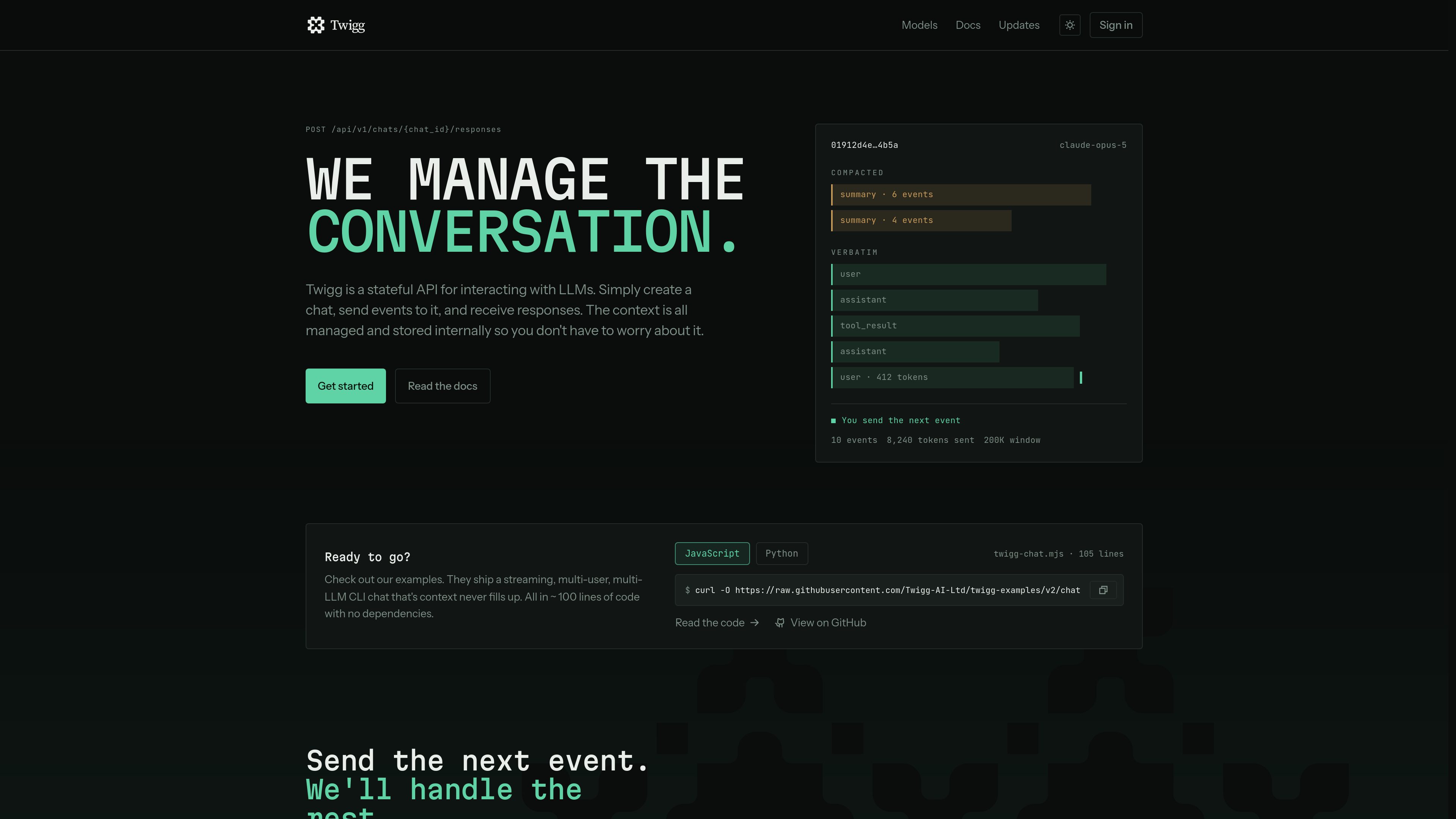
Stateful chat API
Create a chat once and post subsequent events to `/api/v1/chats/{chat_id}/responses`, rather than rebuilding the full transcript for every request.

Twigg è un’API stateful per creare applicazioni LLM, con archiviazione delle conversazioni ospitata, assemblaggio del contesto, compattazione e routing dei modelli. Invia solo l’evento successivo, conserva le chat tra le richieste e cambia modello o provider senza spostare la conversazione in un thread specifico del fornitore.
Twigg is a hosted context store, assembler, and model router for applications that interact with large language models. An application creates a chat, keeps its chat ID, and sends new events to the same chat; Twigg stores the conversation, assembles the request context, calls the named model, and returns the response and usage information.
The conversation remains outside the LLM providers, allowing a single chat to be used with models from different providers. The API can retain provider-native artifacts such as reasoning and tool calls, translate the accumulated ledger into each provider's message format, and compact older context when necessary.
Create a chat once and post subsequent events to `/api/v1/chats/{chat_id}/responses`, rather than rebuilding the full transcript for every request.
Twigg stores and retrieves conversation history, so the application can keep only the chat ID instead of its complete transcript.
Each run names the model to use, allowing a conversation to move between listed models and providers without migrating the chat into a new vendor thread.
Twigg assembles the history for each request and compacts older material when needed to keep the request within the configured context budget.
Namespaces can define context-window budgets and rules for retaining, truncating, or dropping different content types. Tool arguments and results can have separate size and recency rules.
Responses can stream back through the API, and completed runs include model, token usage, stop reason, and cost information when returned by the service.
Keep each user's chats under a separate namespace while the application stores only the open chat ID. Twigg's example CLI supports creating, listing, reopening, and switching between user conversations.
Let a process restart or move between machines without losing the conversation, because the transcript is retrieved by chat ID rather than held in application memory.
Send different turns in one conversation to different named models or providers to compare behavior or match tasks to available model capabilities.
Preserve tool calls, tool results, reasoning artifacts, and ordinary messages in the context ledger while applying separate retention rules to large tool payloads.
Use the documented JavaScript or Python examples to build a streaming chatbot without an SDK or external package dependencies in the examples.
For the documented chat workflow, the application can keep the chat ID and its own agent-loop state. The example CLI says it stores nothing beyond the ID of the open chat, while Twigg keeps the chat and messages.
Yes. The response request includes a model name, and the examples list models through `GET /api/v1/models` and select a different model for later turns in the same chat.
Yes. The examples consume a streamed response and print text delta events as they arrive. The API example also shows a run frame and a final `done` event.
Twigg assembles the conversation within a context budget and can compact older material. The site also describes namespace and model-level controls for budgets, retention boundaries, and truncation rules.
No such full runtime is documented. The product description assigns the application responsibility for the agent loop and tools, while Twigg manages the context ledger, request assembly, model call, and related response data.
I dati sul traffico sono solo a scopo di riferimento.

www.hyperprobe.co
HyperProbe è uno strumento di debugging in produzione assistito dall’AI che inserisce probe di sola lettura nel codice delle applicazioni in esecuzione per acquisire lo stato delle variabili in tempo reale, senza ridistribuire né riavviare. Aiuta i team di engineering e reperibilità a indagare sugli incidenti la cui causa non emerge da log e trace.

orate.dev
AI SDK è un toolkit TypeScript per creare app e agenti AI con diversi framework e provider di modelli.

alphaproxy.ai
AlphaProxy è un gateway compatibile con OpenAI che instrada le richieste tra oltre 450 modelli e 100 provider, con un runtime per agenti dedicato ad attività multi-step e workflow pianificati: un unico endpoint per accedere ai modelli, collegare strumenti e ottenere risultati verificabili.