
AI SDK Core
Provides a unified TypeScript API for text generation, structured objects, tool calls, and agent workflows so apps can use one interface across model providers.

AI SDK è un toolkit TypeScript per creare app e agenti AI con diversi framework e provider di modelli.
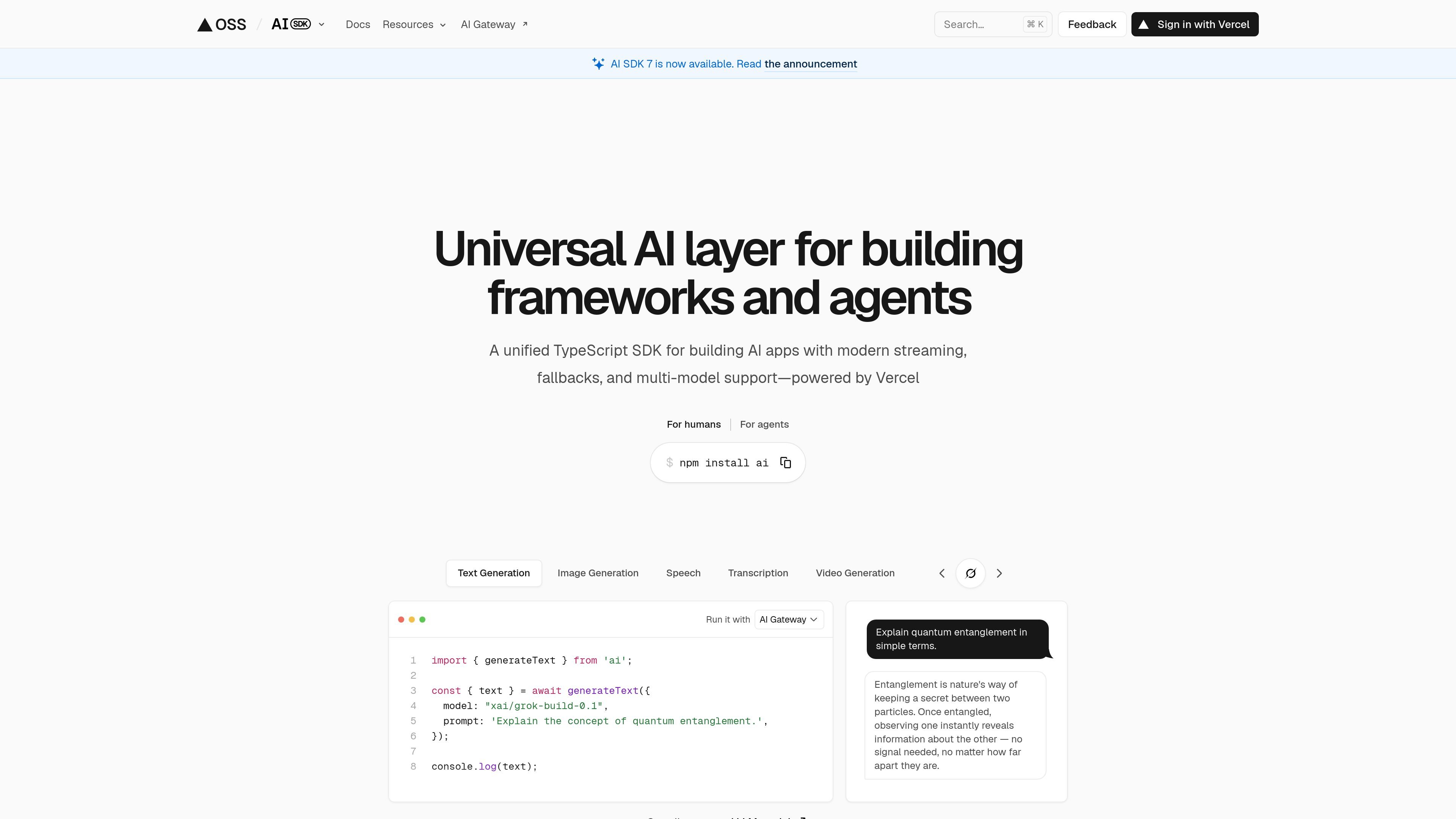
AI SDK is a TypeScript toolkit for building AI applications and agents. It is positioned as a framework-agnostic layer for developers who want to integrate large language models without wiring each provider separately.
The site highlights support for modern streaming, fallbacks, and multi-model workflows, along with surfaces for core generation APIs and UI hooks. It also shows an ecosystem of templates and adjacent tools for common AI app patterns, including chat, retrieval, tool use, and agent workflows.
Provides a unified TypeScript API for text generation, structured objects, tool calls, and agent workflows so apps can use one interface across model providers.
Offers framework-agnostic hooks for chat and generative interfaces, which helps teams build UI without tying the product to one frontend stack.
Supports switching between multiple providers and models with one line of code, reducing provider-specific branching in application logic.
Includes streaming and fallback behavior for production use, allowing applications to deliver real-time responses and handle model interruptions more gracefully.
Documents support for a broad provider ecosystem, including major vendors such as OpenAI, Anthropic, Google, xAI, Azure, Bedrock, Groq, and more.
Surfaces templates and recipes for common builds such as chatbots, Slackbots, SQL agents, retrieval apps, and multi-modal experiences.
Build chat products that need streaming responses, persistence, or multi-modal interactions using the provided SDK surfaces and templates.
Create agents that call tools, return structured objects, and handle multi-step workflows with the core generation APIs.
Switch between model providers or route requests through Vercel AI Gateway when you want provider flexibility without rewriting application logic.
Build framework-specific AI experiences in React, Next.js, Vue, Svelte, or Node.js while keeping the SDK layer consistent.
Use the playground and templates to compare models and start from common patterns such as Slackbots, SQL agents, and retrieval apps.
Yes. The docs describe the AI SDK as a TypeScript toolkit for building AI applications and agents with React, Next.js, Vue, Svelte, Node.js, and more.
The docs present AI SDK Core for generating text, structured objects, tool calls, and agents, and AI SDK UI for framework-agnostic chat and generative interfaces.
The source shows support for multiple providers, including Vercel AI Gateway, OpenAI, Anthropic, Google Generative AI, xAI Grok, Azure, Amazon Bedrock, Groq, Fal AI, DeepInfra, Google Vertex AI, Mistral, Together.ai, Cohere, Fireworks, DeepSeek, Cerebras, Perplexity, Luma AI, and Baseten.
No pricing details were available from the pricing page because it returned a server error in the collected sources.
I dati sul traffico sono solo a scopo di riferimento.
| giu | 0 |
|---|---|
| lug | 0 |
| ago | 0 |
Le analisi del traffico non sono ancora disponibili.
Le analisi del traffico non sono ancora disponibili.

vtok.ai
VTok riunisce diversi provider di modelli AI per la programmazione tramite un’API compatibile con OpenAI.

twigg.ai
Twigg è un’API stateful per creare applicazioni LLM, con archiviazione delle conversazioni ospitata, assemblaggio del contesto, compattazione e routing dei modelli. Invia solo l’evento successivo, conserva le chat tra le richieste e cambia modello o provider senza spostare la conversazione in un thread specifico del fornitore.
superqode.dev
SuperQode è un livello harness open source per agenti di programmazione che consente di scoprire, creare, eseguire, valutare e ottimizzare harness per agenti da un unico terminale. Supporta l’interoperabilità tra A2A, ACP, MCP e UHP, così i team possono continuare a usare gli agenti di programmazione e i modelli che già hanno.

alphaproxy.ai
AlphaProxy è un gateway compatibile con OpenAI che instrada le richieste tra oltre 450 modelli e 100 provider, con un runtime per agenti dedicato ad attività multi-step e workflow pianificati: un unico endpoint per accedere ai modelli, collegare strumenti e ottenere risultati verificabili.