
Minimum-code decision ladder
Guides an agent through a sequence of checks that favors skipping unnecessary work, reusing existing code, and using built-in capabilities before adding new code.

ponytail è un insieme di regole per agenti di programmazione AI che li guida verso la modifica di codice minima che funziona. Aiuta sviluppatori e utenti degli agenti a evitare l’eccesso di progettazione, riutilizzare le funzionalità della piattaforma e mantenere concise le modifiche.
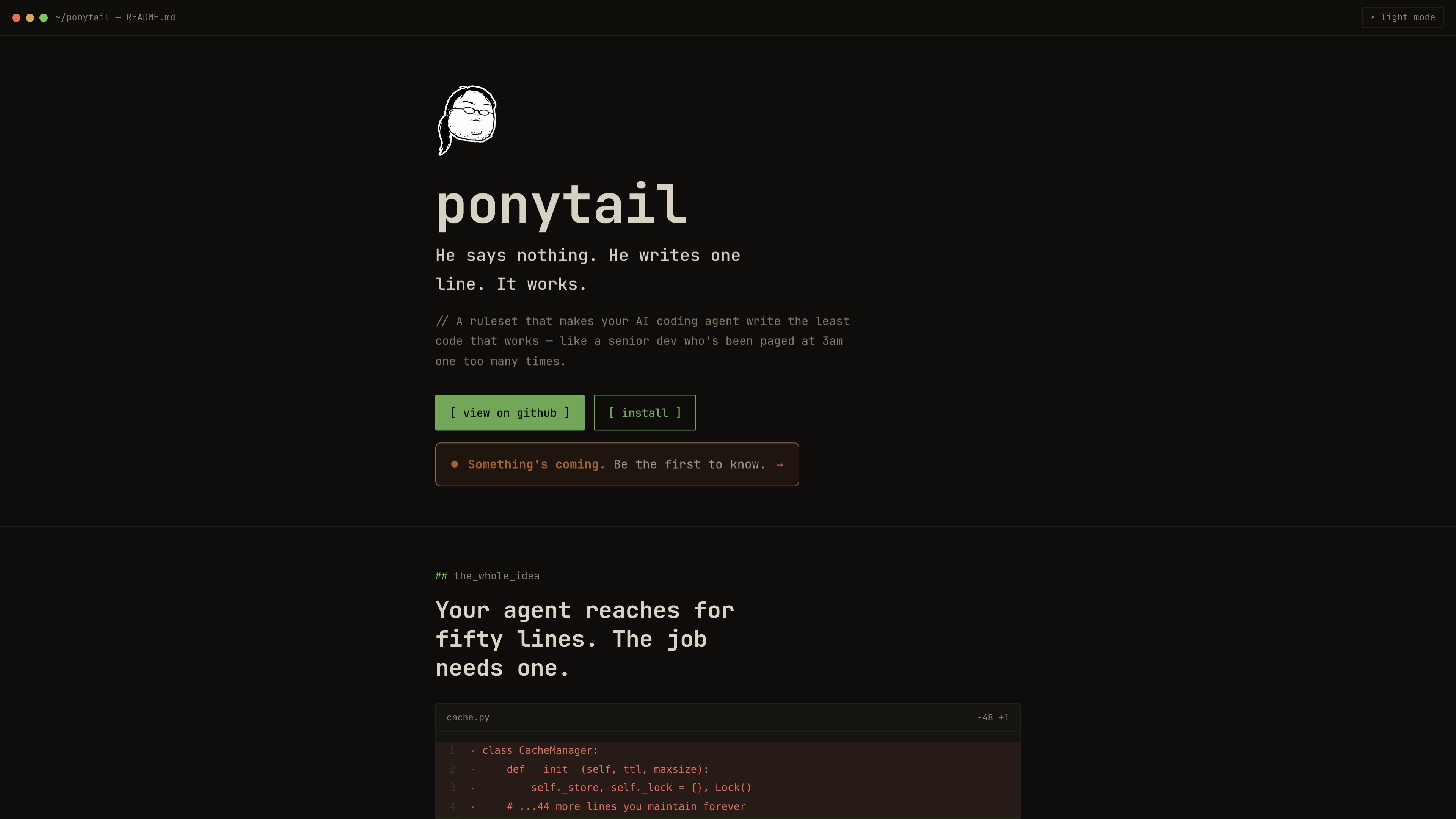
Ponytail is a ruleset for AI coding agents that encourages the smallest code change that still solves the task. The site describes it as “the lazy senior dev for your AI agent,” with a focus on writing less code, using existing helpers or platform features first, and avoiding speculative additions.
The product is positioned for workflows where an AI coding agent might otherwise produce too much code. Its core idea is a ladder of decisions: skip speculative needs, reuse what already exists, prefer standard library or native platform features, and only then write the minimum code that works. The homepage also frames Ponytail as a way to keep validation, error handling, security, and accessibility intact while still reducing code volume.
The site presents Ponytail as a commandable ruleset that can be used with supported agents and plugins, and it includes example commands for adjusting intensity or reviewing a diff for over-engineering. A pricing page exists, but the collected source does not provide a concrete pricing model or plan details.
Guides an agent through a sequence of checks that favors skipping unnecessary work, reusing existing code, and using built-in capabilities before adding new code.
Offers at least three modes — lite, full, and ultra — so users can choose how aggressively the ruleset pushes toward smaller implementations.
Includes chat-style commands such as review, audit, debt, gain, and help for inspecting code, spotting bloat, and viewing benchmark information.
The site shows installation examples for Claude Code, Codex, Copilot CLI, Gemini CLI, and other agent ecosystems, suggesting it is designed to be added through developer tooling.
The homepage reports benchmark results comparing code size, token use, cost, and speed, while noting that safety-related concerns such as validation and security are not simplified away.
Useful when an AI agent produces long implementations for small tasks and you want it to choose a shorter, maintainable path.
Helps when the right solution is to reuse an existing helper, utility, or pattern instead of introducing a new abstraction.
Helpful when teams want agents to prefer built-in controls, such as using native HTML inputs instead of extra UI libraries.
The review and audit commands are aimed at finding bloat in a current change or across a repository.
The intensity modes let teams choose whether they want a lighter nudge or a more forceful anti-bloat rule set.
Ponytail is a ruleset for AI coding agents that pushes them toward the smallest code change that still works, with a preference for reuse and built-in features.
It follows a ladder: skip speculative work, reuse what already exists, use the standard library or native platform features when possible, and only then write the minimum code needed.
Yes. The site shows lite, full, and ultra intensity modes, plus an off option.
Yes. The homepage lists commands for reviewing diffs, auditing the repo, tracking debt, checking benchmarks, and getting help.
A pricing page exists, but the collected source does not provide explicit prices, tiers, or trial details.
I dati sul traffico sono solo a scopo di riferimento.

codity.ai
Codity è una piattaforma di revisione del codice basata sull’AI che analizza tutto il contesto del repository alla base di ogni pull request. Aiuta i team di ingegneria a esaminare le modifiche, individuare problemi di sicurezza, mappare l’architettura e monitorare le analisi degli sviluppatori tra i provider Git collegati.

kilo.ai
Kilo Code è un plugin di programmazione AI multi-agente per JetBrains IDE. Aiuta gli sviluppatori a eseguire e gestire agenti di programmazione AI, esaminare le modifiche in worktree isolati e scegliere da un ampio catalogo di modelli senza uscire dall’IDE.

minimaxi.com
MiniMax è una piattaforma di intelligenza artificiale generalista che offre grandi modelli multimodali, una piattaforma aperta per sviluppatori e prodotti in abbonamento per singoli utenti e team. È adatta a chi necessita di programmazione, attività con agenti, elaborazione multimodale e integrazione di applicazioni native per l’AI.

github.com
GitHub Copilot è un assistente di programmazione e una piattaforma di agenti AI per sviluppatori.

opencode.ai
OpenCode è un agente di programmazione AI open source per terminale, IDE e desktop, che aiuta gli sviluppatori a comprendere le codebase, pianificare modifiche e usare più provider LLM.

tiptap.dev
AI Toolkit aiuta gli sviluppatori a creare agenti AI in grado di comprendere i documenti e modificare i contenuti rich text direttamente sul posto, mantenendo le modifiche verificabili. Supporta workflow lato server, collaborazione in tempo reale ed elaborazione backend senza richiedere una sessione di Tiptap Editor.