ClariLayer logo

ClariLayer

Freemium
Visita

ClariLayer è un livello di contesto personale per agenti AI di programmazione e analisi, che li aiuta a conservare definizioni dei dati, note e join tra una sessione e l’altra. Confronta inoltre il contesto salvato con le evidenze del data warehouse o di HubSpot, segnalando eventuali discrepanze come avvertenze.

Cos'è ClariLayer?

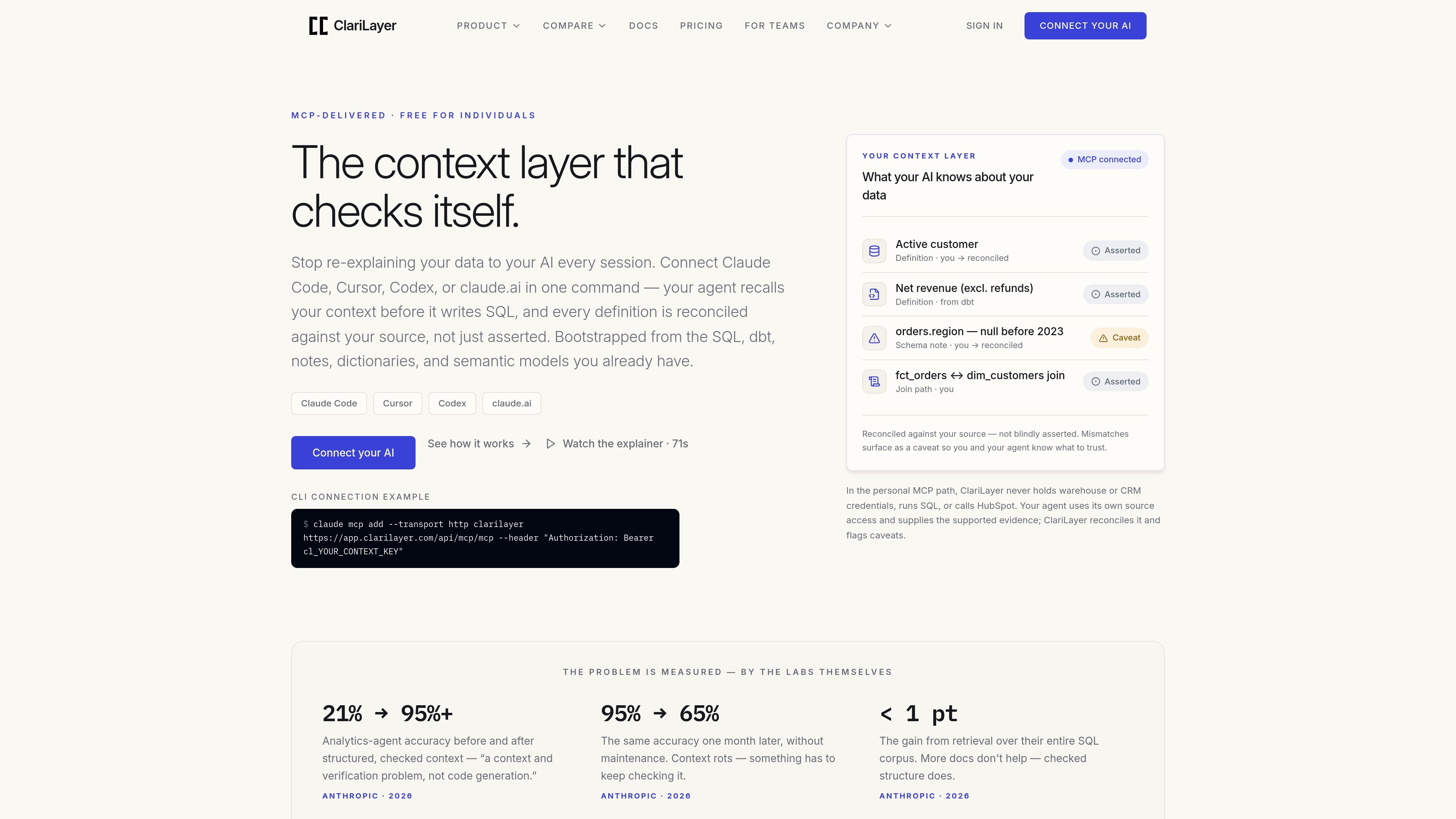
ClariLayer is a personal context layer for AI coding and analysis agents delivered over MCP. It is designed to help an agent remember and reuse data definitions, joins, schema notes, and other project context across sessions instead of making you restate them every time.

Its core workflow is not just storage but verification: you bootstrap context from existing sources, recall it while working, remember new corrections, and reconcile saved definitions against warehouse or HubSpot evidence so mismatches appear as caveats rather than confident errors.

Cosa può fare ClariLayer?

Bootstrap from existing sources

Import context from supported source material so the agent starts with your existing data definitions instead of an empty memory. The docs list SQL, dbt models, CLAUDE.md notes, dictionaries or codebooks, and semantic models.

Recall context during a session

Pull the most relevant saved context into the active task flow when the agent needs it. The docs describe this as recall-first, with context returned in-flow rather than forcing manual re-entry.

Remember corrections and notes

Persist definitions, schema notes, joins, and gotchas so the same corrections can carry across sessions. This is the mechanism that prevents repeated re-explanation.

Reconcile against evidence

Check a saved definition against warehouse actual_sample evidence or, for supported HubSpot contracts, row-free CRM evidence. When declared and observed evidence disagree, the entry surfaces a caveat.

Persist a completion receipt

Record the agent’s completion context before the task closes. The docs describe a completion loop that persists a bounded declaration or an explicit nothing-to-update receipt.

Work inside supported AI clients

Connect through MCP to Claude Code, Cursor, Codex, or claude.ai, with claude.ai also supported over OAuth. The quickstart and pricing pages both frame ClariLayer as a connected context layer rather than a standalone editor.

Casi d'uso

“Persistent context for recurring analysis”

Use ClariLayer when you keep repeating the same warehouse table names, join paths, or metric definitions to your agent in every new chat. The saved context can be recalled in-flow so the agent starts from your established working definitions.

“Check definitions against source evidence”

Use reconcile when you want a saved SQL definition or HubSpot contract checked against evidence instead of trusted as plain text. The product is designed to surface a caveat when the declared definition and observed result disagree.

“Import an existing analytics knowledge base”

Use bootstrap when you are bringing an existing analyst workspace into a context layer for the first time. Supported source material includes SQL, dbt, CLAUDE.md notes, dictionaries or codebooks, and semantic models.

“Carry corrections across sessions”

Use ClariLayer when you want the agent to carry forward corrections, gotchas, and schema notes from one session to the next. Remembered entries are meant to reduce repeated setup work across chats.

“Start solo before team adoption”

Use the free personal path if you are an individual analyst or developer who wants a context layer without seats, usage meters, or procurement. The pricing page positions the personal layer as the default starting point before any team governance.

Domande frequenti

How do you connect ClariLayer to an AI agent?

ClariLayer connects as an MCP context layer for Claude Code, Cursor, Codex, or claude.ai. The docs describe a quickstart that connects an MCP client with a context key or connects claude.ai over OAuth, then confirms the connection so the agent can recall saved context.

What does ClariLayer do after setup?

The public docs describe four main verbs: bootstrap, recall, remember, and reconcile. Bootstrap imports supported source material, recall pulls relevant saved context during a task, remember saves definitions and notes for later, and reconcile checks a saved definition against warehouse or HubSpot evidence.

Is ClariLayer free to use?

ClariLayer supports personal use for one analyst at no cost. The pricing page says the personal context layer is free and unmetered, while the Governed Context Edge for teams is in private pilot and requires early access.

Does ClariLayer access my warehouse or CRM directly?

For the personal MCP path, ClariLayer never receives warehouse or CRM credentials and does not run SQL or call HubSpot itself. The agent uses its own authorized access and sends supported evidence for reconciliation.

What data sources and reconciliation paths are supported?

The docs say the personal context layer can bootstrap from SQL, dbt models, CLAUDE.md notes, a data dictionary or codebook, and semantic models. Reconcile supports warehouse actual_sample evidence and, for HubSpot, bounded row-free crm_evidence; Salesforce is recall-only in the public contract.

Informazioni rapide

Category
Developer Tool
Primary use
AI context layer for data agents
Connection method
MCP; claude.ai also over OAuth
Supported AI clients
Claude Code, Cursor, Codex, claude.ai
Source domain
clarilayer.com
Pricing
Personal use is free and unmetered; team product is in private pilot

Analisi del traffico di ClariLayer

I dati sul traffico sono solo a scopo di riferimento.

Domain Rating
8

Alternative a ClariLayer

Packmind logo

Packmind

packmind.ai

Packmind è una piattaforma di playbook per l’ingegneria che trasforma standard e regole in contesto, protezioni e governance per assistenti di programmazione AI come Cursor, Claude, Copilot e Kiro.

Koreshield logo

Koreshield

koreshield.ai

Koreshield è un livello di sicurezza runtime e di evidenze per i flussi di assistenza basati sull’AI. Controlla gli input dei clienti, il contesto recuperato e le azioni degli strumenti proposte prima che diventino comportamenti affidabili del modello o azioni operative.

nodeterm logo

nodeterm

nodeterm.dev

nodeterm è un gestore di terminali basato su nodi che esegue agenti di programmazione come nodi attivi su una tela infinita. È pensato per chi vuole organizzare in modo spaziale terminali, sessioni degli agenti ed elementi correlati dell’area di lavoro su macOS o Linux.

Onto logo

Onto

buildonto.dev

Onto aiuta i proprietari di siti web a rendere le pagine più facili da leggere per gli agenti AI, fornendo Markdown pulito allo stesso URL. Offre anche analisi delle visite degli agenti e un punteggio di leggibilità AIO. Gli sviluppatori possono recuperare ed elaborare contenuti web tramite la Read API o il server MCP.

SuperQode logo
SuperQode

superqode.dev

SuperQode è un livello harness open source per agenti di programmazione che consente di scoprire, creare, eseguire, valutare e ottimizzare harness per agenti da un unico terminale. Supporta l’interoperabilità tra A2A, ACP, MCP e UHP, così i team possono continuare a usare gli agenti di programmazione e i modelli che già hanno.

CybeDefend logo

CybeDefend

www.cybedefend.com

CybeDefend è una piattaforma di sicurezza del codice progettata per i flussi di lavoro di programmazione con l’IA. Il livello VibeDefend esamina i prompt degli agenti e i diff, applica le regole del progetto e aziendali, protegge dalle azioni rischiose e riunisce le scansioni di codice, dipendenze, segreti, infrastruttura e CI/CD prima di una pull request.