
Context-aware AI agent
Use an AI agent that understands schema, relationships, code, and prior work to help with discovery, analysis, and building data workflows.

Zerve is an agentic AI data platform for data scientists, analysts, and quant researchers. It combines AI-assisted analysis, reproducible notebooks, and deployment tools in one workspace.
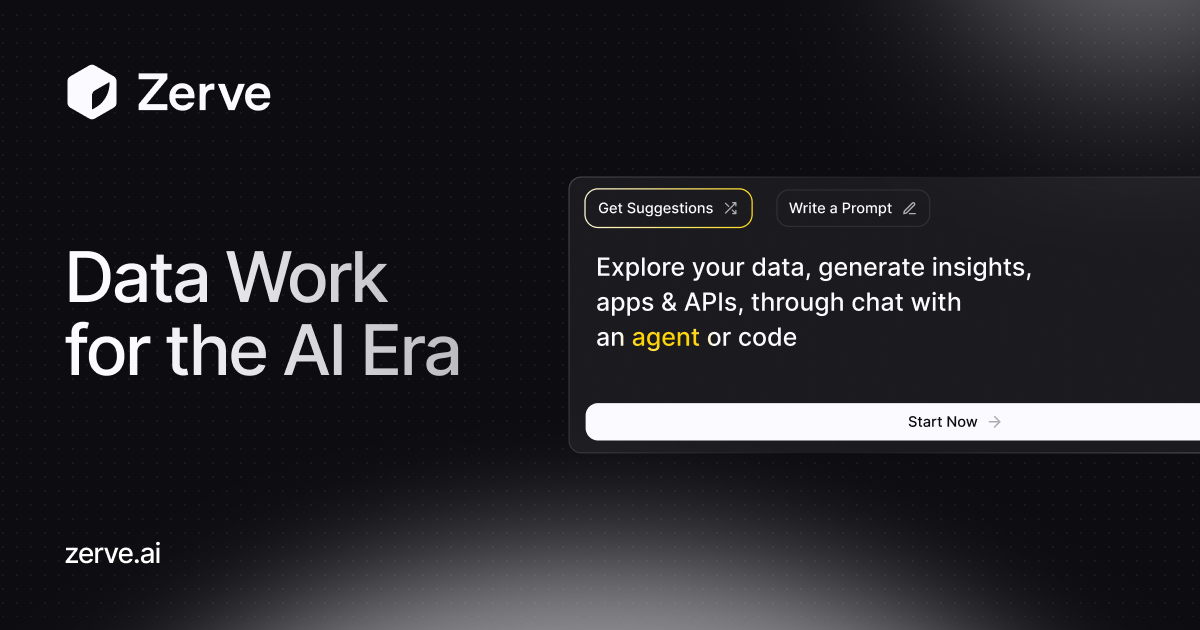
Zerve is an agentic AI data platform for research and analytics. It is built for data scientists, analysts, and quant researchers who want to move from questions to reproducible analysis, reports, and deployments in one workspace.
The product combines an AI agent, notebooks, data discovery, reports, and deployment tools. Across the site, Zerve emphasizes that each analysis should be reproducible, governed, and able to build on a team’s prior work instead of starting from scratch every time.
Use an AI agent that understands schema, relationships, code, and prior work to help with discovery, analysis, and building data workflows.
Work in a notebook that supports Python, SQL, R, and GraphQL, with reproducible runs, cloud execution, and Git-native versioning.
Map schema, lineage, and quality across the data estate so analysis starts with visible context instead of guesswork.
Turn notebook work into APIs, apps, and scheduled jobs without moving to a separate deployment tool.
Capture decisions, methods, and reasoning traces so later analyses can build on the same institutional knowledge.
Use parallel compute to run work across the cloud when tasks need more throughput than a local notebook can provide.
Use the agent to ask questions about a dataset, inspect schema and relationships, and iterate until the analysis is complete rather than stopping at a single response.
Build analyses in notebooks that stay reproducible, versioned, and ready to move toward deployment without changing environments.
Run parallel compute on larger jobs and use deployment options to turn a finished model or pipeline into an API, app, or scheduled job.
Capture decisions, methods, and reasoning traces so the next person who opens the project can understand what was tried and why.
Use enterprise hosting options when work needs to stay within a secure boundary such as an on-prem, VPC, or air-gapped environment.
Zerve is designed for data scientists, analysts, and quant researchers who want AI-assisted research and analytics in one workspace. It combines an agent, notebooks, reports, and deployments so work can move from discovery to production in the same platform.
The source describes an AI agent, AI-native notebooks, data discovery, reports, and deployments. That means you can ask questions, explore and run analysis, generate shareable reports, and deploy APIs, apps, or scheduled jobs from the same environment.
The pricing page shows Free, Pro, Team, and Enterprise options. Free is available to start; paid plans add private projects, more compute, self-hosting, shared controls, SSO, BYOK, and enterprise hosting options.
Yes. The platform page says Zerve can run on Zerve-managed cloud or be self-hosted in your own environment, and the pricing page says Pro and Team support self-serve AWS deployments while Enterprise adds multi-cloud, on-premises, and air-gapped options.
The pricing page says Zerve credits are the core usage unit and are used for agent tasks and compute time. It also says BYOK reduces credit consumption but does not eliminate orchestration charges entirely.