
Natural-language analytics
Ask questions in plain English and get governed SQL, charts, and dashboards based on the same semantic context.

Wren AI is an agentic GenBI platform that turns plain-English questions into governed SQL, charts, and dashboards with cloud, self-hosted, and embedded analytics.
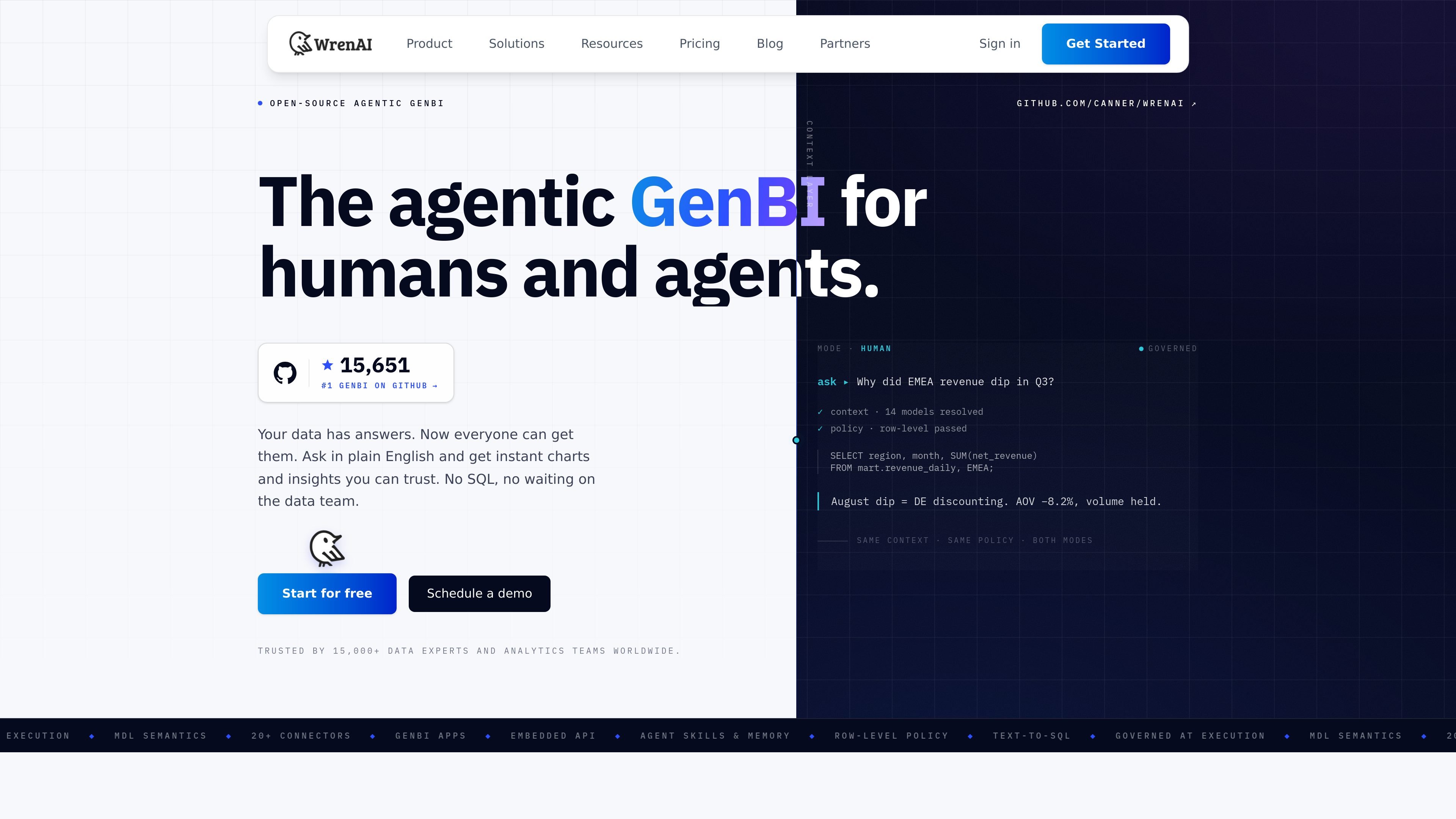
Wren AI is an agentic GenBI platform that helps people and AI agents ask questions of governed data in plain English. The product turns those questions into SQL, charts, dashboards, and other analytics outputs while keeping the underlying context, definitions, and access policies consistent across users and interfaces.
The site positions Wren AI as a context layer for analytics workflows. It supports shared semantic modeling, reusable agent skills, embedded dashboards and spreadsheets, and governed execution across cloud, private cloud, and self-hosted deployments.
Ask questions in plain English and get governed SQL, charts, and dashboards based on the same semantic context.
Use the platform as a context layer where metrics, relationships, and business logic are defined once and reused across humans, agents, dashboards, and API clients.
Run sandboxed, multi-step agent workflows that can query data, chart results, extract knowledge from PDFs, build dashboards, and save reusable skills.
Store skills, memory, semantic models, and instructions as versioned files that can be branched, reviewed, and rolled back.
Apply role-based access, row-level control, column-level control, and audit logs at query time across different consumers.
Embed conversational analytics in applications through the Embedded AI API, with white-labeled dashboards and multi-tenant support.
Business and analytics users can ask questions in plain English and receive governed answers, charts, and follow-up analysis without writing SQL themselves.
Data teams can define metrics, relationships, and business rules once in the semantic model and reuse them across dashboards, spreadsheets, and agents.
Product teams can embed conversational analytics into their own applications with branded interfaces, filters, drilldowns, and multi-tenant behavior.
Operators and executives can use the platform to create dashboards for planning and monitoring, then drill into the same governed data when they need detail.
Agent developers can connect external assistants or MCP clients to the same governed context so different agents follow the same access rules and definitions.
Wren AI is presented as a GenBI platform for humans, teams, and AI agents. It is designed to turn plain-English questions into governed SQL, charts, dashboards, and embedded analytics.
The pricing page shows Free, Essential, and Enterprise plans, with both cloud and self-hosted deployment options. The site also offers a request-demo and contact flow for teams that want to talk to sales.
The product site says Wren AI connects to 20+ data sources and calls out databases and warehouses such as BigQuery, PostgreSQL, ClickHouse, and Amazon Redshift, plus file sources and dbt sync.
The homepage and platform pages describe outputs such as charts, dashboards, spreadsheets, and embedded AI experiences. The product also supports drill-down, roll-up, filters, and report caching in the UI.
The pricing page says free credits are available for testing, with credits that expire at the end of the month and do not roll over. It also distinguishes web credits from Embedded AI API usage.