
One-line model deployment
Deploy models with a one-line workflow using the API endpoint shown on the homepage, with examples for HTTP, Node, Python, and curl.

Synexa is a developer platform for deploying and running AI models through APIs, with support for image, video, 3D, audio, and related generative media workflows. It uses usage-based pricing for outputs and GPU hardware, and includes playgrounds for model experimentation.
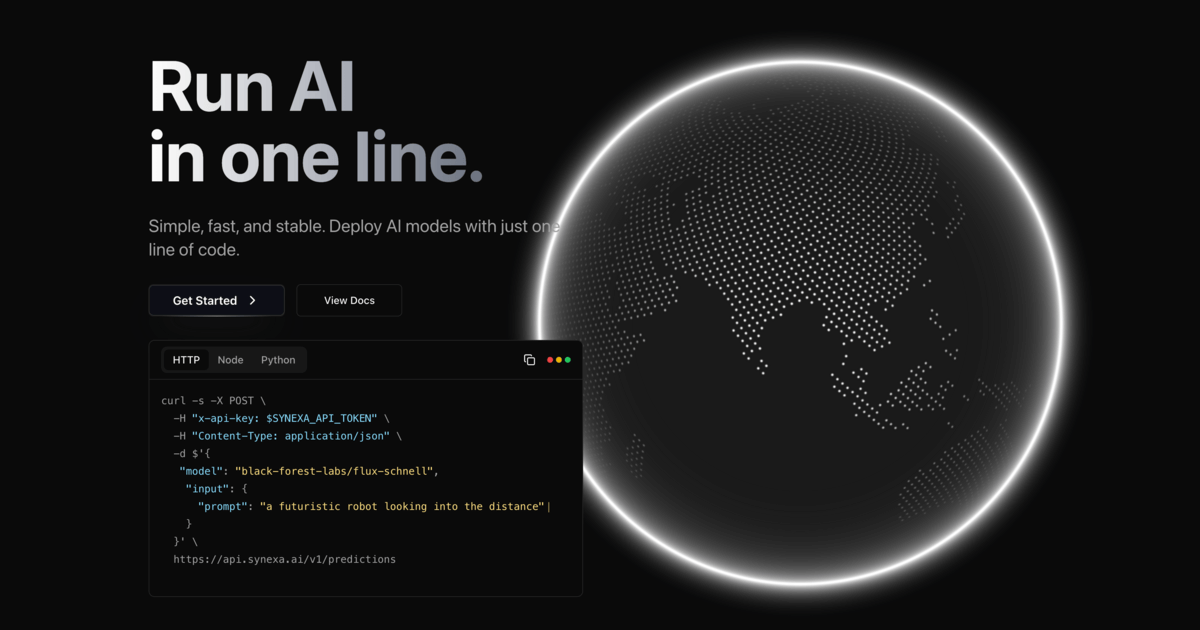
Synexa is a generative media platform for developers that provides AI model inference, training APIs, and interactive UI playgrounds. The site positions it as a way to deploy AI models with a one-line API call and build media applications without managing your own GPU infrastructure.
The product focuses on production-ready workflows for image generation, video generation, 3D generation, restoration, captioning, speech, and fine-tuning. Pricing is usage-based: model outputs are billed per request or per output, and hardware is billed by the second with scale-to-zero behavior when idle.
Deploy models with a one-line workflow using the API endpoint shown on the homepage, with examples for HTTP, Node, Python, and curl.
Access a gallery of 100+ production-ready models across text-to-image, video, 3D, audio, restoration, and utilities, with new models added weekly.
Use serverless deployment options and scale to zero when idle, so compute is consumed only when jobs run.
Work with ready-to-use inference APIs optimized for speed and scalability, plus interactive UI playgrounds for model experimentation.
Choose from supported Python, JavaScript, and REST API workflows with documentation aimed at quick integration.
Run on enterprise-grade GPU infrastructure across three continents, with A100 and H100 hardware and smart routing described on the homepage.
Build applications that generate images, videos, or 3D assets through a single API flow, using the provided model gallery and request examples as a starting point.
Experiment with models in the browser playground before integrating them into an application, which suits prototyping and prompt iteration.
Run custom or production workloads on serverless infrastructure that scales up for traffic spikes and scales to zero when idle.
Add AI capabilities to existing products through Python, JavaScript, or REST-based integration.
Use the pricing model to estimate cost for image, video, and hardware workloads based on output volume and run time.
Synexa provides ready-to-use inference APIs, serverless deployment options for custom AI models, and interactive UI playgrounds for experimentation. The docs describe it as a generative media platform for developers with production-ready APIs and training capabilities.
The source shows support for Python, JavaScript, and REST API access, and the homepage includes example code for HTTP, Node, Python, and curl. The docs also mention comprehensive API documentation.
The homepage and docs both describe Synexa as a developer-focused platform with production-ready APIs, interactive playgrounds, and serverless deployment options. The source does not provide a separate team plan or collaboration workflow on the pages reviewed.
The model gallery includes image generation, video generation, image restoration, captioning, fine-tuning, speech generation, and 3D generation models. The docs also state that Synexa specializes in running diffusion models.
The pricing page shows pay-per-use billing for model outputs and hardware billed by the second, with scale-to-zero when idle. It does not show a free tier on the pages reviewed.