
Async and streaming transcription
Transcribe pre-recorded audio in an asynchronous workflow or process live audio with the streaming API. The site says the same API family supports both modes.

Rev AI is a developer-first speech-to-text API for transcription and transcript analysis. It supports asynchronous and streaming workflows, multi-language speech recognition, and enterprise pricing options.
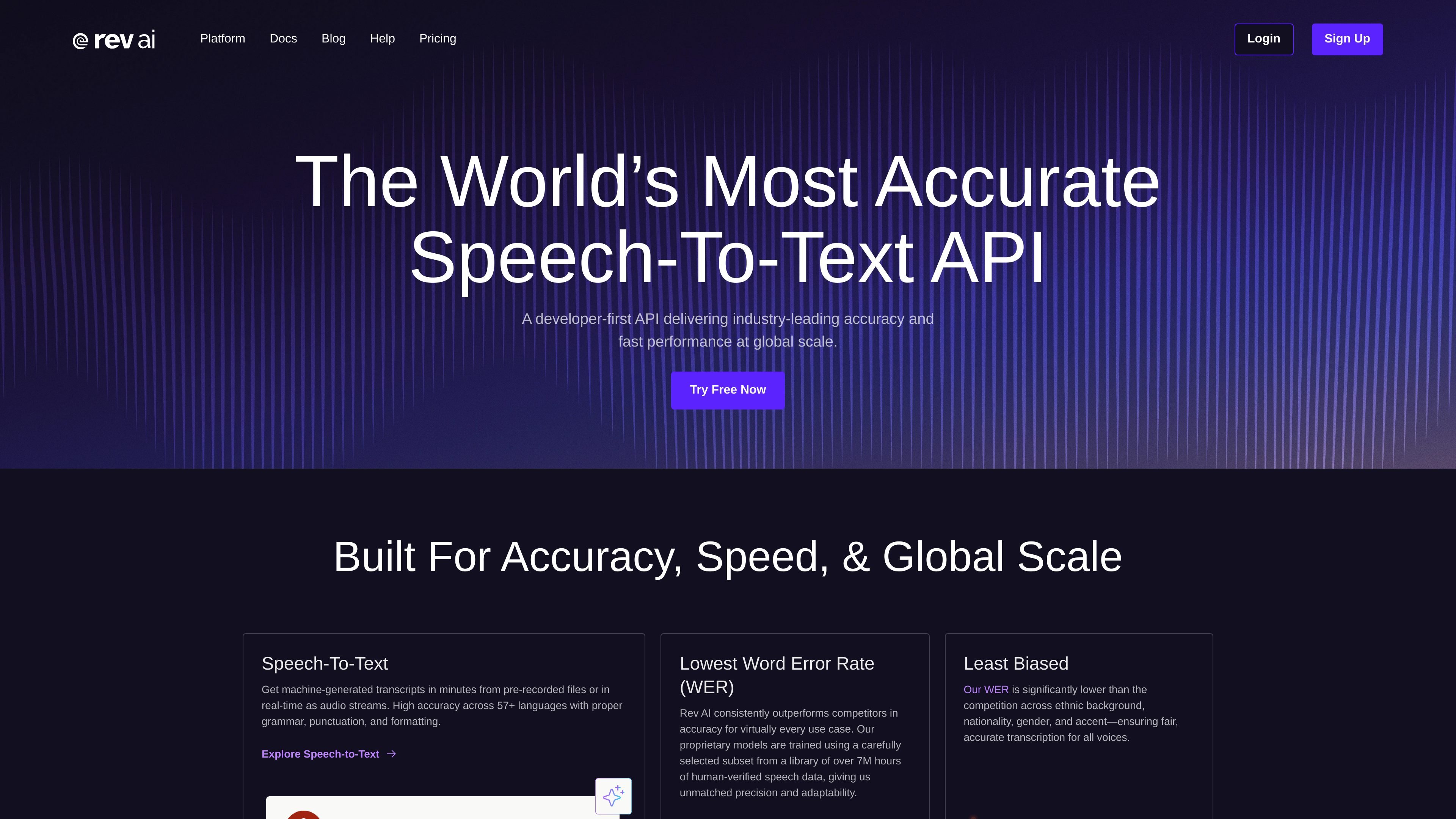
Rev AI is a developer-first speech-to-text API platform for turning audio into transcripts and related analysis. Its core product is speech recognition for both pre-recorded and live audio, with an adjacent Insights API for sentiment analysis, topic extraction, summarization, language identification, translation, and forced alignment.
The site positions the platform for teams that need accurate transcription at scale across many languages and audio conditions. It supports asynchronous and streaming workflows, offers developer tooling such as SDKs and documentation, and includes enterprise options for security, deployment, and support.
Transcribe pre-recorded audio in an asynchronous workflow or process live audio with the streaming API. The site says the same API family supports both modes.
Use Rev AI for speech-to-text across 57+ languages, with built-in language identification to help route content correctly before transcription.
Generate transcripts with proper grammar, punctuation, formatting, and word-level timestamps. The product pages also mention inverse text normalization and custom vocabulary support.
Extract sentiment, topics, summaries, translations, and language information from transcripts through the Insights API.
Choose from JSON, plain text, SRT, and VTT outputs, and connect results through JSON output integration and webhook callbacks.
Deploy in the cloud or on-prem, with enterprise options that include HIPAA readiness, EU deployment options, SOC II, GDPR, PCI compliance, and encrypted files at rest and in transit.
Transcribe recorded interviews, meetings, and archives with the asynchronous API when the audio does not need to be processed live.
Generate live captions and low-latency transcripts for broadcasts, webinars, and other real-time audio streams.
Analyze customer calls, interviews, or meeting recordings with sentiment analysis, topic extraction, and summarization to turn transcripts into reviewable insights.
Detect the primary language in audio before transcription and route multilingual content through the appropriate workflow.
Create searchable media workflows with word-level timestamps and forced alignment for content indexing, accessibility, and precise citation.
Rev AI provides a REST API for speech-to-text and related audio analysis. The site highlights asynchronous transcription for pre-recorded files, streaming transcription for live audio, and insights features such as sentiment analysis, topic extraction, summarization, language identification, translation, and forced alignment.
The speech-to-text product supports 57+ languages on the main site, and the languages page shows language-specific availability by product. The source also notes multilingual English/Spanish support and language identification support in 22 languages.
Rev AI offers both asynchronous and streaming speech-to-text. The asynchronous API handles pre-recorded files, while the streaming API is designed for low-latency live transcription and captions.
The pricing page lists pay-as-you-go options and enterprise pricing. It also mentions free credits equivalent to 5 hours of Reverb ASR and enterprise features such as volume-based pricing, flexible commercial terms, a dedicated account manager, and priority technical support.
The product pages mention JSON with timestamps, plain text, SRT, and VTT for speech-to-text output. Insights also integrates with Rev AI transcription output so timestamps can link analysis back to source moments.