
AI Search
Ask research questions in natural language and get answers backed by relevant papers rather than only keyword matches. The site says the search can analyze millions of papers and return cited responses.

Paperguide is an AI research assistant for finding papers, reviewing literature, managing references, and writing academic documents with cited sources.
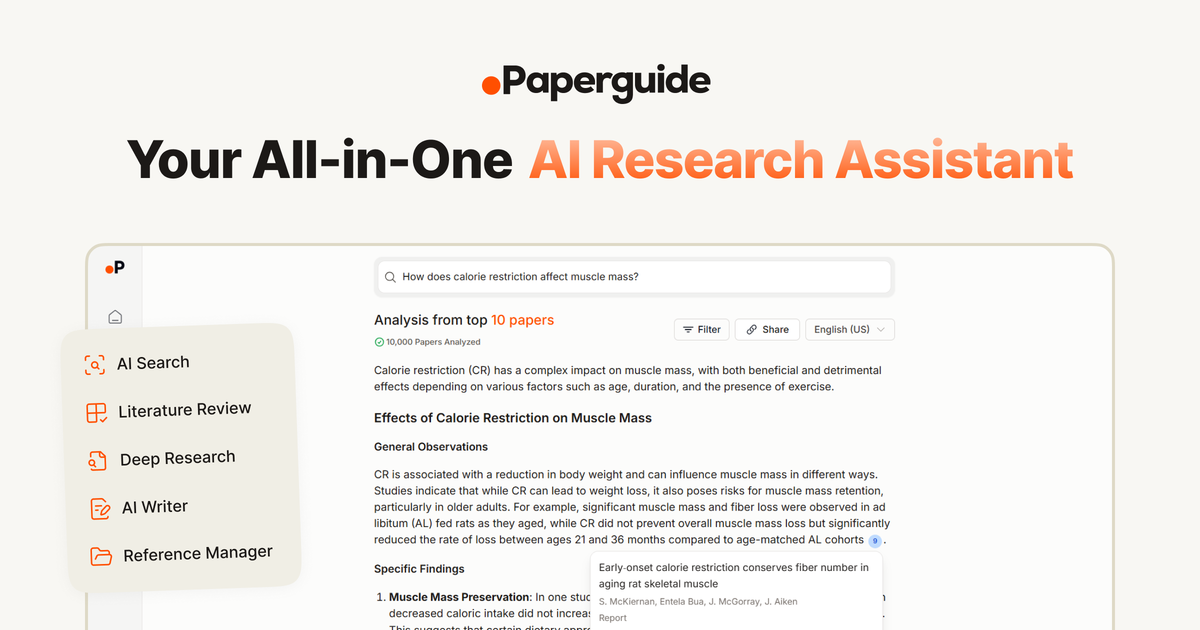
Paperguide is an AI research assistant for finding papers, reviewing literature, managing references, and writing research documents. The product brings those tasks into one workflow so users can search with questions, compare sources, and generate cited writing from the same platform.
The site positions Paperguide for academic research and literature review work, with additional pages aimed at writing papers and managing references. It also highlights broader applications such as drug discovery, clinical trial design, health economics and outcomes research, and systematic reviews.
Ask research questions in natural language and get answers backed by relevant papers rather than only keyword matches. The site says the search can analyze millions of papers and return cited responses.
Review papers with structured summaries, data extraction, and side-by-side comparison across multiple sources. The product also highlights verification with supporting quotes and original text.
Generate a deeper research report that handles paper discovery, screening, and data extraction, then organizes findings into structured sections. This is positioned for larger reviews that would otherwise take more manual time.
Draft and refine academic content with references in mind, including full document generation, outlines, titles, and polishing commands. The writer flow emphasizes automatic citations for AI-generated content.
Import and organize references from Zotero, BibTeX, RIS, DOI, direct URLs, PDFs, and public research sources. The reference manager also supports AI-generated summaries and shared libraries.
Work directly with papers and PDFs, view AI summaries, and access source text for verification. The site also mentions paper quality metrics such as SJR rankings and citation metrics.
Find research-backed answers to questions without manually checking every paper. Paperguide is positioned for users who need cited responses and a faster starting point for a literature search.
Compare multiple studies, extract key data, and build structured summaries for reviews. The literature review and deep research pages suggest a workflow for consolidating evidence across many sources.
Draft research papers, essays, and other academic documents using selected references or a broader research library. The writer workflow is aimed at generating full documents, outlines, and citations.
Organize citations, import existing libraries, and keep sources in a shared reference manager. This suits users who want to replace manual reference handling with a searchable research library.
Work on larger review projects such as systematic reviews, drug discovery research, clinical trial planning, or HEOR analysis. The site explicitly names these as solution areas for the platform.
Paperguide is built for researchers, students, faculty, and professionals who need help finding papers, reviewing literature, managing references, and drafting research documents.
The site shows support for question-based AI search across a large paper database, but it does not provide a full public list of the specific databases it searches.
Paperguide offers reference import from sources such as Zotero, BibTeX, RIS, DOI, direct URLs, and PDFs, and it includes workflows for AI search, literature review, deep research, and writing.
The product pages state that AI-generated content is cited automatically and that users can work with PDFs, papers, and references, but the source does not give detailed limits on output quality.
Pricing includes a free plan and paid plans, plus an Enterprise option for teams and institutions with custom plans and centralized billing.