
Repository-aware vendor monitoring
Oxpecker reads the endpoints, request parameters, and response fields your code actually touches, so its findings are tied to specific lines and files rather than generic vendor announcements.

Oxpecker monitors the vendor APIs your code actually uses and reports which lines in your repository could be affected when a vendor changes. It opens a pull request with a reviewable finding before the sunset date, while keeping your source code inside your CI.
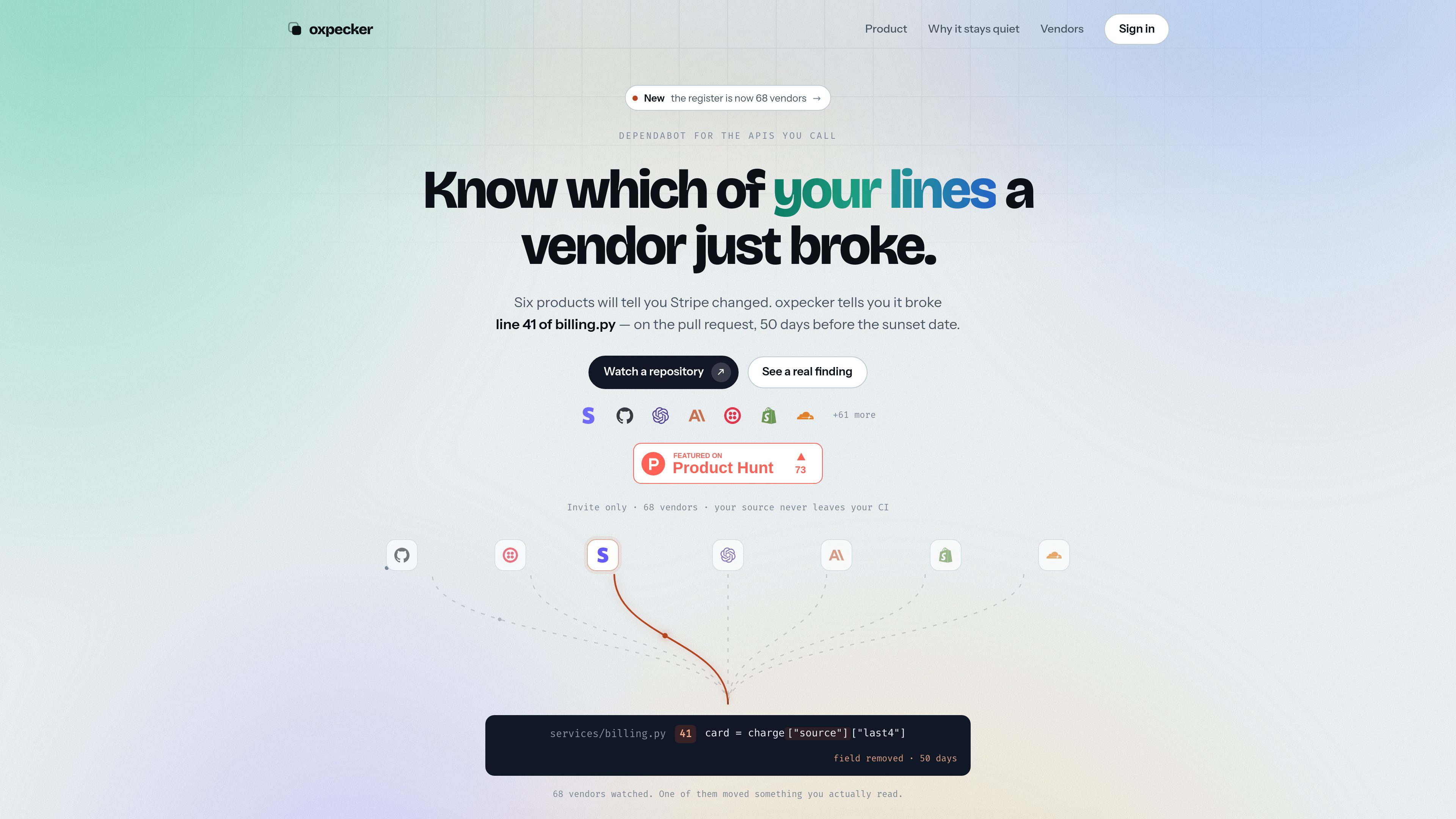
Oxpecker is a developer tool for monitoring third-party API changes against the code that actually consumes those APIs. Rather than surfacing every vendor update, it indexes the endpoints and response fields your repository reads and only reports changes that could affect those lines of code.
The product’s core workflow is repository-based: you pick a repository, oxpecker analyzes it in your own CI, and it opens a pull request with a finding when a vendor change maps to something your code uses. The site emphasizes that the analysis stays inside your CI and that the result is reviewable before merge, which makes the output suitable for teams that want early warning without broad, noisy change feeds.
Oxpecker reads the endpoints, request parameters, and response fields your code actually touches, so its findings are tied to specific lines and files rather than generic vendor announcements.
When oxpecker detects a relevant change, it opens a pull request adding one file, giving teams a reviewable artifact before it merges.
The site shows a register of 68 vendors and distinguishes between vendors with machine-readable specs and those where only endpoints are visible.
Oxpecker diffs vendors’ published specifications on a schedule, so it can compare current and prior states and identify removed fields, deleted endpoints, and newly required parameters.
The product states that your source code never leaves your CI, and that analysis runs in the same harness used to check pages against the approved design.
The register indicates where oxpecker can see a full API surface and where it can only observe endpoints, helping users understand the limits of each vendor’s visibility.
Useful when a product depends on APIs from vendors such as payments, messaging, or infrastructure providers and you want to know which files or lines might need updates.
Teams can inspect a pull request that contains the finding before it merges, instead of discovering the issue only after deployment.
Organizations that rely on machine-readable API specifications can use oxpecker to compare spec changes over time against what their code reads.
For vendors that do not publish a complete API spec, the register still distinguishes what is visible and what is not, which helps teams understand where monitoring is incomplete.
It indexes the endpoints and response fields that your code actually reads, rather than every change a vendor publishes.
The site says it opens a pull request adding one file, so the finding is delivered as a reviewable change rather than an automatic merge.
No. The homepage explicitly says your source never leaves your CI.
Not always. The register distinguishes vendors with machine-readable specs from those where some fields are invisible because no full spec is published.
A pricing page path exists, but the provided source returns a 404, so no public pricing details can be confirmed from this evidence.
I dati sul traffico sono solo a scopo di riferimento.
| mag | 0 |
|---|---|
| giu | 0 |
| lug | 0 |
Le analisi del traffico non sono ancora disponibili.
Le analisi del traffico non sono ancora disponibili.