
Expert personas
Build specialized AI experts trained on company knowledge so they can answer questions, support users, and retain context over time.

Neon.ai builds custom private AI systems for businesses, including agents, companions, avatars, and private LLMs. It is aimed at organizations that want AI aligned to their own data, workflows, and control requirements.
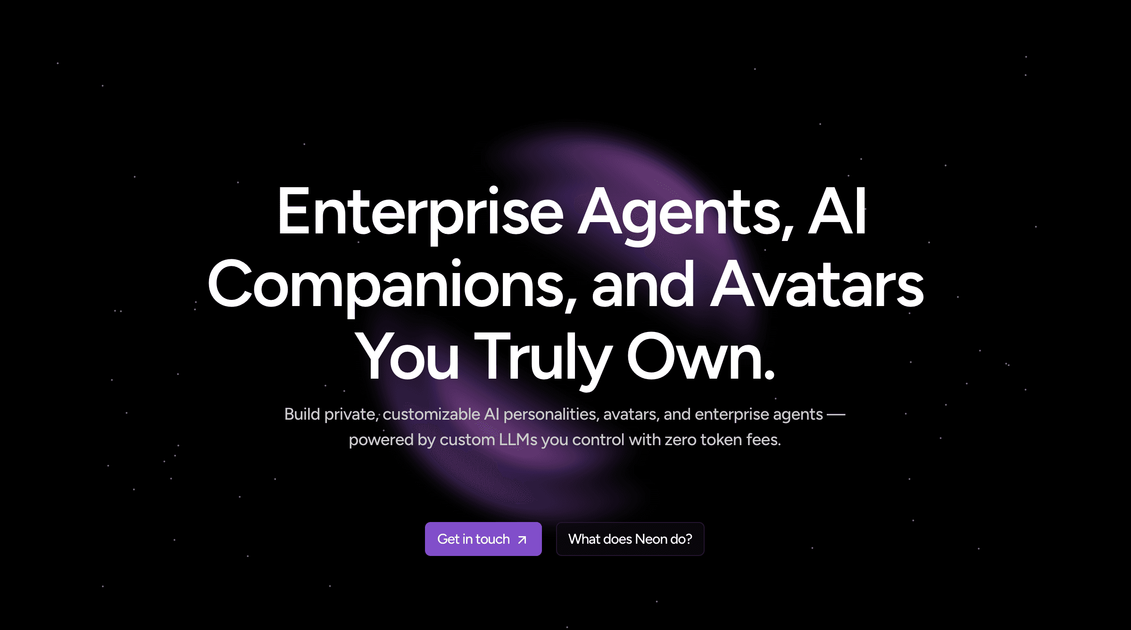
Neon.ai builds custom AI systems for businesses that want private, controlled models rather than a generic off-the-shelf assistant. The site positions the product around enterprise agents, AI companions, conversational avatars, and private LLMs that are trained for a customer’s use cases and data.
The platform’s core job is to turn an organization’s knowledge, workflows, and expertise into AI that can think, speak, and act in a specific role. Neon.ai describes a process that starts with discovery, continues through persona and use-case design, connects the AI to relevant knowledge sources and systems, and ends with training and safety testing.
The site also emphasizes ownership and economics: it repeatedly highlights private models, customer control, and zero token fees. Public examples on the site include advisor panels, cybersecurity personas, AI instructors, and collaborative conversational systems, which suggests the platform is aimed at teams that need tailored assistants for support, training, outreach, and decision-making.
Rather than presenting a single packaged chatbot, Neon.ai reads as a custom AI development and deployment offering. The company says it works with enterprises, small businesses, nonprofit organizations, community projects, and individuals, and it offers a contact-first sales flow rather than published pricing on the page.
The demos and about pages reinforce that framing with examples of custom personas and agentic workflows. That makes Neon.ai most relevant for buyers who want an owned AI system aligned to a specific business context, data source, or public-facing role.
Build specialized AI experts trained on company knowledge so they can answer questions, support users, and retain context over time.
Create panels of AI specialists that work together and can provide cited guidance for areas such as manufacturing, logistics, or compliance.
Use the BrainForge knowledge engine to connect documents and systems into a living knowledge base with private vector storage, semantic memory, access control, audit logs, and real-time syncing.
Deploy AI avatars and companions with voice, movement, personality tuning, and long-term memory for web, video, chat, retail kiosks, or support settings.
Design enterprise AI agents for lead generation, personalized outreach, and automated content creation with a private model workflow.
Use a step-by-step process that covers discovery, persona and use-case design, knowledge connection, and safety testing before launch.
Build a domain-specific assistant that answers questions from internal knowledge, supports employees or customers, and stays aligned to a company’s terminology and workflows.
Create a panel of AI advisors for education, operations, or compliance that can collaborate and provide more structured guidance than a single chatbot.
Deploy AI avatars or companions for web, chat, kiosks, video, or support environments where voice, personality, and long-term memory matter.
Use enterprise agents for lead generation, personalized outreach, and content creation when a team needs repetitive tasks handled at scale.
Train role-play or instructional experiences such as an AI instructor, interview practice, or coaching scenario for learning and practice.
Neon.ai describes its offerings as privately trained, custom AI that can be owned and controlled by the customer. The site frames its products as enterprise agents, AI companions, avatars, and private LLMs rather than a general-purpose public chatbot.
The site says its process starts with a strategy session, then moves through AI persona and use-case design, connecting knowledge sources and systems, and finally training, alignment, and safety testing before deployment.
The site says Neon.ai can connect to content and systems that make the AI useful, and it specifically mentions sources such as SharePoint, Google Drive, Confluence, and Slack.
Neon.ai says its models are privately trained and emphasizes zero token fees, ownership, and control. The site also notes that some AI training can be licensed in-house for customers that want complete privacy.
The demos page shows examples such as an undergraduate advisor panel, collaborative conversational AI, AI interview and instructor demos, and a cybersecurity persona, which suggests the system can be adapted for different roles and scenarios.