
Single API across surfaces
Use one API key across the SDK, CLI, and MCP surfaces, with examples for creating cards, storing secrets, and connecting services.

Naïve is an agent infrastructure platform for identity, payments, permissions, and real-world capabilities as code. One API across SDK, CLI, and MCP.
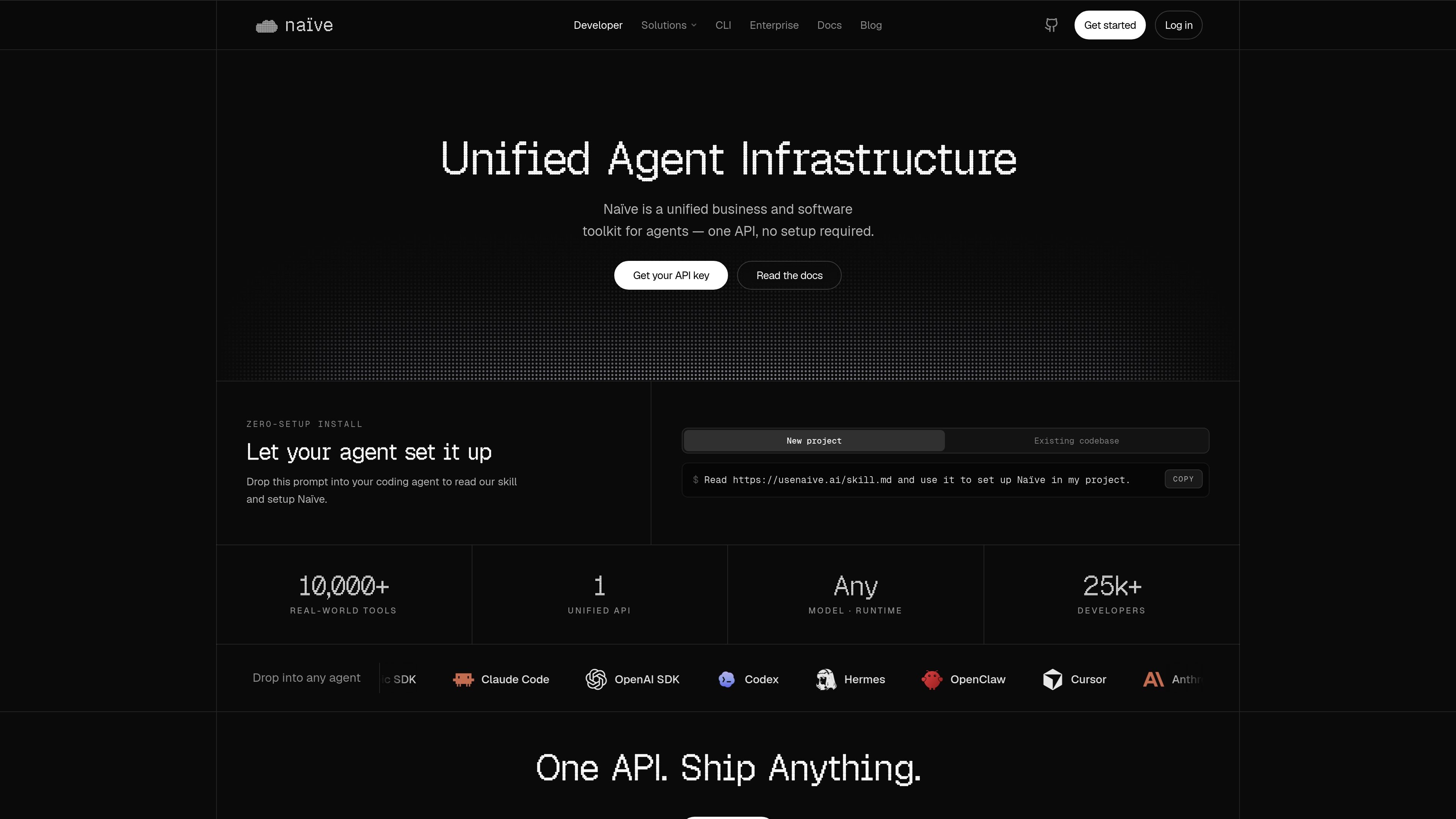
Naïve is an agent infrastructure platform that exposes identity, money, permissions, and a large set of real-world capabilities as code. The homepage positions it as a unified business and software toolkit for agents, with one API and no setup required.
The product is built for agents that need to operate in real services, not just call models. It includes primitives for account signup, scoped cards, incorporation, verification, email, search, apps, compute, and more, while letting teams set guardrails, approval rules, and tenant boundaries around those actions.
Use one API key across the SDK, CLI, and MCP surfaces, with examples for creating cards, storing secrets, and connecting services.
Provision a separate identity for each agent, including verified identity options such as KYC or EIN, so each agent can act as its own operator.
Issue scoped virtual cards with hard spending limits and define approval flows for sensitive actions like spending or publishing.
Connect real-world services through primitives for signup, email, domains, search, LLMs, images, video, social posting, SEO, apps, compute, queues, and more.
Scope data and access by user, with multi-tenant workflows, role-based access control, and encrypted secrets for connected apps.
Track actions in an audit log and apply custom policies for budgeting and review.
Build agents that need to sign up for services, connect accounts, send email, or perform other actions in real systems through scoped primitives.
Create products where each end user gets isolated cards, secrets, and connected accounts using user-scoped infrastructure.
Set up workflows that require spending controls, manual review, or logged actions before sensitive operations are allowed.
Launch internal tools or agent apps that combine hosted app creation, Postgres, compute, jobs, and queues under the same platform.
Use the CLI or SDK to provision identity and permissions from a terminal or backend without wiring each service separately.
Naïve provides a quickstart through its SDK, CLI, or MCP surface. The documentation says one API key works across all three, and examples show how to create cards, store secrets, connect accounts, and scope actions to a specific user.
The docs describe two modes: a solo mode that auto-scopes to a default user, and a multi-tenant mode where you create users and then scope calls with `forUser(id)` or a `user_id`.
Naïve is designed so agents can take actions with guardrails. The security page says you can require human approval for sensitive actions such as spending money or publishing, while still allowing autonomous workflows where appropriate.
The security page says connected account credentials and API keys are encrypted at rest and scoped to specific workflows, and the platform uses logical tenant isolation between workspaces.
The source shows a broad set of primitives, but also notes on the primitives page that more capabilities are coming soon. That means the surface is extensible, but the exact list may change over time.