
Generative Workflow Engine
Create AI employees with a Generative Workflow Engine and pre-built agents, then activate them through natural language to handle complex enterprise workflows.
Ema is a Universal AI Employee for enterprise teams that want to build and deploy AI agents across roles, departments, and industries. The site positions it around workflow automation, pre-built agents, app integrations, and governance controls.
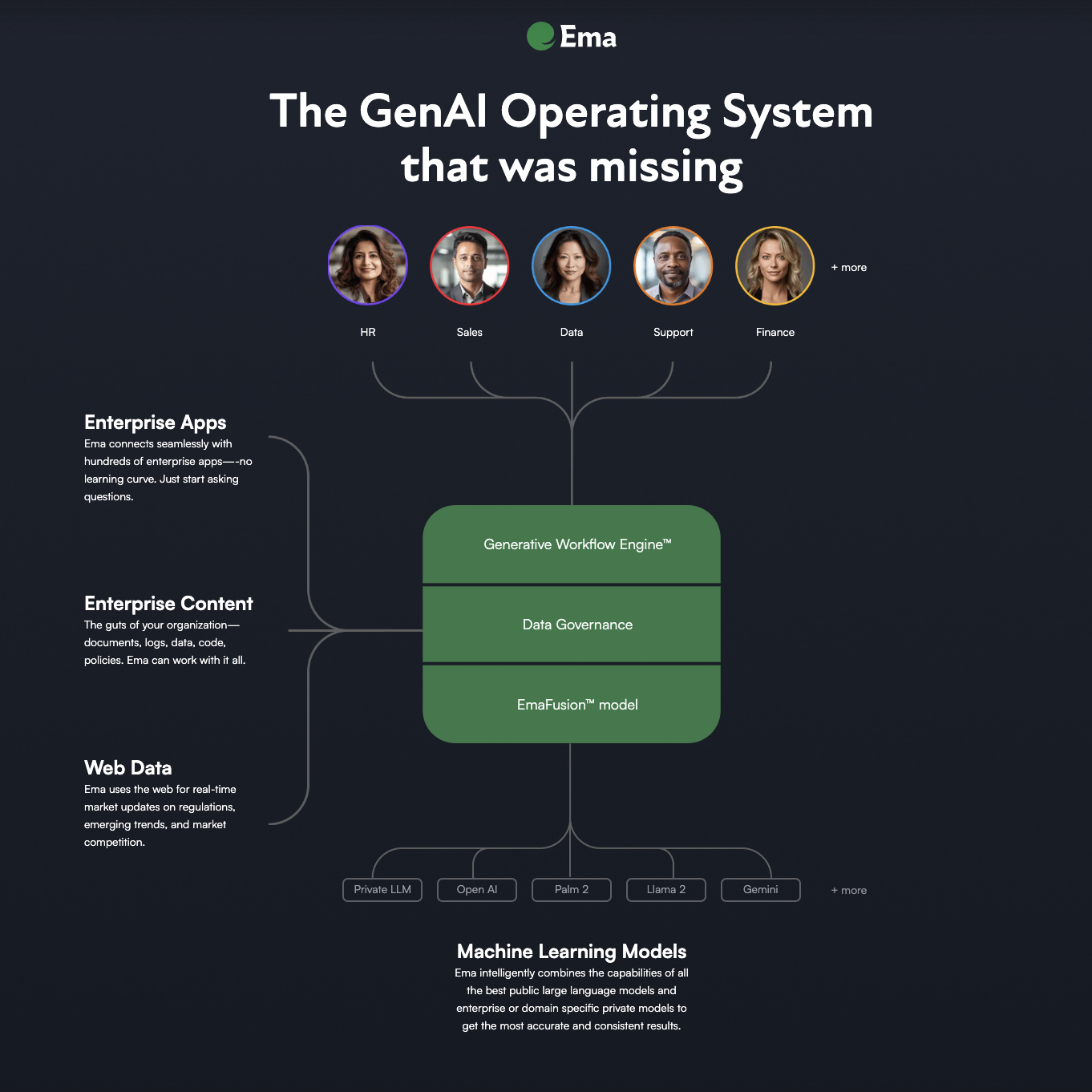
Ema is presented as a Universal AI Employee for enterprise teams. The site positions it as a platform for building and deploying AI agents across roles, departments, and industries through natural language.
Its homepage and persona pages emphasize that Ema can automate business workflows rather than isolated tasks. Examples shown on the site include employee lifecycle work, customer support, finance operations, recruiting, claims handling, compliance checks, proposal writing, and other specialized business processes.
The product is also described as pre-integrated with hundreds of apps and supported by a Generative Workflow Engine and pre-built AI agents. Ema’s public materials additionally highlight governance controls, including data redaction before sending information to public LLMs, along with encryption and customizable private models.
The resources page shows case studies and product videos for enterprise use cases, which reinforces that the product is aimed at operational teams that want to deploy AI employees in existing business workflows.
Create AI employees with a Generative Workflow Engine and pre-built agents, then activate them through natural language to handle complex enterprise workflows.
Use pre-built AI agents for functions such as employee experience, customer experience, finance operations, sales, and marketing, rather than starting from scratch.
Connect Ema to a broad app ecosystem; the site says it is pre-integrated with hundreds of apps to support deployment across existing systems.
Apply EmaFusion, described on the site as a proprietary model that blends public and private models to improve accuracy and cost efficiency.
Use built-in trust and security controls such as sensitive-data redaction, encryption, and customizable private models before data is passed to public LLMs.
Support enterprise workflows across roles and industries, with persona examples ranging from recruiting and onboarding to claims, compliance, and proposal writing.
Customer support teams can use Ema’s customer experience AI employees to resolve routine questions, deflect tickets, assist agents, and evaluate conversations for quality and compliance.
HR and recruiting teams can apply AI employees to recruiting, resume screening, onboarding, employee assistance, and other parts of the employee lifecycle.
Finance and operations teams can use the platform for financial-context tasks that require interpreting records, making decisions, and acting across finance systems.
Sales, marketing, and revenue teams can use persona-based agents such as AI SDRs, sales intelligence analysts, campaign managers, and proposal writers.
Industry teams such as healthcare, insurance, and professional services can use specialized agents for tasks like prior authorization, claim processing, compliance analysis, and business proposal writing.
Ema is presented as a Universal AI Employee for enterprise use. The site shows AI Employees for functions such as customer experience, employee experience, sales and marketing, finance operations, and industry-specific workflows.
The source describes Ema as conversationally activated through natural language. It is positioned to build and deploy AI employees that can execute business workflows across roles and teams.
The site says Ema is pre-integrated with hundreds of apps and can be configured and deployed easily. It also highlights a Generative Workflow Engine and pre-built AI agents.
The public sources reviewed do not provide pricing details. The pricing URL currently returns a 404 page, so purchase terms are not stated on the pages provided.
The site references trust and security features including data governance that redacts sensitive information before passing data to public LLMs, compliance with leading standards, top-tier encryption, and customizable private models.