
Bipedal android platform
Clone is presented as a bipedal android companion with natural walking motion and a home-focused form factor.

Clone makes musculoskeletal androids and a biomimetic robotic hand for home and business use, with natural movement and natural-language interaction.
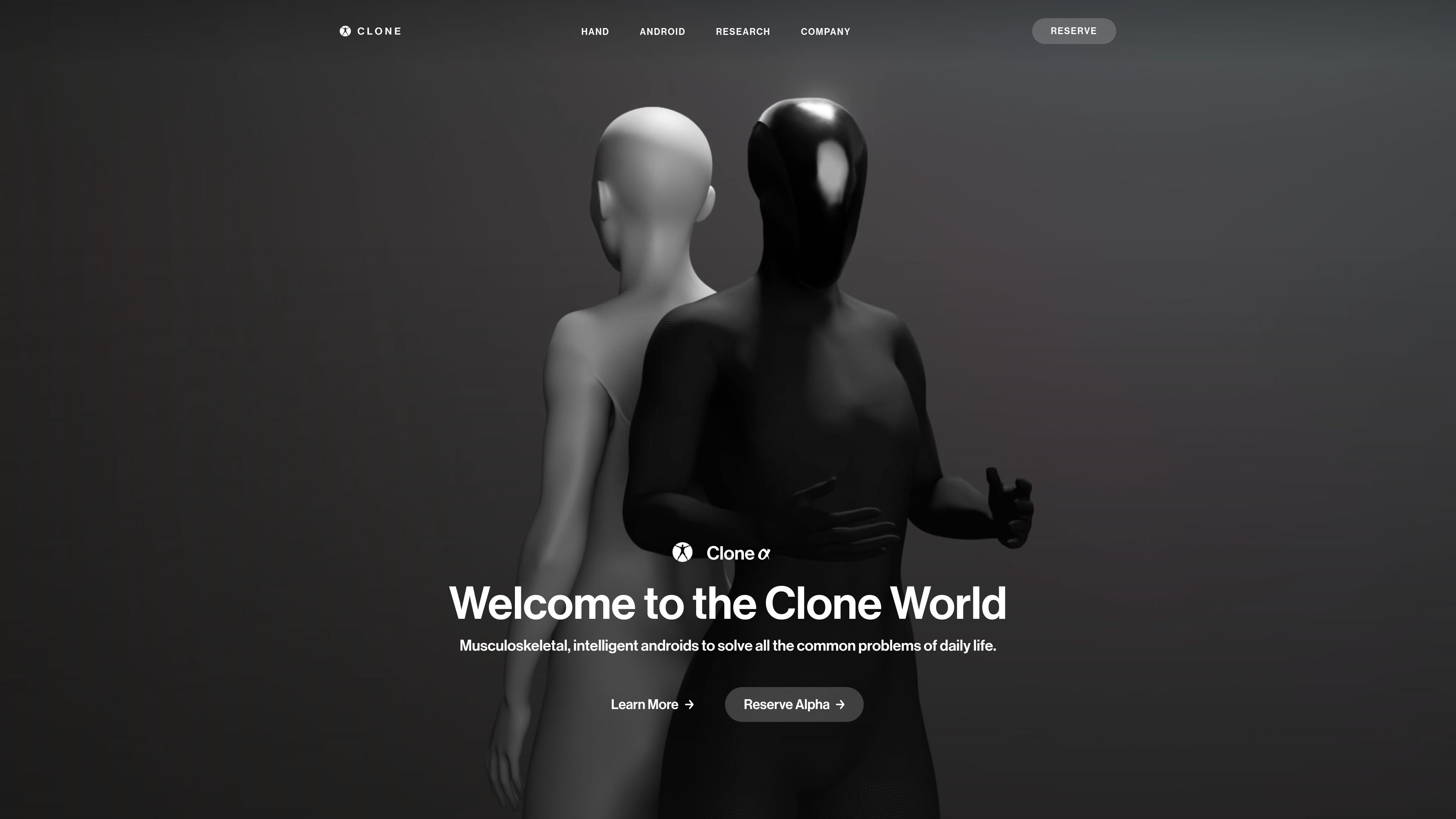
Clone is a robotics product line centered on musculoskeletal androids and a biomimetic robotic hand. The home page describes the company’s goal as building intelligent androids to solve common problems of daily life, while the Android page positions Clone as a bipedal companion for individuals and businesses.
The public site emphasizes the body architecture behind the system: synthetic muscular, skeletal, nervous, and vascular systems, plus Myofiber artificial muscles that attach to anatomically accurate points on the skeleton. The hand product extends that approach to manipulation, with a focus on human-level grip, thumbs, and compatibility with human tools.
The site also frames Clone as an interactive machine rather than a fixed-purpose robot. Its Android page highlights natural-language interfaces, and the hand page invites career inquiries and prototype access for people building robot learning systems. Public details on pricing and availability are limited, so the published product page should stay close to the confirmed home, android, and hand page messaging.
Clone is presented as a bipedal android companion with natural walking motion and a home-focused form factor.
The Android page describes synthetic organ systems, including muscular, skeletal, nervous, and vascular systems, as the product’s internal architecture.
Clone’s muscular system uses Myofiber, an artificial muscle technology developed by Clone to actuate anatomically accurate points on the skeleton.
The site says Clone is controlled through natural language, letting users speak to the android in plain English.
The Clone Hand is described as a biomimetic hand designed for human-level manipulation tasks and complex tools.
The hand page highlights compatibility with human tools, along with precision, force, and back-drivable antagonistic muscles and tendons.
Use Clone as a home companion platform when the goal is to automate everyday physical tasks with a bipedal robot that is designed to move naturally.
Use the system in business settings where a humanoid form factor and human-tool compatibility matter more than a fixed industrial arm.
Use the hand platform for manipulation research, especially where thumb function, grip, and precision are central to the task.
Use the product as a starting point for robot learning systems or prototype work; the hand page explicitly invites interest from teams building those systems.
Use Clone when natural-language control is important, since the Android page positions the system as something users can speak to in plain English.
The site presents Clone as an android companion for the home, with the Alpha edition described as one of the first 279 Clones ever made. The page does not provide a general availability date or public ordering process beyond a Reserve call to action.
The home page describes Clone as a bipedal android companion made for individuals and businesses. The Android page frames it as an android designed for the home, while the Hand page focuses on the robotic hand component and prototype access for career and research interest.
Clone’s Android page says the system uses synthetic organ systems, including muscular, skeletal, nervous, and vascular systems. The Hand page adds that the hand uses Myofiber artificial muscle technology and is built for manipulation tasks a human can perform.
The site does not list pricing or plan details. A pricing URL returns a page-not-found error, so no public price, tier, or preorder amount is confirmed.
The Research page says it is currently researching and will be available soon. The site therefore does not yet provide a public research hub with detailed reports or documentation.