
Unified model access
The site describes unified multi-model access, allowing agents to reach top-tier models through a single API surface rather than handling each provider separately.

BAI is a developer platform for AI agents with unified model access, crypto payments, and settlement for autonomous workflows.
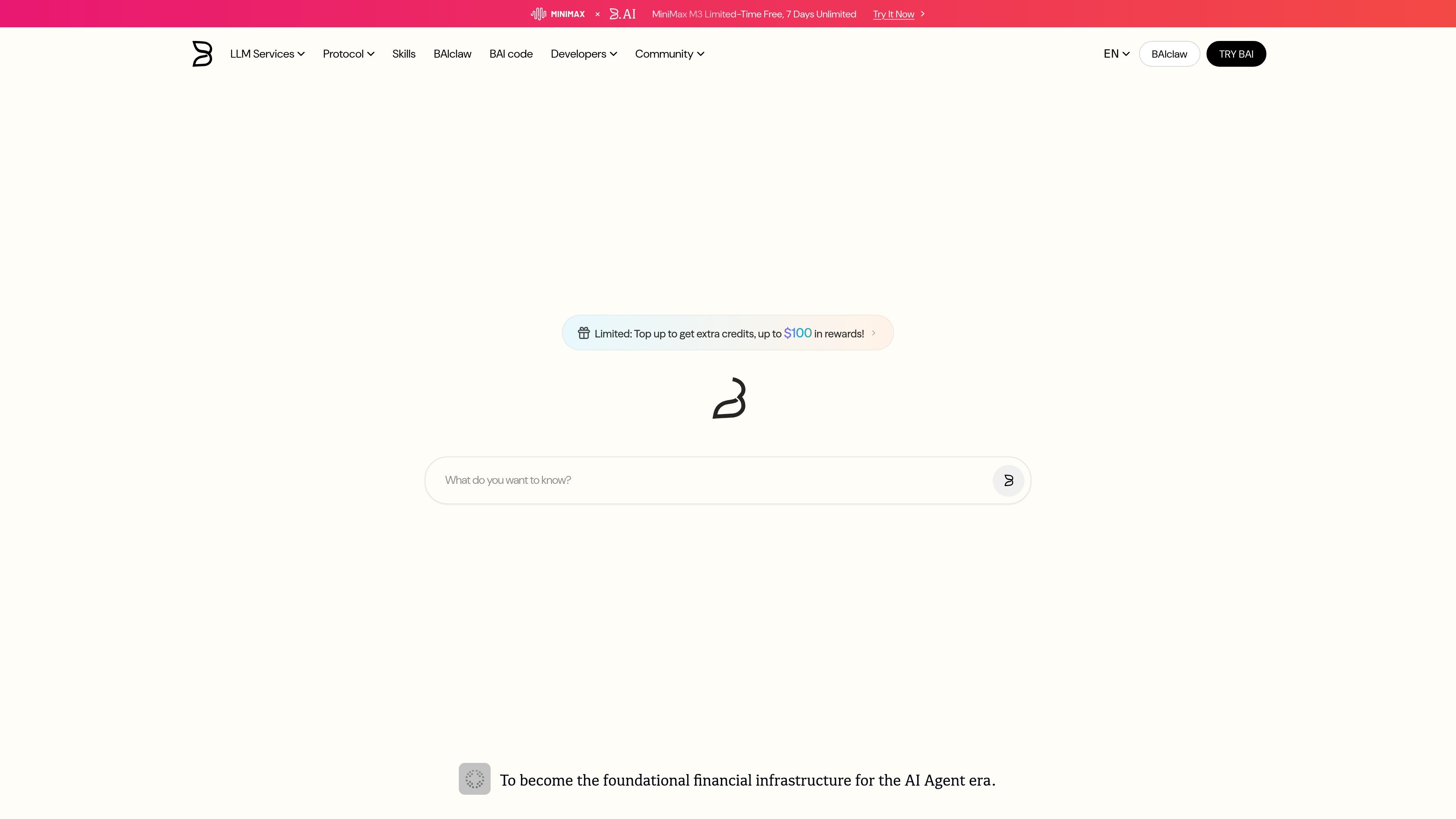
BAI is a developer-oriented platform that describes itself as foundational economic infrastructure for AI agents. Its stated purpose is to give agents a unified way to access model services, move funds, and settle transactions so they can operate with more financial autonomy.
The homepage positions the product around three related functions: permissionless access to LLMs, Agent-to-Agent trust, and AI as an economic entity. It points to developer documentation, quick start material, and protocol resources for teams that want to embed the platform into agent workflows.
The site describes unified multi-model access, allowing agents to reach top-tier models through a single API surface rather than handling each provider separately.
BAI says it provides privacy-first integration and an anonymous API pipeline, which is positioned around borderless access to model services.
The homepage highlights native crypto payments and self-custodying funds, suggesting agents can hold and use funds for autonomous actions.
The product emphasizes intelligent routing, which implies requests can be directed across available models based on the platform’s routing layer.
BAI presents Agent-to-Agent settlement support, with on-chain addresses used as permanent IDs and transaction history used as verifiable trust.
The site points to developer docs, quick start material, and multiple protocol references for embedding BAI into agent workflows.
Use BAI when you want an agent to call multiple LLMs through one API layer instead of wiring separate integrations for each provider.
Use it for workflows where an agent needs to self-custody funds, procure compute, or settle transactions autonomously through crypto rails.
Use the platform when your application needs agent-to-agent payments or micro-settlements with permanent on-chain identities.
Use the docs and integration resources to embed BAI into an existing agent stack and follow the site’s quick-start guidance.
Use the privacy-first access model if you need borderless access to model services without relying on a single commercial provider path.
BAI presents itself as infrastructure for AI agents that need access to model APIs and a settlement layer for payments. The site also points to developer docs and integration resources, which suggests it is meant to be embedded into agent workflows rather than used as a standalone chat app.
The homepage highlights unified multi-model access, privacy-first integration, native crypto payments, intelligent routing, and support for Agent-to-Agent settlements. It also references developer docs for quick embedding and common use cases.
The site links to documentation, quick start material, integration pages, and protocol references such as x402, 8004, MCP Server, and Openclaw Extension. That indicates the product is aimed at developers building AI agents and related workflows.
The pricing page exists, but the provided content does not include actual prices, plan names, or limits. The only concrete promotion shown is a top-up offer for extra credits and up to $100 in rewards.
The visible site text does not provide a complete public API reference or SDK list. It does, however, point to developer docs, quick start material, and several protocol and integration resources.
I dati sul traffico sono solo a scopo di riferimento.
| apr | 28064 |
|---|---|
| mag | 445990 |
| giu | 319031 |