
Traces Eraser AI Reduction
Rewrite text sentence by sentence, prioritizing a lower false-positive risk in AIGC detection while preserving the original meaning, terminology, and data as much as possible.

爱改写 is a Chinese AIGC detection and rewriting platform for reducing AI false positives, text checking, proofreading, and paper rephrasing.
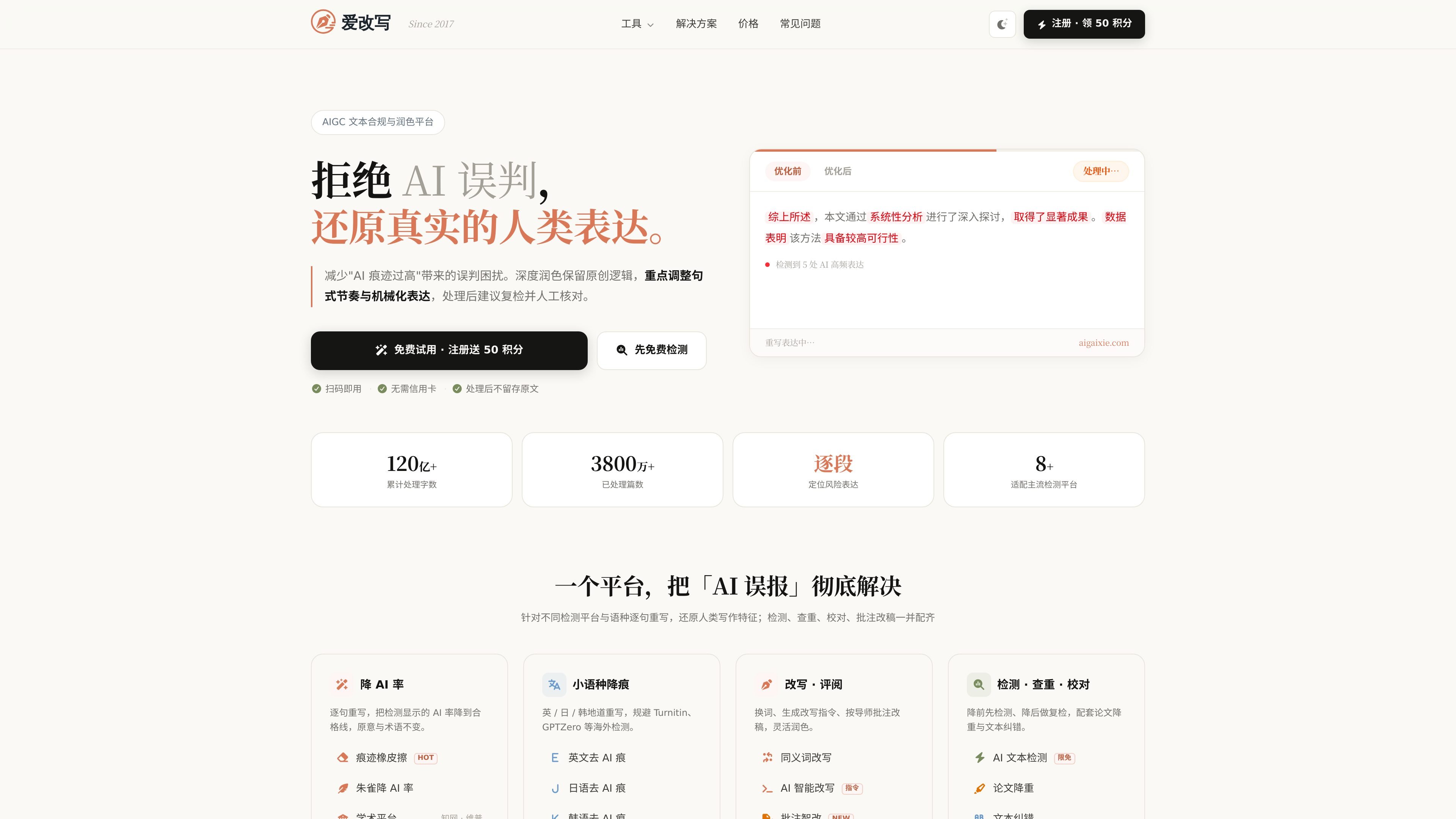
AiGaixie is a Chinese trace-reduction platform for handling false positives in AIGC detection. Its core task is to adjust text that is likely to be judged as “AI-generated” so that it reads more like natural human writing. It does this by restructuring sentence patterns, breaking up repetitive structures, and adjusting rhythm and word choice to help reduce the risk of false judgments caused by mechanical expression.
The platform is not a single rewriting tool. Instead, it combines AI reduction, AI text detection, text correction, paper rephrasing, synonym rewriting, and annotation-based intelligent revision into a workflow of “detect first, reduce traces next, and recheck afterward.” The page also clearly notes that manual verification is recommended after processing, and that key facts, terminology, and data can be preserved with protection mode as much as possible.
In terms of coverage, it supports general Chinese scenarios and is also adapted for common detection platforms such as CNKI, Wanfang, and Zhuniao, while providing trace-reduction versions for English, Japanese, and Korean. Billing uses a credit system deducted according to actual usage, making it suitable for individual users who need to process text on demand.
Rewrite text sentence by sentence, prioritizing a lower false-positive risk in AIGC detection while preserving the original meaning, terminology, and data as much as possible.
Handle Tencent Zhuniao detection with category-based processing, adjusting expression style and sentence rhythm for article types such as overviews and detailed descriptions.
Provide AI text detection that identifies AI-generated traces paragraph by paragraph, outputs an overall AI rate, and labels suspected AI / human paragraphs.
Supports text correction, synonym rewriting, AI-assisted rewriting prompts, and revision based on annotations.
Covers Chinese paper rephrasing as well as reduction for smaller language texts in English, Japanese, and Korean, suitable for different detection scenarios.
Provides top-up by usage and history tracking, supporting fast short-text processing and segmented processing for longer texts.
Before a thesis defense, submission, or plagiarism check, first use AI text detection to review the overall risk, then use the AI reduction feature to process high-risk paragraphs, and finally recheck the result.
When WeChat Official Account copy, short-video scripts, or platform articles are flagged as machine-generated and this affects recommendation or publishing, trace-reduction rewriting can restore a more natural writing style.
When dealing with detection requirements from platforms such as CNKI, Wanfang, or Zhuniao, you can choose the corresponding tool for each scenario instead of relying only on general synonym replacement.
When English, Japanese, or Korean content becomes overly templated or has sentences that are too uniform, the corresponding language version can be used for trace reduction.
When supervisor comments, reviewer feedback, or revision requests need a more natural expression, annotation-based intelligent revision, synonym rewriting, and text correction can be used together.
AiGaixie helps reduce misjudgments in AIGC detection by restructuring sentence patterns, adjusting expression rhythm, and reducing repetitive structures. It cannot prove the source of a text, but it can be used to polish text that may be flagged as AI-generated and then check it again.
Yes. The page information shows that it supports general Chinese text reduction and is adapted for common detection scenarios such as CNKI, Wanfang, and Zhuniao. For other languages, it also covers English, Japanese, and Korean versions.
The system tries to preserve the original facts, arguments, data, and terminology as much as possible while adjusting wording, sentence structure, and writing rhythm. Names, institutions, and key terms can be locked with protection mode, and manual review is recommended after processing.
The page shows that billing is based on credits, with 1 RMB = 10 credits, and usage is deducted according to actual processing volume. AI text detection may be available for a limited free period or as part of a free promotion; the exact quota and validity period depend on the account page.
The platform notes that processed content is destroyed after use and not retained. The AI text detection page also states that detected content is destroyed after use and not retained, and the results are for reference only.