66论文 icon

66论文

Rivendica

66论文 is an online AI tool for paper topic selection and writing, with free outlines, source input, multi-level chapter editing, and multilingual first drafts.

66论文

Product Overview

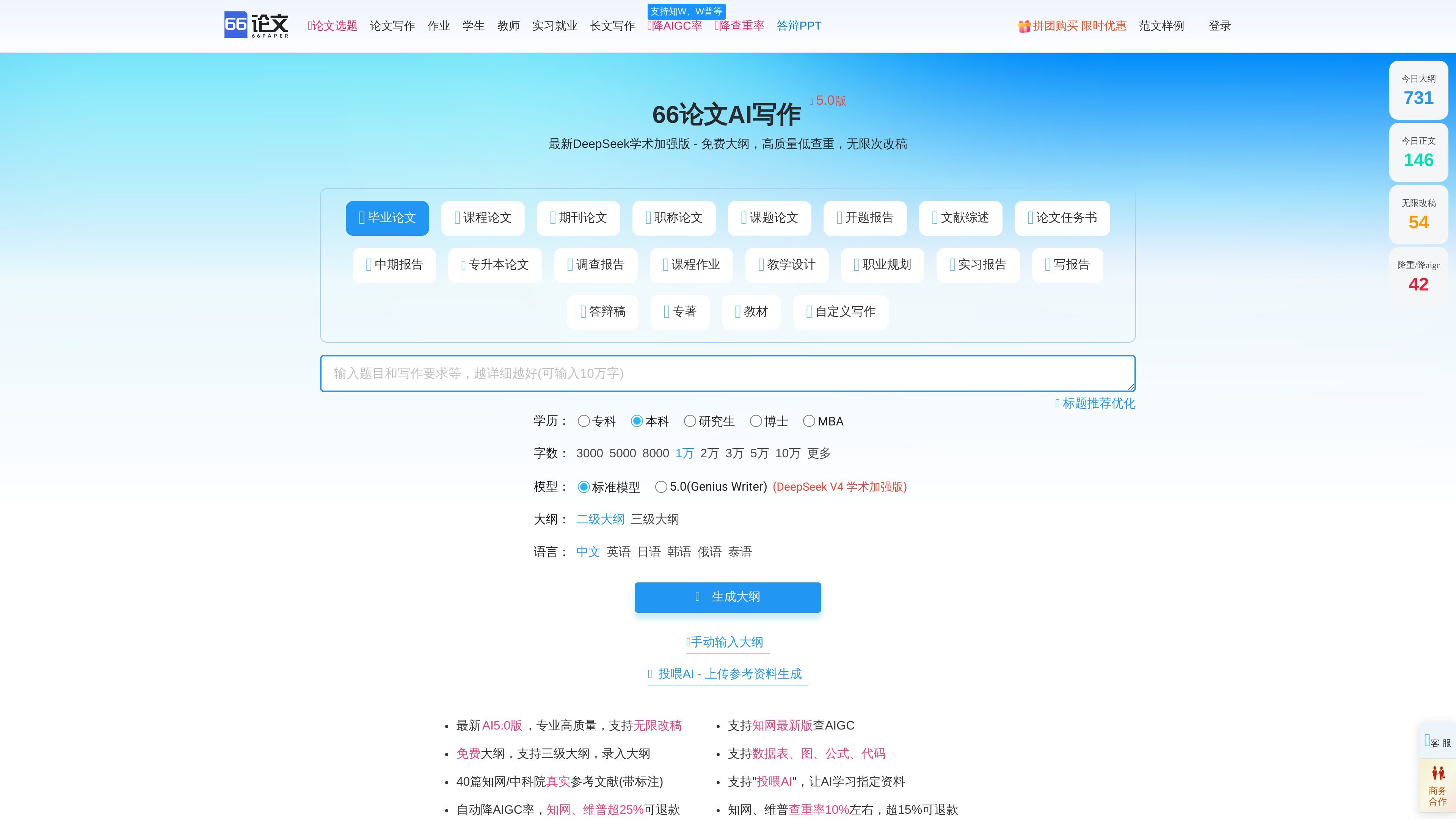
66论文 is an online AI tool for paper writing, focused on a continuous generation workflow from topic selection, outlines, and proposal reports to the first draft of the main text. The homepage and themed pages show that it covers common academic and writing tasks such as theses, course papers, journal papers, title-evaluation papers, research papers, literature reviews, task sheets, midterm reports, survey reports, teaching designs, career plans, internship reports, and defense scripts.

The product page highlights writing modes such as "Free Outline" and "AI 5.0 / DeepSeek academic enhanced version," and provides editing capabilities including custom outlines, source input, literature search, and inserting charts, formulas, and code. The generated results are labeled as sample first drafts for reference only, and should not be used directly as a graduation thesis or publication draft.


Core Features

Free outlines and multi-level chapter structure

The homepage and feature pages both provide a free outline entry, and support second-level and third-level outlines, making it suitable for confirming the chapter structure before generating the main text.

Custom outline editing

Users can enter an outline directly, or modify and delete chapters after generation. They can also insert figures, tables, formulas, and code, allowing finer control over academic structure.

Reference-material-fed generation

The page provides an "Feed AI" feature that lets users upload reference materials so the model can learn first and then generate content. It supports doc, docx, pdf, txt, md, and other formats, and multiple files can be uploaded.

References and annotation support

The page explicitly mentions 40 real CNKI/CAS reference papers with annotations, and supports smart references, manual reference entry, and CNKI novelty checking (citation format).

Multilingual writing output

It supports writing in multiple languages, including Chinese, English, Korean, Japanese, Russian, and Thai, making it suitable for papers, reviews, and reports in different languages.

Plagiarism reduction and AIGC control

The page says it provides one-click plagiarism reduction / AIGC reduction, the latest CNKI AIGC check, and refund instructions if the plagiarism rate exceeds the threshold, but the specific rules are subject to the page notes.

Use Cases

  • Getting started with paper topic selection

    Suitable for people who need to quickly determine a research direction. The site includes an intelligent topic-selection page that can generate paper topics and topic-selection rationale based on the research field, helping narrow the scope early.

  • Building an outline and adjusting structure

    Suitable for users who already have a topic but do not yet have a chapter framework. You can generate a second-level or third-level outline first, then manually modify, delete, or insert charts and formulas as needed.

  • Generating a paper first draft

    Suitable for graduation theses, course papers, and review-style writing scenarios that need a formal first draft. The page shows result types such as main-text generation, literature review, abstract, acknowledgments, and defense script.

  • Reference-driven writing

    Suitable for writers who already have reference materials and want the content to stay closer to specific source material. Users can upload documents to "feed" the system and let the AI learn before continuing the writing process.

  • Multilingual writing and plagiarism-reduction handling

    Suitable for scenarios that require language-version handling or plagiarism reduction. The site supports multilingual writing and provides pages and add-on service notes related to AIGC reduction and plagiarism reduction.

Pros and Cons

Pros

  • Covers multiple stages of thesis writing, with entry points from topic selection and outlining to main text and defense scripts.
  • Supports second-level, third-level, and custom outlines, which is suitable for academic writing that needs structural control.
  • Supports uploading reference materials to "feed AI," and allows multiple document formats and multiple-file input.
  • Provides explanations related to real, verifiable references and annotations, making it suitable for writing that needs literature support.
  • Supports multilingual writing, including Chinese and several common foreign languages.

Cons

  • The pricing page currently returns 500, so public pricing and plan information cannot be directly verified from the pricing page.
  • The generated content is clearly labeled as a sample first draft for reference only, and cannot be used directly for a thesis or publication.
  • Some capability descriptions come from different pages on the site, so the exact scope and limits may change with version switching.

FAQ

What can 66论文 mainly do?

It provides tools for the paper-writing and topic-selection workflow, including common output stages shown on the site such as free outlines, proposal reports, literature reviews, main body drafting, and defense scripts. The generated content is labeled as a sample first draft for reference only.

What outline workflow does it support?

The page shows support for second-level and third-level outlines. Users can choose to generate an outline, enter one manually, or keep adjusting the chapter content after the outline is generated.

What materials can be uploaded for AI to learn from?

The page says it supports uploading doc, docx, pdf, txt, md, and other documents, and multiple files can be uploaded. Another page also mentions up to 50 files, with each file no larger than 100M.

Which languages are supported?

It supports writing in Chinese, English, Korean, Japanese, Russian, and Thai. Both the homepage and the topic-selection page mention support for multiple languages.

What are the limits for plagiarism checking and final drafts?

The FAQ states that when using the one-click plagiarism-reduction add-on service, the CNKI plagiarism rate is around 10%, and refunds are available if it exceeds 15%. The page also emphasizes that the content is only a sample first draft and is not recommended for direct use in a thesis or publication.

Quick Facts

Product Name
66论文
Website Domain
66paper.cn
Product Type
AI thesis writing tool
Primary Users
Students and academic writers who need topic selection, writing, and revisions
Supported Languages
Chinese, English, Korean, Japanese, Russian, Thai
Core Workflow
Topic selection → Outline → Source input → Draft generation → Revision / plagiarism reduction