
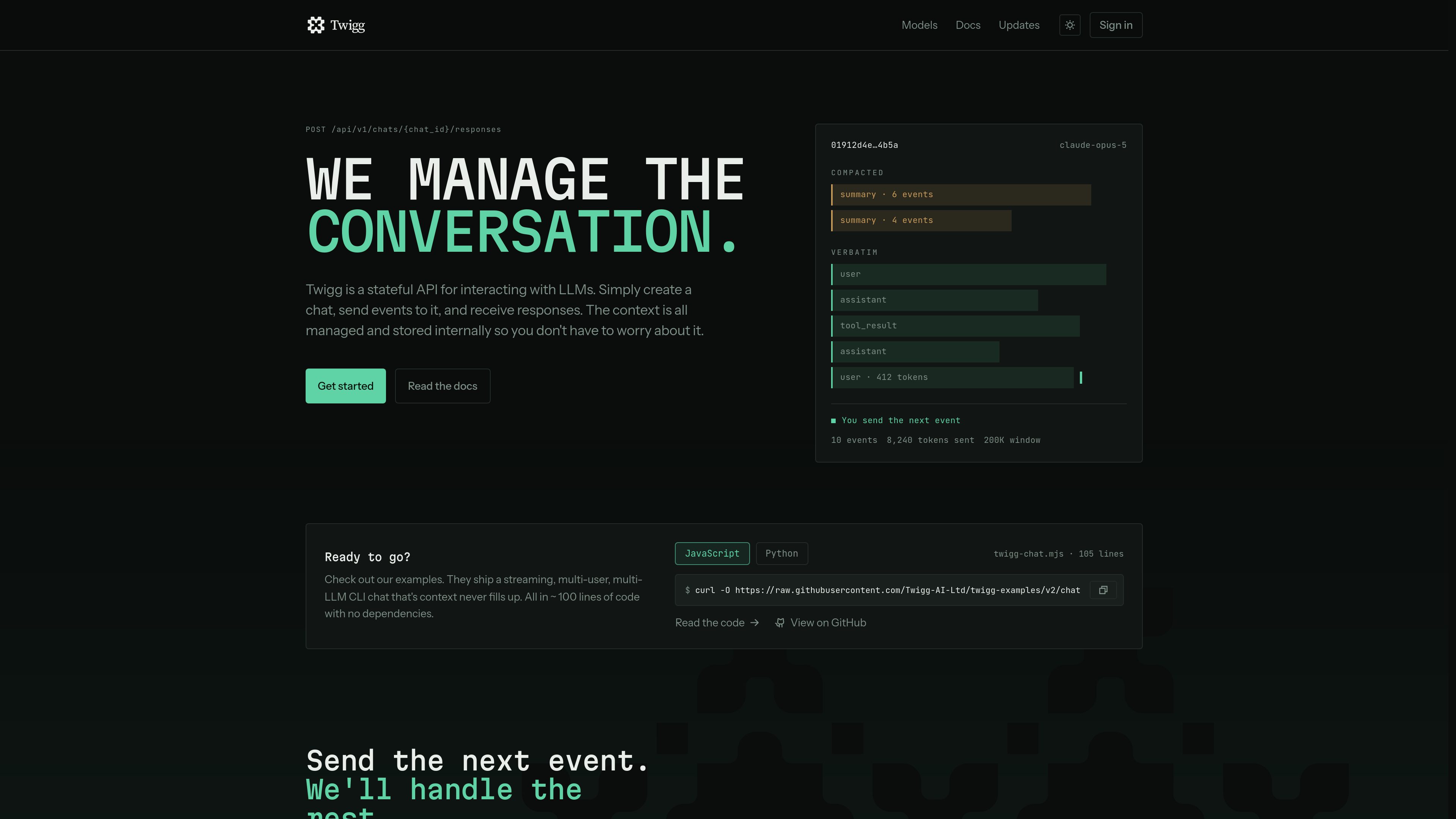
Stateful chat API
Create a chat once and post subsequent events to `/api/v1/chats/{chat_id}/responses`, rather than rebuilding the full transcript for every request.

Twigg est une API avec état conçue pour créer des applications LLM. Elle propose le stockage hébergé des conversations, l’assemblage du contexte, la compaction et le routage des modèles. Envoyez uniquement l’événement suivant, conservez les conversations entre les requêtes et changez de modèle ou de fournisseur sans déplacer les échanges vers un fil propre à un fournisseur.
Twigg is a hosted context store, assembler, and model router for applications that interact with large language models. An application creates a chat, keeps its chat ID, and sends new events to the same chat; Twigg stores the conversation, assembles the request context, calls the named model, and returns the response and usage information.
The conversation remains outside the LLM providers, allowing a single chat to be used with models from different providers. The API can retain provider-native artifacts such as reasoning and tool calls, translate the accumulated ledger into each provider's message format, and compact older context when necessary.
Create a chat once and post subsequent events to `/api/v1/chats/{chat_id}/responses`, rather than rebuilding the full transcript for every request.
Twigg stores and retrieves conversation history, so the application can keep only the chat ID instead of its complete transcript.
Each run names the model to use, allowing a conversation to move between listed models and providers without migrating the chat into a new vendor thread.
Twigg assembles the history for each request and compacts older material when needed to keep the request within the configured context budget.
Namespaces can define context-window budgets and rules for retaining, truncating, or dropping different content types. Tool arguments and results can have separate size and recency rules.
Responses can stream back through the API, and completed runs include model, token usage, stop reason, and cost information when returned by the service.
Keep each user's chats under a separate namespace while the application stores only the open chat ID. Twigg's example CLI supports creating, listing, reopening, and switching between user conversations.
Let a process restart or move between machines without losing the conversation, because the transcript is retrieved by chat ID rather than held in application memory.
Send different turns in one conversation to different named models or providers to compare behavior or match tasks to available model capabilities.
Preserve tool calls, tool results, reasoning artifacts, and ordinary messages in the context ledger while applying separate retention rules to large tool payloads.
Use the documented JavaScript or Python examples to build a streaming chatbot without an SDK or external package dependencies in the examples.
For the documented chat workflow, the application can keep the chat ID and its own agent-loop state. The example CLI says it stores nothing beyond the ID of the open chat, while Twigg keeps the chat and messages.
Yes. The response request includes a model name, and the examples list models through `GET /api/v1/models` and select a different model for later turns in the same chat.
Yes. The examples consume a streamed response and print text delta events as they arrive. The API example also shows a run frame and a final `done` event.
Twigg assembles the conversation within a context budget and can compact older material. The site also describes namespace and model-level controls for budgets, retention boundaries, and truncation rules.
No such full runtime is documented. The product description assigns the application responsibility for the agent loop and tools, while Twigg manages the context ledger, request assembly, model call, and related response data.
Les données de trafic sont fournies à titre indicatif uniquement.

www.jurniti.com
jurniti est une plateforme d’hébergement géré qui maintient les agents IA en ligne dans des microVM Firecracker dédiées. Elle propose des identifiants de modèle BYOK, un tableau de bord web, une CLI, un accès MCP et un stockage persistant, avec des forfaits fixes ou à l’usage pour des exécutions continues ou ponctuelles.

instantdb.com
InstantDB est un backend temps réel pour applications frontend et assistées par IA, avec authentification, permissions, stockage, présence et streams intégrés.

getunblocked.com
Unblocked transforme le code, les documents, les tickets et les conversations en contexte exploitable pour les revues de code, les Q&R et les workflows de développement avec AI.

www.maximem.ai
Maximem Synap est une plateforme de mémoire agentique et de gestion du contexte pour les agents IA. Elle enregistre les conversations, crée une mémoire structurée et délimitée, puis récupère un contexte concis via des SDK, des API, MCP et des adaptateurs natifs pour 23 frameworks d’agents.

www.experientiallabs.ai
Experiential Labs est une passerelle d’IA open source qui fournit aux équipes un point de terminaison et une clé API uniques pour les modèles hébergés, les clés appartenant aux clients et les modèles locaux ou personnalisés. Elle ajoute aussi le routage, la gestion des budgets, le contrôle d’accès, l’attribution et des fonctions d’intelligence facultatives pour le trafic des agents.

www.oxlo.ai
API d’inférence IA compatible avec OpenAI, Oxlo.ai propose aux développeurs et aux équipes IA une tarification mensuelle prévisible par requête pour les charges de production.