
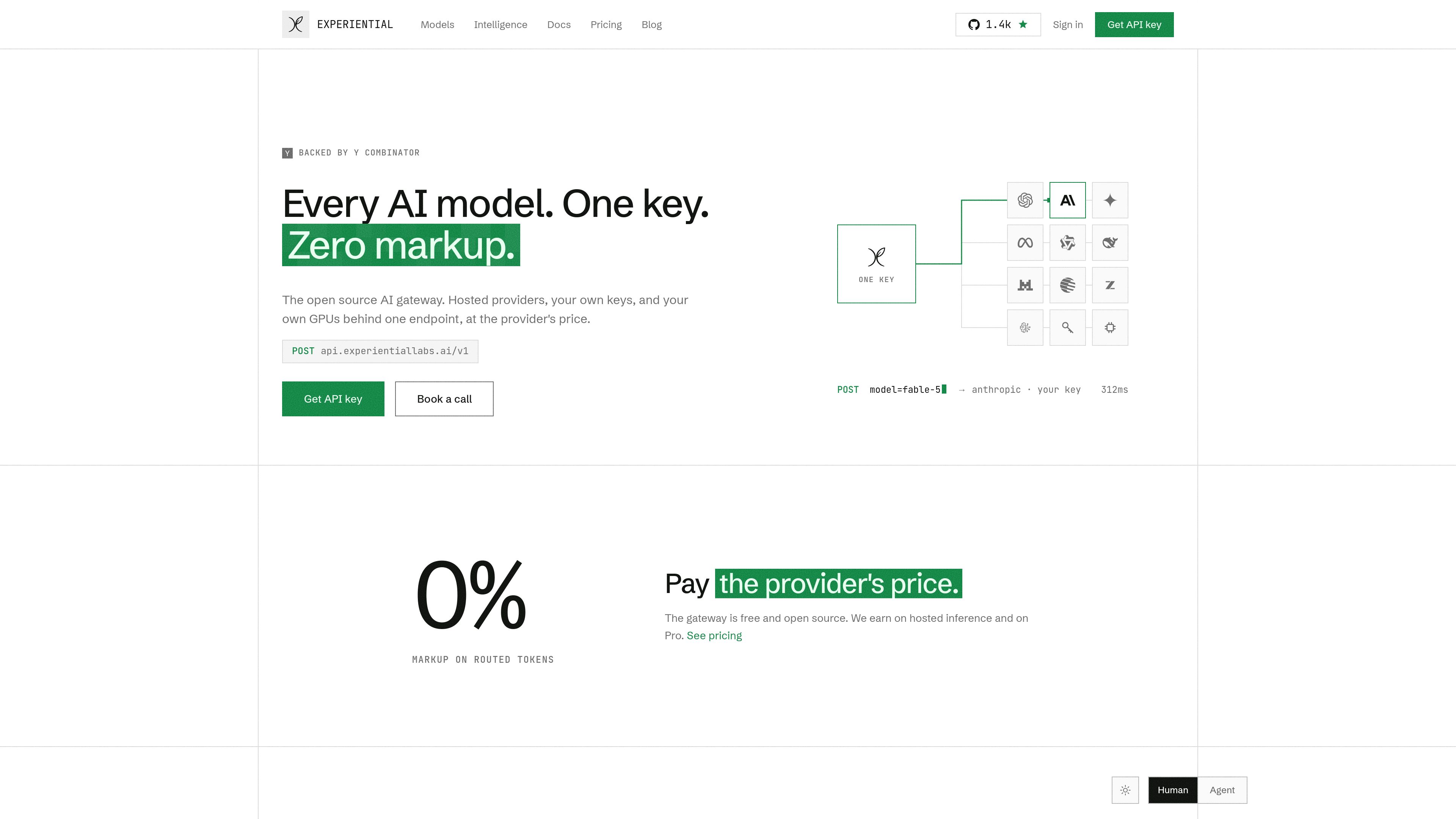
OpenAI-compatible gateway endpoint
Exposes a single `/v1` endpoint with streaming support so existing clients can connect without changing their basic API shape.

Experiential Labs est une passerelle d’IA open source qui fournit aux équipes un point de terminaison et une clé API uniques pour les modèles hébergés, les clés appartenant aux clients et les modèles locaux ou personnalisés. Elle ajoute aussi le routage, la gestion des budgets, le contrôle d’accès, l’attribution et des fonctions d’intelligence facultatives pour le trafic des agents.
Experiential Labs is an open source AI gateway for routing model traffic through one OpenAI-compatible endpoint. It lets teams point agents and applications at a single API while using hosted providers, their own provider keys, or local and custom models behind the same interface.
The product is designed to centralize key management, usage controls, and attribution across model calls. Its core gateway is free and open source to self-host, while the hosted service adds managed routing, org controls, and an intelligence layer that can suggest cheaper or faster routes, improve cache hit rate, and support a model trained on a team’s traffic.
Exposes a single `/v1` endpoint with streaming support so existing clients can connect without changing their basic API shape.
Routes requests across hosted providers, cloud hosts, pooled accounts, customer keys, and local models, with failover on capacity or provider errors.
Enforces hard caps, model allowlists, and request-level policies at the gateway so limits apply on every call.
Provides logs and dashboards for spend, requests, token counts, TTFT, and usage broken down by agent, person, model, or day.
Supports bringing your own provider keys and, on higher plans, routing to local and custom models through the same endpoint.
Offers per-prompt model optimization, caching suggestions, prompt compression guidance, and an opt-in model trained on the team’s traffic.
Teams that use multiple model providers can give agents and developers one endpoint, one login, and one place to manage keys and policies.
Admins can set caps, route by budget, and inspect usage by key, person, agent, or day to understand where costs are coming from.
Product and engineering teams can use the intelligence layer to route simple prompts to cheaper models and harder prompts to stronger ones.
Organizations that want to run the gateway on their own infrastructure can self-host the open source core and route to local models behind the same API.
Teams that need recordkeeping can review request logs with route, token, fallback, and cost data for individual calls.
Pricing is credit-based. Routed tokens spend credits at the provider’s list price with no markup, and intelligence features also consume credits. The site offers a Free plan, a Pro plan, and Enterprise with custom committed credits.
Yes. The site says BYOK is supported, and routed traffic can use your own provider keys first.
Yes. The core gateway is open source and can be run on your own infrastructure.
Yes. The site mentions budgets, allowlists, RBAC, org-wide policies, and API key management.
It can suggest optimal model routing, identify caching opportunities, and support an opt-in model trained on your traffic.
Les données de trafic sont fournies à titre indicatif uniquement.

maritime.sh
Maritime est une plateforme pour déployer, gérer et faire évoluer des agents IA avec des micro-VM isolées et un point de terminaison API actif. Elle permet de créer des agents destinés aux clients, des workflows personnalisés et des déploiements par client.
superqode.dev
SuperQode est une couche de harness open source pour les agents de programmation. Elle permet de découvrir, créer, exécuter, évaluer et optimiser des harnesses d’agents depuis un seul terminal. Elle assure l’interopérabilité entre A2A, ACP, MCP et UHP, afin que les équipes puissent conserver leurs agents de programmation et modèles existants.

dedaluslabs.ai
Dedalus Labs fournit des machines Linux persistantes pour les workflows d’agents, avec démarrage rapide, état conservé et contrôle via CLI. La facturation porte sur le calcul actif ; l’inactivité et le stockage sont gratuits.

skillsmp.com
SkillsMP est une marketplace gratuite pour découvrir des compétences d’agents open source dans des dépôts GitHub publics, avec recherche, navigation, API REST et accès MCP pour Claude Code, Codex CLI et ChatGPT.

apipark.com
Portail API d’entreprise et passerelle IA open source pour les API et les LLM en production

www.maximem.ai
Maximem Synap est une plateforme de mémoire agentique et de gestion du contexte pour les agents IA. Elle enregistre les conversations, crée une mémoire structurée et délimitée, puis récupère un contexte concis via des SDK, des API, MCP et des adaptateurs natifs pour 23 frameworks d’agents.