
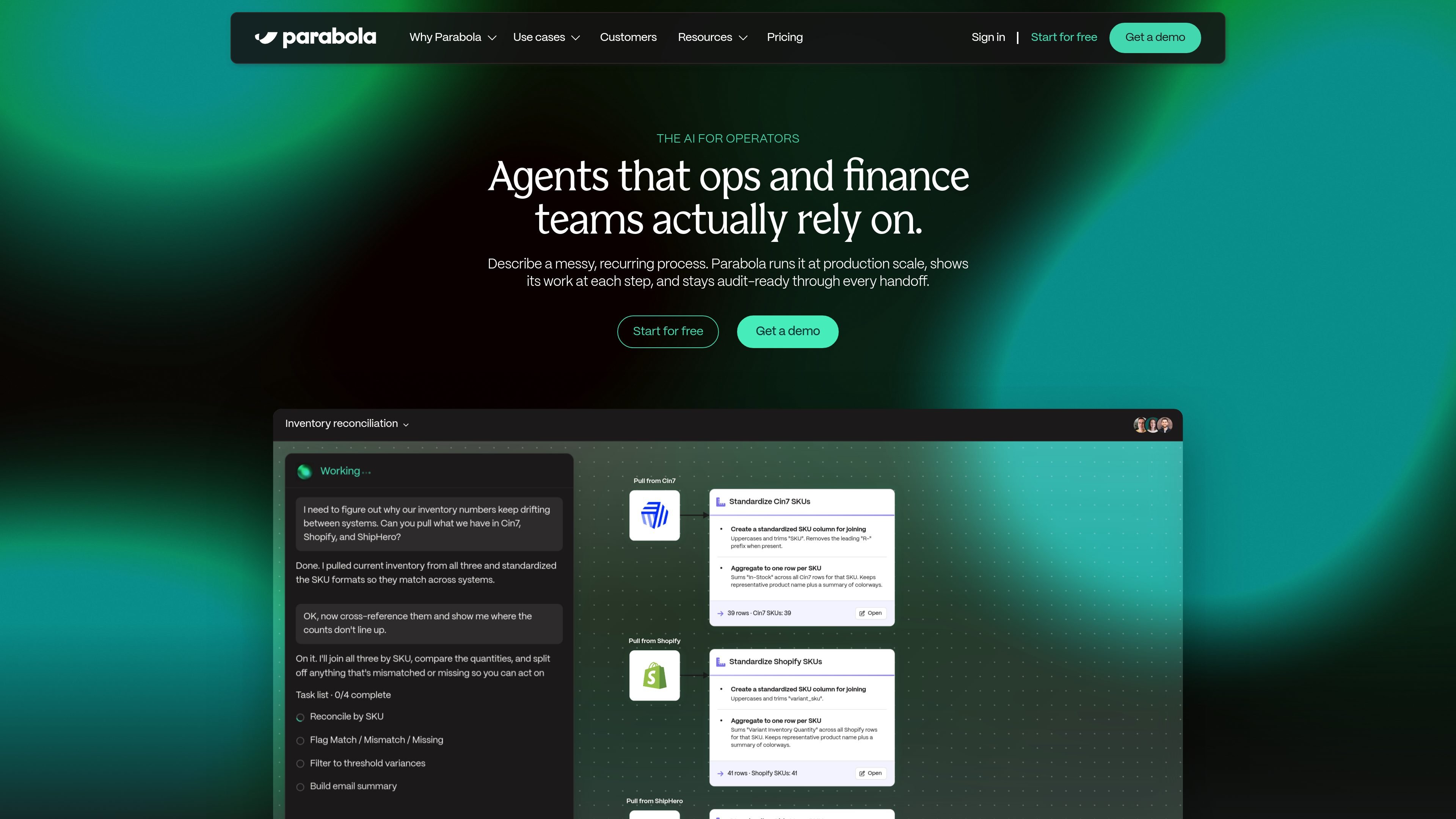
Plain-language agent building
Describe a recurring process in plain language, then ship an agent that can run it. The homepage presents this as the starting point for building production workflows.

Plateforme d’agents IA qui automatise les tâches récurrentes liées aux données pour les équipes opérationnelles et financières.
Parabola is an AI agent platform for operations and finance teams that need to automate recurring, data-heavy work. It is designed around a visual workflow model: users describe a messy process, Parabola builds an agent, and the resulting steps can be reviewed, adjusted, and run at production scale.
The product emphasizes transparency and control. The site shows agents pulling from multiple systems, standardizing data, comparing results, and producing a documented output that can be scheduled, shared, and audited. Business plans add team features such as deployment support, role-based permissions, version history, and enterprise security controls.
Describe a recurring process in plain language, then ship an agent that can run it. The homepage presents this as the starting point for building production workflows.
Parabola documents each step of the workflow as it builds, so the resulting agent can be reviewed and edited as a visual process instead of a black box.
Agents can be connected to existing tools, scheduled to run automatically, and triggered by events. The homepage also shows use of retries, failure alerts, and run logs.
The platform supports row-level and table-level transformations such as standardizing SKUs, joining data from multiple systems, comparing quantities, and generating summaries or gate conditions.
Business plans include role-based access controls, version history, rollback, centralized integration governance, and audit trails for agent runs.
The pricing page says Parabola provides pre-built integrations and can connect to common data sources, including ERP, warehouse, APIs, email, and file systems.
Pull inventory from systems such as an ERP, storefront, and shipping tool, normalize the identifiers, and compare quantities to find mismatches before they create downstream problems.
Bring together invoices and rate-card data to spot rate, zone, weight, or accessorial overcharges before payment.
Normalize sales data from channels such as Shopify, Amazon, retail, and wholesale into a single reporting table without rebuilding the report every cycle.
Build and schedule recurring operational reports that combine data, calculate totals or variances, and send a clean summary only when attention is needed.
Parabola’s self-serve plans are designed for individual users, while Business plans are built for teams that want hands-on support, multiple users, and enterprise-grade security and governance features.
Credits are consumed when agents run, not while you build them. The plan includes a monthly credit allowance, and additional credits can be added as usage grows. The pricing page also says complex tasks use more credits than simple ones.
Yes. Self-serve plans include a free tier, and Business customers begin with a proof of concept built with Parabola’s automation engineering team. If value is not proven, the customer can walk away at no cost.
Yes. The pricing page says customers can start on a self-serve plan and later upgrade to a Business plan after proving value.
Les données de trafic sont fournies à titre indicatif uniquement.

www.useverse.ai
Verse est une plateforme qui permet de créer des employés IA autonomes à partir d’instructions en langage naturel. Elle aide les particuliers et les équipes à automatiser les tâches récurrentes grâce à des outils connectés, des workflows et des espaces de travail partagés pour les agents.

minimaxi.com
MiniMax est une plateforme d’intelligence artificielle généraliste qui propose de grands modèles multimodaux, une plateforme ouverte pour les développeurs et des produits par abonnement pour les particuliers et les équipes. Elle convient aux utilisateurs qui ont besoin de coder, d’exécuter des tâches avec des agents, de traiter des contenus multimodaux et d’intégrer des applications natives de l’IA.

kaily.ai
Fynd Kaily est une plateforme d’agents IA conversationnels pour les équipes commerciales, support et marketing, qui automatise les échanges clients sur chat, voix, WhatsApp, sites web et applications mobiles.

penligent.ai
Penligent est une plateforme de tests d’intrusion assistés par l’AI pour les équipes de sécurité, les pentesters et les red teams. Elle automatise la découverte, la validation, la reproduction d’exploits et les rapports fondés sur des preuves pour les applications web, les API, la logique métier et les agents AI.

twin.so
Twin est une plateforme d’agents IA no-code pour connecter des applications, parcourir le Web et automatiser les workflows récurrents de recherche, prospection et collecte de données.

zaro.ai
Zaro est une plateforme de travail d’IA pour créer des applications internes, des agents et des workflows à partir des données de votre entreprise, avec un forfait d’essai gratuit et des offres payantes pour des usages plus importants.