MiniMax logo

MiniMax

Freemium
Visiter

MiniMax est une plateforme d’intelligence artificielle généraliste qui propose de grands modèles multimodaux, une plateforme ouverte pour les développeurs et des produits par abonnement pour les particuliers et les équipes. Elle convient aux utilisateurs qui ont besoin de coder, d’exécuter des tâches avec des agents, de traiter des contenus multimodaux et d’intégrer des applications natives de l’IA.

Qu'est-ce que MiniMax ?

MiniMax is a general artificial intelligence technology company. According to the official website, it has been continuously developing multimodal foundation models since its founding in early 2022, and it provides AI-native products and open platform services to users worldwide. The page highlights coverage of multiple modalities, including text, audio, images, video, and music, and says it serves developers, enterprises, and individual users.

From the product line perspective, MiniMax’s core offerings include M3 for coding and agent tasks, M2.7 for complex productivity and office delivery, as well as applications such as MiniMax Code, MiniMax Hub, MiniMax Audio, and Xingye. For developers, the platform provides API access and Token Plan options; for individuals and small teams, it offers monthly subscriptions and desktop versions.

Que peut faire MiniMax ?

Million-token context handling

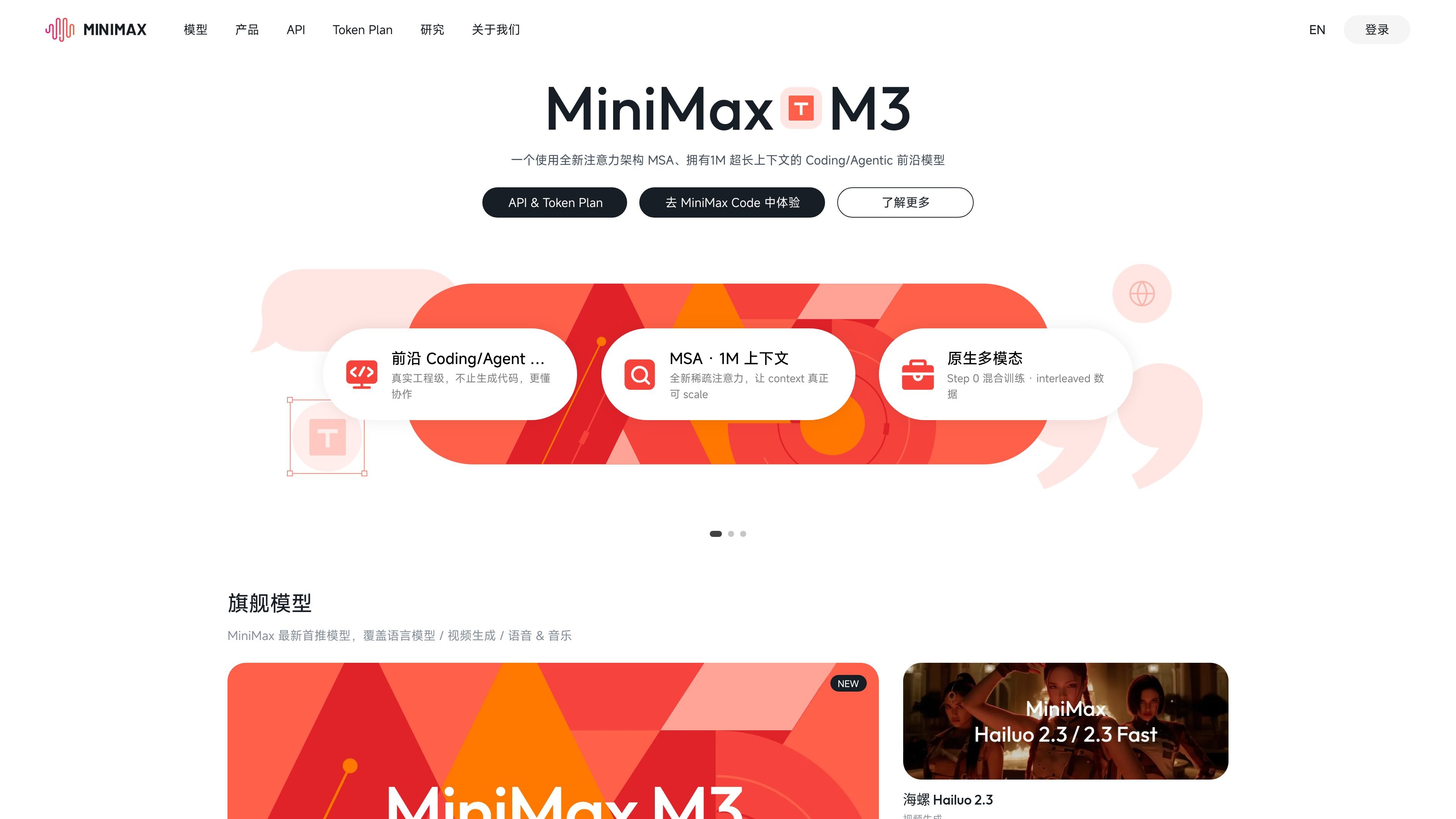
M3 uses the MiniMax Sparse Attention (MSA) architecture. The API supports up to a 1M-token context window, and the documentation says at least 512K tokens are available, making it suitable for long-context coding, long-horizon agents, and long-document tasks.

Native multimodal understanding

M3 is described as a native multimodal model that learns multimodal representations from the start of training, for unified processing of text and visual semantics rather than shallow multimodal capability added later.

For coding and agentic workflows

M3 emphasizes coding, tool calling, autonomous task decomposition, and multi-step reasoning, with the goal of producing code that can be delivered directly and agent tasks that can keep running.

Complex productivity tasks

M2.7 emphasizes complex agent building, real software engineering, log troubleshooting, code security, machine learning, and office document editing tasks, covering more productivity-oriented scenarios.

Dual-track API and subscription access

The pricing page divides the products into API usage with real-time billing and monthly subscriptions. The subscription side includes Token Plan and Team Edition, respectively for individuals, small teams, and seat-based allocation scenarios.

Multiple access paths

The model pages provide quick-start API integration examples and mention access points such as MiniMax Code, the open platform, and a desktop version, showing that the product is aimed at both developers and non-developers.

Cas d'utilisation

“Long-context coding and code delivery”

Suitable for coding tasks that require long-context processing, such as large codebase modifications, cross-file refactoring, long-horizon debugging, and continuously iterated agent workflows. M3’s 1M context window and tool-calling capabilities are designed for this kind of workflow.

“Agent task execution”

Suitable for agent scenarios that require autonomous task decomposition, tool use, and multi-step reasoning, such as information retrieval, browsing, experiment execution, and long-running automation tasks. The M3 page highlights these capabilities directly.

“Complex engineering and productivity tasks”

Suitable for productivity scenarios such as software engineering, log troubleshooting, code security, machine learning experiments, and complex project delivery. M2.7’s examples and benchmarks focus on these workloads.

“Office document processing”

Suitable for office document workflows that require complex editing and multiple rounds of revision, such as high-fidelity editing and content organization in Excel, PPT, and Word. M2.7 specifically emphasizes these capabilities.

“Platform integration and personal use”

Suitable for users who want to integrate model capabilities through APIs or get started quickly with Token Plan and the desktop version. The pricing page and model pages provide different entry points for choosing based on usage preferences.

Questions fréquentes

What billing options does MiniMax offer?

MiniMax offers enterprise API billing and monthly subscription plans for individuals and small teams. The pricing page says the two plans use separate Key systems, but the full price list is not included in the collected text.

What is the difference between M3 and M2.7?

M3 is designed for coding and agent tasks, with an emphasis on a 1M context window, native multimodal capabilities, and tool-calling. M2.7 focuses on complex agent building, software engineering delivery, and office task handling.

How can MiniMax models be used?

MiniMax Code is a desktop Coding Agent version adapted for MiniMax models. The model page also mentions open platform API access, as well as subscription and platform access options for AI Coding Tools.

What products and capabilities does MiniMax mainly offer?

The source materials show that MiniMax models cover multimodal capabilities including text, audio, images, video, and music, and that MiniMax has launched AI-native products such as MiniMax Code, MiniMax Hub, MiniMax Audio, and Xingye.

Informations rapides

Brand
MiniMax
Category
General AI platform
Main products
MiniMax M3, MiniMax M2.7, MiniMax Code, MiniMax Hub, MiniMax Audio, Xingye
Access methods
API, Token Plan, Team Edition, desktop version
Target users
Developers, enterprises, individuals, and small teams
Website domain
minimaxi.com

Analyse du trafic de MiniMax

Les données de trafic sont fournies à titre indicatif uniquement.

Évaluation du domaine
77

Alternatives à MiniMax

Needle logo

Needle

needle-ai.com

Needle est une plateforme de mise en relation des connaissances et d’automatisation des workflows basée sur l’IA, conçue pour rechercher dans différentes données, automatiser les processus et créer des applications RAG fondées sur des sources fiables. Elle propose des modèles, des collections et des forfaits à crédits pour les particuliers et les équipes.

Panguard AI logo

Panguard AI

panguard.ai

Panguard AI est une plateforme de sécurité open source pour les agents IA. Elle analyse les skills et les serveurs MCP avant leur exécution et protège les actions des agents à l’exécution, avec des contrôles auto-hébergés et des preuves de conformité signées pour les développeurs, fournisseurs d’IA et équipes réglementées.

cto logo

cto

enginelabs.ai

cto est un créateur de produits IA et une plateforme d’équipes d’agents pour créer des applications, des agents et des startups avec des modèles d’IA. Une offre gratuite sans carte bancaire ni clé API est disponible, ainsi que Premium à partir de 20 $.

Verse logo

Verse

www.useverse.ai

Verse est une plateforme qui permet de créer des employés IA autonomes à partir d’instructions en langage naturel. Elle aide les particuliers et les équipes à automatiser les tâches récurrentes grâce à des outils connectés, des workflows et des espaces de travail partagés pour les agents.

Sidegent logo

Sidegent

sidegent.com

Sidegent est une plateforme pratique pour créer des agents et des applications d’IA dans le navigateur. Elle propose des ateliers d’initiation gratuits et un abonnement Pro donnant accès à l’ensemble des cours, aux ateliers guidés et aux nouvelles leçons.

Devin logo

Devin

devin.ai

Devin est un agent de codage et un ingénieur logiciel doté d’IA pour les développeurs et les équipes d’ingénierie. Il propose un accès depuis un ordinateur, la CLI et les IDE, ainsi que des offres pour les équipes et les entreprises, avec des workflows d’agents cloud et des contrôles d’administration.