
Persistent memory layer
Mem0 adds persistent memory for agents and apps so they can carry context across sessions instead of starting from scratch each time.

Couche de mémoire IA pour que les agents et apps conservent le contexte entre sessions
Mem0 is an AI memory layer for agents and apps that stores and retrieves context across sessions. It is positioned as drop-in memory infrastructure for production systems that need to remember user preferences, past interactions, and other useful context instead of treating every exchange as a fresh start.
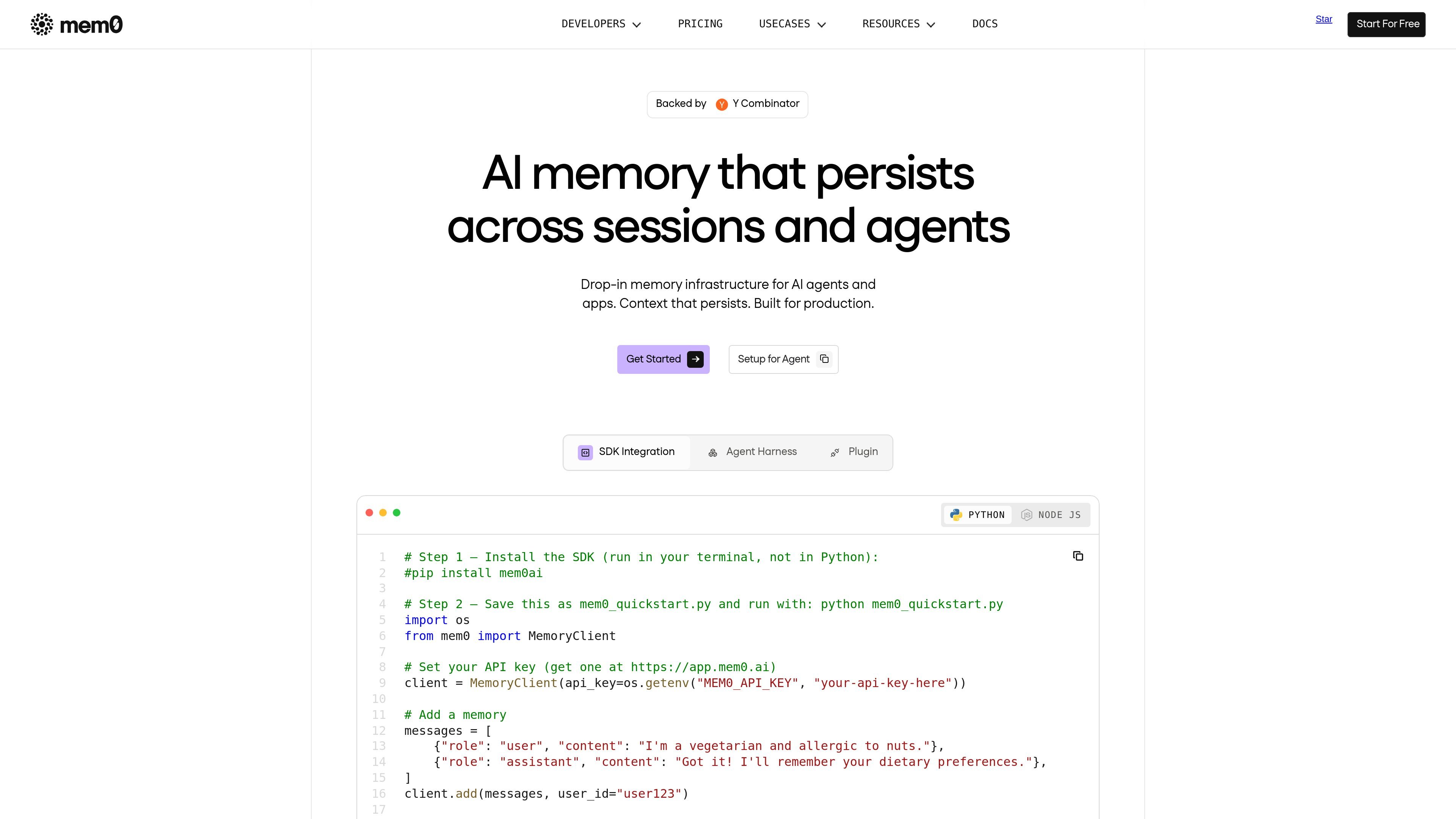
The product is presented through a simple developer workflow: install the SDK, create a MemoryClient, add conversational messages as memories, and later search them when the agent needs context. The site also shows research, education, healthcare, and sales-oriented use cases, plus enterprise options for governance, deployment flexibility, and auditability.
Mem0 adds persistent memory for agents and apps so they can carry context across sessions instead of starting from scratch each time.
The quickstart shows a simple flow: install the SDK, create a `MemoryClient`, add messages, and search by user ID. That makes the memory layer usable without rebuilding the app’s pipeline.
The home page describes a memory compression engine that condenses chat history into compact memories, which helps reduce token usage and latency.
The research page says retrieval uses multiple signals in parallel, including semantic similarity, keyword matching, and entity matching.
The pricing page includes graph memory, also labeled entity linking, which indicates support for linking related entities in stored memory.
The enterprise section lists governance, portability, and auditing features such as SOC 2, HIPAA, BYOK, zero-trust, Kubernetes, private cloud, air-gapped deployment, and read/write logs.
The education page shows AI tutors tracking student pace, learning style, strengths, and struggles over time so feedback and lesson recommendations reflect earlier progress instead of a single exchange.
The healthcare page shows patient-facing and clinician-facing agents remembering history, allergies, treatment preferences, and what has or has not worked across visits.
The home page positions Mem0 for sales and CRM workflows where agents need to track interactions, objections, and milestones across long sales cycles.
The research page highlights benchmarked memory retrieval and extraction, making the product relevant for teams evaluating token-efficient memory algorithms and agent infrastructure.
The home page and enterprise section show Mem0 as infrastructure for production apps that need persistent context, logging, and deployment control.
Mem0’s setup shown on the home page uses a Python SDK and a `MemoryClient`. The quickstart installs `mem0ai`, creates a client with an API key, adds messages as memory, and then searches those memories by user ID.
The pricing page presents Mem0 as a platform for AI memory with a free tier, paid plans, and an enterprise option. It also distinguishes Mem0’s platform from its open-source offering in the FAQ list, but the page text shown does not fully spell out those differences.
The pricing page distinguishes memory add requests from retrieval requests, and the home page shows both storing memories and searching them later. This suggests Mem0 is designed to capture user interactions and fetch relevant context when an agent needs it.
The home page and use-case pages show Mem0 being used for persistent context in agents and apps, including education and healthcare scenarios. It is positioned for teams that want AI systems to remember user preferences, history, or prior interactions across sessions.
The pricing page shows a free tier and paid plans, plus an enterprise contact path and usage-based pricing mention. The exact limits and what each plan includes are only partially visible in the provided page text.
Les données de trafic sont fournies à titre indicatif uniquement.

openmemory.dev
Mem0 est une couche de mémoire IA pour les agents et les applications. Elle conserve le contexte entre les sessions, retrouve les souvenirs pertinents et personnalise les réponses pour les workflows IA en production.

vectorize.io
Mémoire d’agents open source pour un contexte persistant et la récupération intersessions

trypolygraph.com
Polygraph est un méta-harnais pour agents de programmation IA, qui relie plusieurs dépôts en un graphe de travail unifié et préserve le contexte des sessions lors des transmissions.

www.coolplugz.com
CoolPlugz est une couche d’orchestration pour Claude Code qui rassemble le contexte, exécute des workflows structurés et aide à mener à bien des tâches de programmation avec moins de supervision constante. Elle s’adresse aux développeurs qui souhaitent limiter les changements de contexte entre Jira, GitHub, Slack, Notion et CI.

supermemory.ai
Supermemory ajoute une mémoire et un contexte persistants aux agents IA via API, plugins et applications.

xirp.spotify.com
Xirp relie vos services, responsables, documentation et décisions d’architecture afin que les sessions de codage avec l’IA s’appuient sur le contexte du système plutôt que sur des suppositions. Conçu pour les équipes utilisant des outils de développement agentique et Spotify Portal.