
System-aware agent sessions
Xirp is described as seeing the wider system around the code, not just the file being edited. The site says it can understand services, ownership, dependencies, and architectural decisions in every session.

Xirp relie vos services, responsables, documentation et décisions d’architecture afin que les sessions de codage avec l’IA s’appuient sur le contexte du système plutôt que sur des suppositions. Conçu pour les équipes utilisant des outils de développement agentique et Spotify Portal.
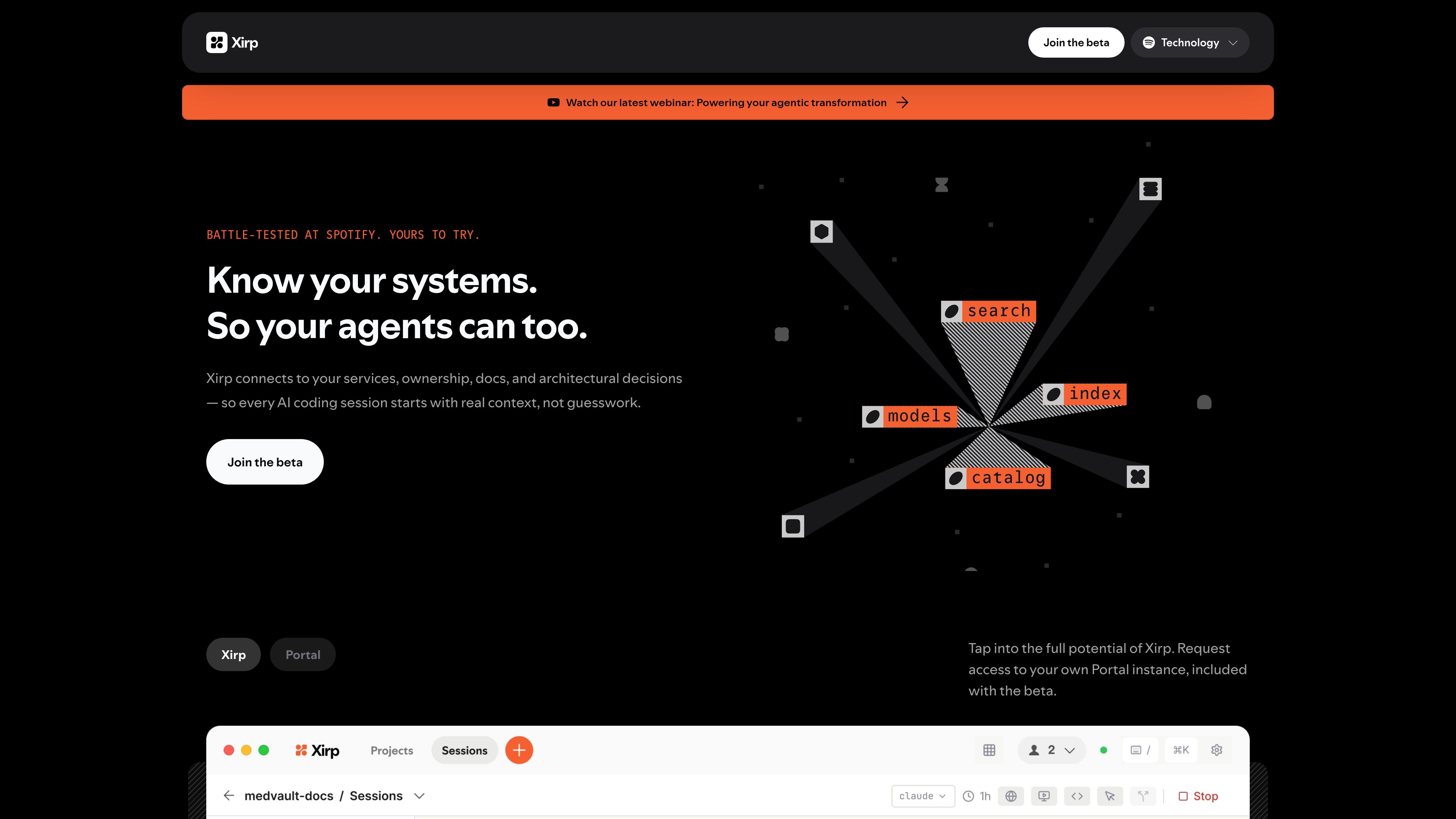
Xirp is an agentic development environment that gives AI coding sessions context about the system they are working in. According to the site, it connects to Portal so it can surface services, ownership, dependencies, and architectural decisions during a session, rather than leaving the model to infer them from the current file alone.
The product is positioned around a specific problem: AI tools can produce code quickly, but they may make decisions that are technically correct and operationally wrong when they lack organizational context. Xirp’s purpose is to keep that context available across sessions, so engineers and agents can work from shared knowledge instead of stale documents or scattered institutional memory.
Xirp is described as seeing the wider system around the code, not just the file being edited. The site says it can understand services, ownership, dependencies, and architectural decisions in every session.
Xirp connects to Portal and uses it as the context layer for teams. The site also describes Workspace as a Portal plugin that holds work items, sessions, and docs in one place.
When an engineer finishes a session, the context is stored so the next person or agent touching that system can start with the same background instead of rebuilding it from scratch.
The site says each coding session generates real knowledge that Xirp captures and turns into documentation, then feeds back into future sessions so context stays current as work continues.
Xirp is presented as a harness for the model you prefer. The site says it works with Claude, Gemini, and Codex, and that you can switch between them without losing context.
The product says sessions can run locally or remotely, which gives teams flexibility in how they use the environment while keeping the same shared context layer.
Teams can use Xirp when a new engineer needs to understand who owns a service, what depends on it, and why it was built a certain way before making changes.
Xirp is meant for coding sessions where an agent could otherwise make a change that looks correct in isolation but is wrong for the surrounding system.
When a session ends, Xirp stores the useful context so it can be reused by the next engineer or agent, reducing the need to rediscover the same decisions later.
The product is positioned for teams that do not want to rely only on READMEs, Confluence pages, or architecture diagrams that may lag behind the codebase.
Teams that switch between Claude, Gemini, and Codex can keep the same context layer in place, rather than rebuilding setup and system knowledge for each model.
Xirp is designed to give AI coding tools the system context they often lack. The site frames this as a retrieval problem: knowledge about ownership, dependencies, and architectural decisions exists, but is hard to find at the moment it is needed.
The site says Xirp connects to Portal and uses it to understand services, ownership, docs, dependencies, and architectural decisions. No broader integration list is provided on the public pages.
The public site says Xirp works with Claude, Gemini, and Codex.
Yes. The site says Xirp stores session context in Workspace so the knowledge is available to the next person or agent who works on that system.
No pricing details were available in the collected pages. The pricing URL returned a not-found page, so the public cost and plan structure could not be verified.
Les données de trafic sont fournies à titre indicatif uniquement.
| mai | 0 |
|---|---|
| juin | 0 |
| juil. | 143 |
Les analyses de trafic ne sont pas encore disponibles.

www.warp.dev
Warp est un environnement de développement agentique pour coder dans le terminal et le cloud, avec des offres pour particuliers, équipes et entreprises.

haystackeditor.com
Haystack est un outil de revue de code basé sur l’IA, conçu pour les workflows de pull requests. Il aide les équipes à trier les PR, à repérer les changements risqués et à attribuer les revues en s’appuyant sur les décisions consignées, les responsables et le contexte.

www.agentconnect.md
AgentConnect permet aux équipes d’intégrer des agents ACP comme Claude Code, Codex et Gemini CLI à Slack, Telegram, Discord et GitHub, afin qu’ils puissent prendre en charge des tâches dans les canaux où les équipes collaborent déjà. La solution est open source et auto-hébergeable, avec des rôles, des outils, une mémoire et des déclencheurs configurables pour les workflows des agents.

www.paritok.com
Paritok est une passerelle de compression pour les agents de codage IA. Elle compresse à la volée, sans altérer le contenu, les outils, les fichiers et l’historique des conversations, pour prolonger les sessions avec moins de tokens tout en gardant la possibilité de récupérer le contenu d’origine.

devin.ai
Devin est un agent de codage et un ingénieur logiciel doté d’IA pour les développeurs et les équipes d’ingénierie. Il propose un accès depuis un ordinateur, la CLI et les IDE, ainsi que des offres pour les équipes et les entreprises, avec des workflows d’agents cloud et des contrôles d’administration.

kiro.dev
Kiro est une plateforme d’ingénierie agentique et de développement IA pour développeurs et équipes, transformant les prompts en spécifications et facilitant l’implémentation et la validation via IDE, CLI et web.