
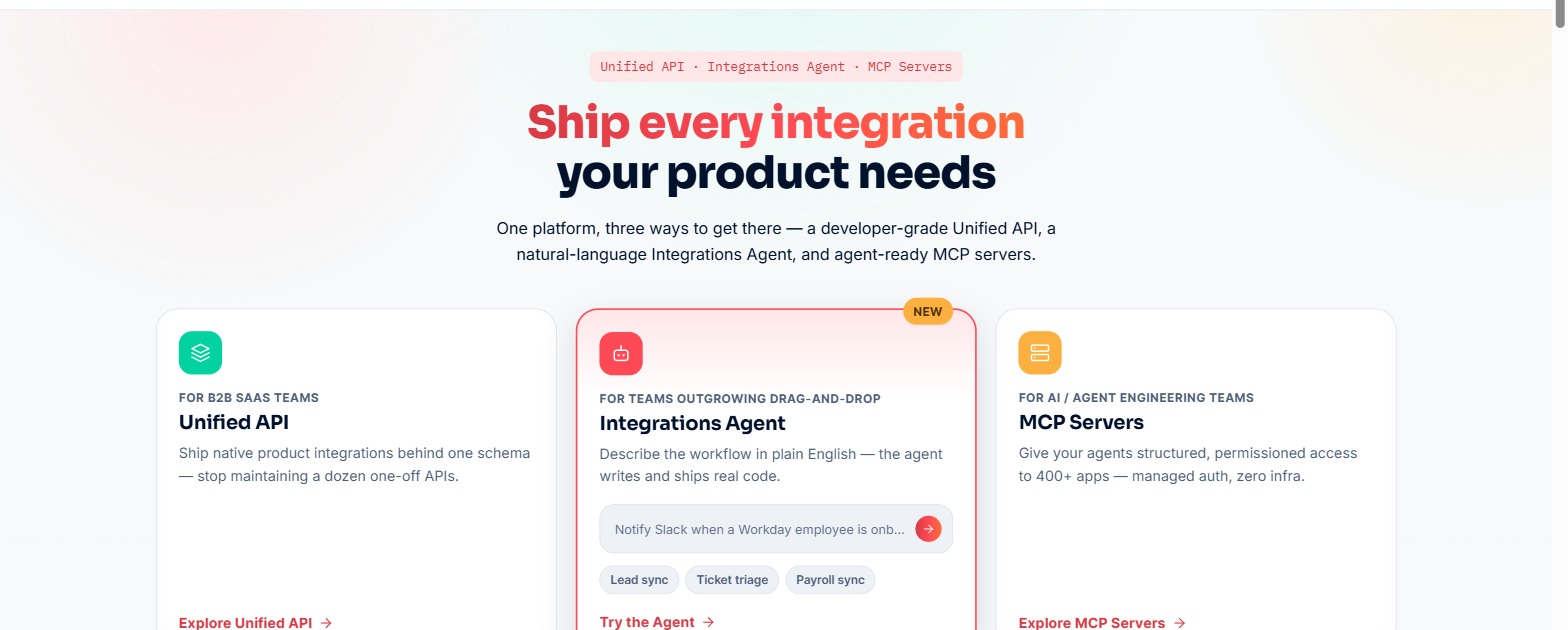
Unified API for bi-directional sync
Connect once to access a unified schema for read and write operations across supported app categories, rather than maintaining separate integrations for each provider.

Infrastructure d’intégration pour B2B SaaS, agents IA et clients MCP avec Unified APIs, MCP Servers et LLM Tools.
Knit is an integration infrastructure platform for B2B SaaS products, AI agents, and MCP clients. It combines Unified APIs, MCP Servers, and LLM Tools so teams can connect to third-party software through a single platform instead of building separate integrations for each app.
The site positions Knit as a way to add and run native product integrations, with support for bi-directional data sync, managed authentication, and AI-oriented tool access. Its pricing and FAQ pages describe plans for startups, larger teams, and AI integration use cases, along with a developer workflow that is API-first and language-agnostic.
Connect once to access a unified schema for read and write operations across supported app categories, rather than maintaining separate integrations for each provider.
Use managed authentication, Magic Links, and an embedded auth component so end users can authorize integrations without custom credential handling in your application.
Ship AI-facing integrations with LLM-ready tools, descriptive tool metadata, and framework-agnostic support for agent workflows.
Create or use MCP Servers to expose SaaS actions to AI clients, with Knit describing managed auth and serverless access patterns.
Control sync behavior with options such as configurable frequency, webhook-style delivery, filters, field mappings, and custom object handling on higher tiers.
Monitor integration health with logs, issue alerts, error messages in the auth component, and account management tools.
Access the platform through REST/HTTP APIs, with a Postman collection and a React SDK for the Connect component.
Build product integrations for SaaS customers without creating and maintaining a separate connector for every third-party app.
Give AI agents access to external systems with LLM-ready tools, managed auth, and actions such as syncing data or triggering workflows.
Expose MCP servers for clients that need code-free, serverless access to SaaS tools and managed access control.
Add read and write sync flows for data such as contacts, tasks, candidate notes, or employee records where supported by the source system.
Support teams that need configurable sync frequency, filters, field mappings, or custom objects as integration requirements become more specific.
Knit is an API-first integration infrastructure platform. It gives developers a single way to connect B2B SaaS products, AI agents, and MCP clients to third-party apps through Unified APIs, MCP Servers, and LLM-ready tools.
Knit states that it offers three main product lines: Unified APIs for bi-directional sync, MCP Servers for code-free access to SaaS tools, and LLM Tools for AI agents that need ready-made integrations.
The pricing page shows multiple paths: Start Up, Scale Up, Enterprise, Launchpad, Individual, and Enterprise for AI integrations. Several plans are self-serve, while higher tiers route users to sales or a demo.
Knit’s FAQ says it is API-first and language-agnostic. It provides REST/HTTP access, a Postman collection for testing, and a React SDK for the Connect component.
Knit’s FAQ describes authentication as a managed flow with redirect URIs, secure token exchange, and background refreshes. It also offers Magic Links and an embedded auth component for user authorization.
Les données de trafic sont fournies à titre indicatif uniquement.

useparagon.com
Infrastructure d’intégration pour produits SaaS et IA natifs
omlx.ai
oMLX est un serveur d’inférence LLM natif pour macOS, basé sur MLX, qui exécute localement sur Apple Silicon des modèles compatibles de langage, vision-langage, embeddings et reranking. Conçu pour les workflows d’agents de programmation, il fonctionne avec Claude Code, OpenClaw, Cursor et les clients compatibles avec OpenAI.

maritime.sh
Maritime est une plateforme pour déployer, gérer et faire évoluer des agents IA avec des micro-VM isolées et un point de terminaison API actif. Elle permet de créer des agents destinés aux clients, des workflows personnalisés et des déploiements par client.

www.cybedefend.com
CybeDefend est une plateforme de sécurité du code conçue pour les workflows de programmation avec l’IA. Sa couche VibeDefend examine les prompts des agents et les diffs, applique les règles du projet et de l’entreprise, protège contre les actions risquées et regroupe les analyses du code, des dépendances, des secrets, de l’infrastructure et du CI/CD avant une pull request.

superagent.sh
Sécurité IA pour le code et les agents, avec détection et correction continues des vulnérabilités via pull requests.

dedaluslabs.ai
Dedalus Labs fournit des machines Linux persistantes pour les workflows d’agents, avec démarrage rapide, état conservé et contrôle via CLI. La facturation porte sur le calcul actif ; l’inactivité et le stockage sont gratuits.