
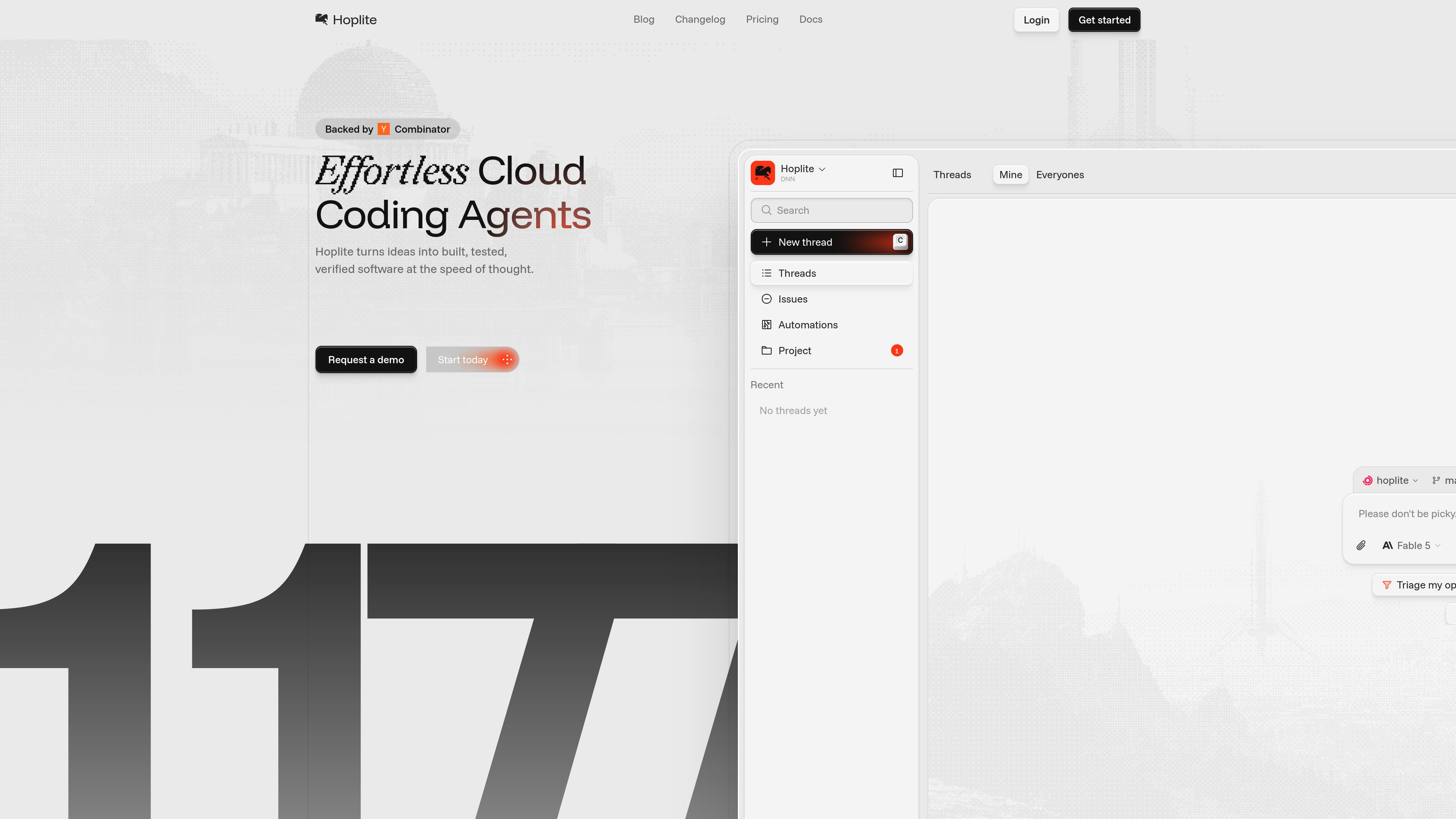
Repository-scoped agent threads
Users create a project from a GitHub repository and start a thread for a specific task. The thread keeps the conversation, agent runs, diffs, and pull requests together in one place.

Hoplite est une plateforme d’agents de programmation qui exécutent des tâches dans des environnements de développement isolés et peuvent ouvrir des pull requests une fois celles-ci terminées. Elle s’adresse aux équipes qui souhaitent déléguer le travail sur leurs dépôts à des agents, avec des retours et des validations en temps réel.
Hoplite is a coding agent platform for delegating repository tasks to agents that run in isolated development environments. Users connect a GitHub repository, start a thread, and describe the work they want done.
The agent can read and edit code, run commands, start the dev server, check its work in a browser, and open a pull request when the task is finished. The workflow is designed to make agent execution visible and reviewable rather than hidden behind a static diff.
The product is organized around workspaces, projects, threads, runs, and sandboxes. That structure lets teams scope agent work to a repository, follow progress in context, and review changes before they land.
Users create a project from a GitHub repository and start a thread for a specific task. The thread keeps the conversation, agent runs, diffs, and pull requests together in one place.
Each thread runs in a sandboxed dev environment cloned from the repo, with setup scripts and environment variables applied. This gives the agent a full environment for installs, builds, and test runs.
Tool calls stream into the thread as they happen, and sensitive actions can pause for approval before executing. That makes it easier to see what the agent is doing and to control changes when needed.
The agent can start a live preview of the app and check its work in a built-in browser. The changelog also shows ongoing preview improvements, which suggests previews are a core part of the workflow.
When a task is complete, the agent can open a pull request and continue iterating as reviews come in. This makes the output suitable for standard GitHub review workflows.
The docs mention shared workspaces, member roles, Slack and Linear integrations, and automations that can run agents on webhooks and schedules.
A developer can connect a repo, describe a change in a thread, and let the agent work through the implementation in an isolated environment before it opens a pull request.
Teams that want the agent to do more than edit files can use the sandbox to run test suites, start the app, and confirm the result in a browser before review.
Because threads keep messages, diffs, approvals, and PRs together, Hoplite fits teams that want agent output to stay visible and easy to inspect during review cycles.
The docs mention automations that can launch agent runs from webhooks and schedules, which suits routine tasks such as scheduled checks or event-driven follow-up work.
Shared workspaces and member roles make the product suitable for teams that want multiple people to coordinate agent work around the same repositories and billing context.
Hoplite is a coding agent platform that lets you delegate repository work to agents in a real dev environment. The agent can edit code, run tests, start the app, verify changes, and open a pull request.
According to the docs, you sign in, connect GitHub, choose a repository, and send a message in a thread describing the task you want done.
Yes. The docs say each thread runs in an isolated sandbox cloned from the repository, with setup scripts and environment variables applied.
Yes. The platform is described as shipping pull requests when the work is done, and the thread keeps the PR linked to the agent run and discussion.
The pricing page shows paid per-seat plans with pooled sandboxes and prepaid credits, plus an enterprise option with custom pricing.
Les données de trafic sont fournies à titre indicatif uniquement.
| mai | 0 |
|---|---|
| juin | 0 |
| juil. | 233 |
Les analyses de trafic ne sont pas encore disponibles.

agentgrid.sh
AgentGrid est une application de bureau qui permet de gérer plusieurs agents IA sur un canevas infini, avec terminaux, navigateurs, notes et outils de code dans le même espace de travail. Elle s’adresse aux développeurs qui orchestrent visuellement des tâches parallèles d’agents sur macOS, Windows et Linux.

cubic.dev
cubic est une plateforme de revue de code basée sur l’IA pour les bases de code complexes. Elle aide les équipes à détecter les bugs dans les pull requests et à analyser les dépôts avant fusion ou mise en production.

minimaxi.com
MiniMax est une plateforme d’intelligence artificielle généraliste qui propose de grands modèles multimodaux, une plateforme ouverte pour les développeurs et des produits par abonnement pour les particuliers et les équipes. Elle convient aux utilisateurs qui ont besoin de coder, d’exécuter des tâches avec des agents, de traiter des contenus multimodaux et d’intégrer des applications natives de l’IA.

conductor.build
Conductor est une app Mac qui exécute en parallèle les agents Claude Code, Codex et Cursor dans des espaces de travail isolés, afin de déléguer des tâches, examiner les diffs et fusionner localement.

tessl.io
Tessl est une plateforme d’habilitation des agents qui fournit aux agents de programmation un contexte structuré et versionné ainsi qu’une couche de compétences gouvernée. Elle aide les équipes à créer et gérer des logiciels natifs de l’IA avec les offres Free, Team et Enterprise.

cosyra.com
Cosyra est un terminal cloud mobile destiné aux développeurs qui souhaitent exécuter des agents de programmation IA depuis un iPhone ou un appareil Android sans gérer leur propre VPS. Il fournit un espace de travail Ubuntu isolé, un stockage persistant et une facturation avec votre propre clé API.