
Unified schema composition
Compose services, databases, and APIs into a single federated graph so teams can manage multiple backends through one API layer.

Plateforme de gestion d’API GraphQL pour graphes fédérés, gouvernance, observabilité et déploiement auto-hébergé.
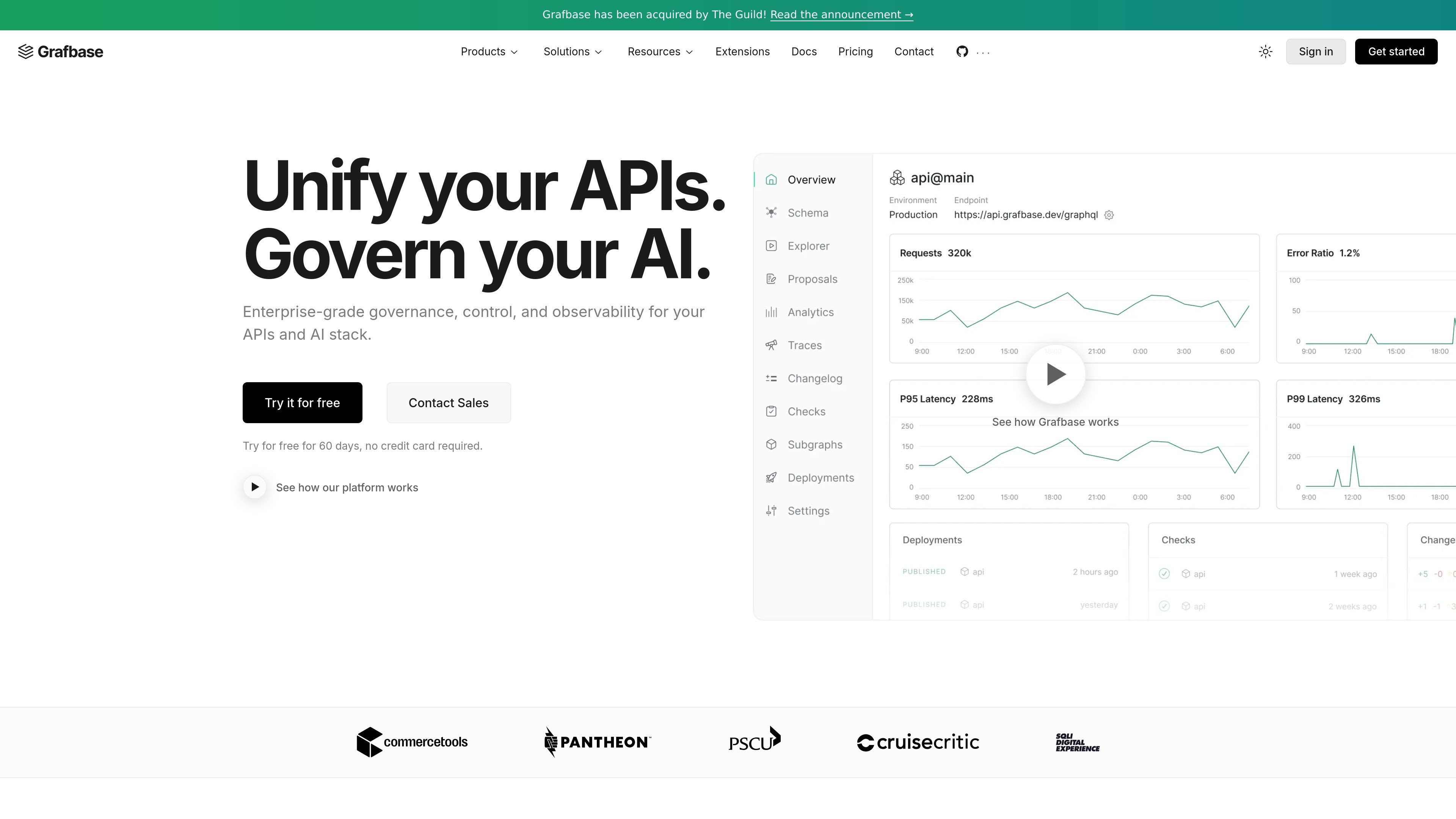
Grafbase is a GraphQL API management platform for building and operating federated graphs across multiple data sources. The product is positioned around governance, control, observability, and performance for enterprise API and AI workloads.
The platform combines a federated GraphQL gateway, schema management, security features, observability tooling, and deployment flexibility. It supports self-hosted enterprise deployment, and the public docs describe Helm-chart-based installation on Kubernetes with supporting services such as Postgres, ClickHouse, Kafka, Zitadel, and S3-compatible storage.
Compose services, databases, and APIs into a single federated graph so teams can manage multiple backends through one API layer.
Use schema proposals, approval workflows, and schema checks to coordinate changes and reduce breaking updates across teams.
Apply rate limiting, trusted documents, SAML SSO, fine-grained access control, authentication, authorization, and access logging to protect the gateway.
Use logs, metrics, traces, telemetry, and custom access log messages to monitor and debug federated graphs.
Customize gateway behavior with Rust-based WebAssembly extensions for authentication, authorization, resolvers, and integrations with external services.
Deploy in cloud, hybrid, fully air-gapped on-prem, or self-hosted Kubernetes environments depending on operating requirements.
Unify services, databases, and APIs into a federated graph when a team needs a single GraphQL layer over multiple data sources.
Coordinate schema changes across multiple teams using schema proposals, approvals, and checks to catch breaking changes before they reach production.
Host the platform inside your own infrastructure when regulatory or internal security requirements call for self-hosted control.
Extend gateway behavior with custom authentication, authorization, or resolver logic when default gateway behavior is not enough.
Add observability and access controls for production federated graphs that need logging, metrics, traces, and document-based access policies.
The source says the Grafbase Enterprise Platform is self-hosted, runs in your infrastructure, and is distributed via Helm charts that can be installed on Kubernetes clusters. The public docs also mention a Grafbase CLI for building and deploying extensions.
The pricing page says the platform offers a 60-day free trial with no credit card required. After the trial, users are invited to contact sales to discuss the right plan.
Yes. The pricing page says customers can switch between self-hosted and cloud control planes at any time.
The self-hosting docs list Postgres, ClickHouse, Zitadel, Kafka, OpenTelemetry Collector, and an S3-compatible object store such as MinIO as part of the enterprise platform architecture. MinIO is described as optional because any S3-compatible storage can be used.
The docs say Grafbase extensions are written in Rust and compiled into WebAssembly modules. The gateway loads them automatically at startup through configuration, and extensions can be used for custom authentication, authorization, and resolver logic.
Les données de trafic sont fournies à titre indicatif uniquement.

www.dograh.com
Dograh est une plateforme open source et auto-hébergeable pour créer et déployer des agents vocaux en production. Elle relie téléphonie, voix, modèles de langage, synthèse vocale, workflows et observabilité sur votre infrastructure ou son cloud géré.

relaticle.com
Relaticle est un CRM open source pour les équipes qui réunit des fiches partagées, la gestion du pipeline et des tâches, un chat IA intégré et un serveur MCP doté de 39 outils. Les équipes peuvent utiliser l’espace de travail hébergé ou auto-héberger l’application AGPL-3.0 et connecter des agents IA externes via MCP et l’API REST.

baserow.io
Baserow est une plateforme de base de données open source et no-code pour créer bases de données, applications, tableaux de bord et automatisations, dans le cloud ou en auto-hébergement.

dash0.com
Dash0 est une plateforme d’observabilité native OpenTelemetry pour les logs, métriques, traces, tableaux de bord et alertes. Elle aide les développeurs, SRE et ingénieurs plateforme à analyser les services et à maîtriser les coûts de télémétrie grâce à une tarification à l’usage.

webiny.com
CMS headless open source et auto-hébergé pour contenus, sites web et fichiers

vdf.ai
VDF AI est une plateforme d’orchestration d’agents IA pour les entreprises, qui coordonne agents, modèles, outils, recherche et workflows sous une gouvernance centralisée. Elle s’utilise en service cloud géré ou se déploie dans un cloud privé, un centre de données, un environnement souverain, un compte AWS ou une infrastructure isolée.