
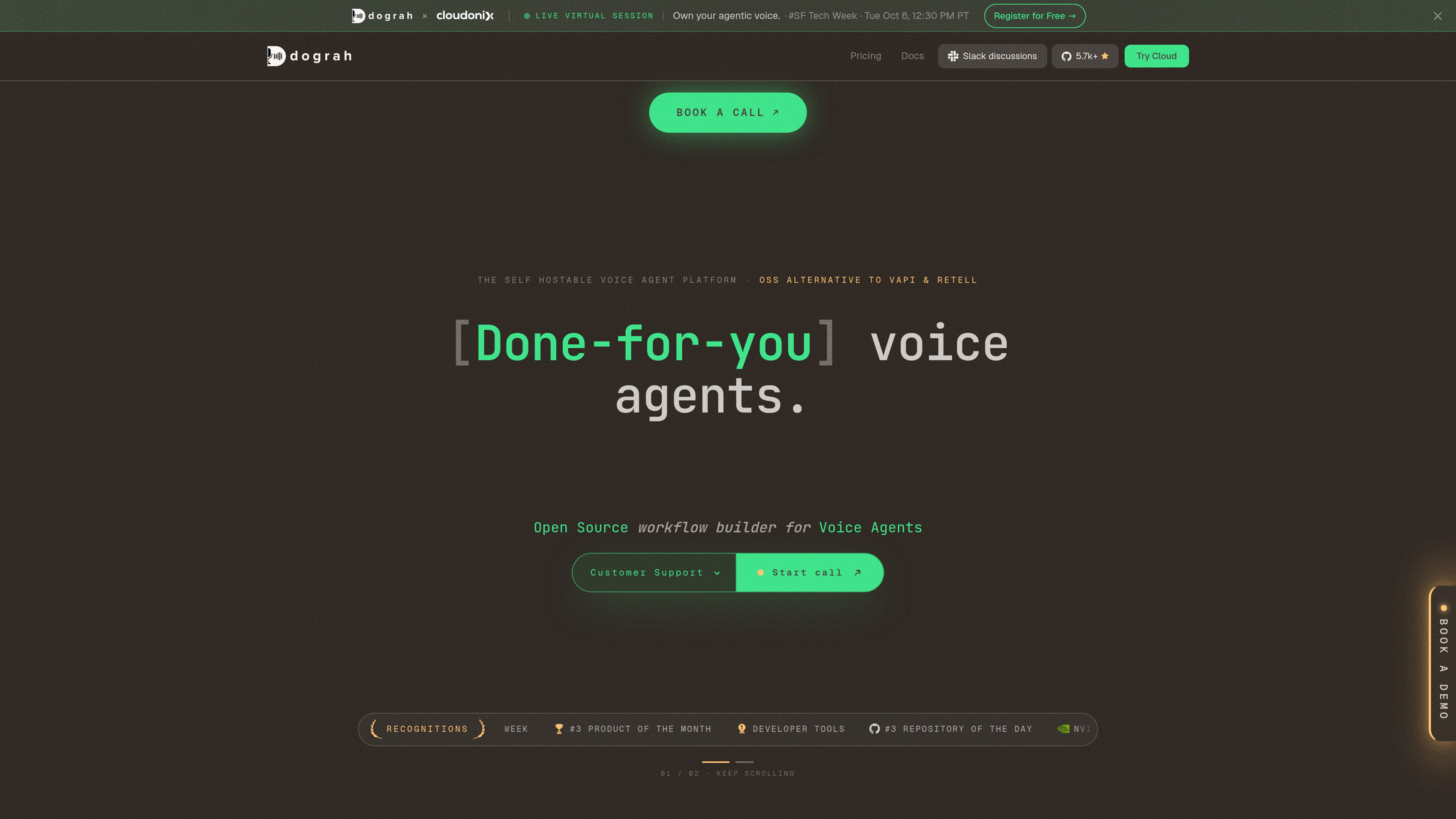
Visual voice-agent workflow builder
Build production voice agents with a no-code workflow builder for inbound and outbound calling. Workflows can include call logic, webhooks, and pre-call steps such as fetching CRM context.

Dograh est une plateforme open source et auto-hébergeable pour créer et déployer des agents vocaux en production. Elle relie téléphonie, voix, modèles de langage, synthèse vocale, workflows et observabilité sur votre infrastructure ou son cloud géré.
Dograh is an open-source, self-hostable platform for building production voice agents. Its workflow builder connects telephony with speech-to-text, language models, text-to-speech, webhooks, and related call logic, while also supporting direct speech-to-speech pipelines.
Organizations can run the stack on their own servers, inside a private cloud or VPC, or use Dograh’s managed cloud. The platform is positioned for teams that want control over model providers and data location, including regulated organizations with requirements around data residency and auditability.
Build production voice agents with a no-code workflow builder for inbound and outbound calling. Workflows can include call logic, webhooks, and pre-call steps such as fetching CRM context.
Select providers for telephony, speech-to-text, language models, and text-to-speech, or replace the multi-step cascade with a speech-to-speech model. The site lists integrations including OpenAI, Google, Groq, OpenRouter, Azure, AWS, Hugging Face, Plivo, Telnyx, Twilio, Vonage, Asterisk, and multiple speech providers.
Dograh ships a Model Context Protocol server that lets compatible clients such as Claude Code, OpenClaw, Cursor, and Codex create, modify, and deploy voice agents from an IDE or agent runtime.
Audio-to-audio pipelines avoid the text round trip of a conventional STT, LLM, and TTS cascade. Dograh describes this mode as supporting real-time turn-taking and interruption handling, with Gemini and GPT Realtime options shown on the site.
Agents can combine prerecorded voice clips with live text-to-speech in the same cloned voice. A prerecorded line is used when it fits the interaction, with TTS available for responses that require generation.
The full stack can run on a customer’s servers, in a private cloud or VPC, or in a fully air-gapped environment. Dograh also offers managed cloud and private-cloud operations, with the private option keeping deployment inside the customer’s environment.
Create inbound or outbound support agents that handle voice interactions using configurable call workflows and connected telephony providers.
Use voice agents to contact or respond to property leads, gather qualifying information, and automate an initial lead-generation workflow.
Build outbound calling flows for activities such as sales outreach, event invitations, or EMI reminder and soft-collection scripts.
Use voice agents for patient scheduling, reminders, support automation, or law-firm call intake and routing, with deployment options intended for organizations managing sensitive information.
Deploy claim-status, banking, fintech, or public-sector voice workflows within an organization’s infrastructure when data residency and an existing compliance perimeter are important considerations.
Dograh can be run on the customer’s own servers, used as a managed cloud service, or deployed and operated inside the customer’s VPC. The site also describes fully air-gapped and in-perimeter deployments for supported environments.
Yes. Dograh is designed around bringing your own models and selecting providers for telephony, speech-to-text, language models, and text-to-speech. The site also lists self-hosted options such as Whisper, Voxtral, Kokoro, and Chatterbox; it notes that LLM swapping for self-hosted models is in beta.
Dograh provides an MCP server that compatible clients can use to create, modify, and deploy voice agents. The site names Claude Code, OpenClaw, Cursor, and Codex as examples of clients or runtimes that can connect to it.
Yes. In addition to the conventional STT-to-LLM-to-TTS cascade, Dograh supports speech-to-speech pipelines in which audio is sent in and audio is returned directly.
The self-hosted open-source platform is described as free forever with no platform limits. Dograh also offers managed options, including usage-based cloud service, committed volume, and custom private or on-premise plans.
Les données de trafic sont fournies à titre indicatif uniquement.

thunderphone.com
ThunderPhone est une plateforme d’agents téléphoniques IA permettant de créer, tester et déployer des agents vocaux pour les appels entrants, sortants et passés depuis le web ou une application. Elle s’adresse aux équipes qui ont besoin d’une gestion des appels en production intégrant téléphonie, prise en charge des langues et workflows au sein d’une même pile.

vdf.ai
VDF AI est une plateforme d’orchestration d’agents IA pour les entreprises, qui coordonne agents, modèles, outils, recherche et workflows sous une gouvernance centralisée. Elle s’utilise en service cloud géré ou se déploie dans un cloud privé, un centre de données, un environnement souverain, un compte AWS ou une infrastructure isolée.

baserow.io
Baserow est une plateforme de base de données open source et no-code pour créer bases de données, applications, tableaux de bord et automatisations, dans le cloud ou en auto-hébergement.

ycode.com
Ycode est un créateur de sites web et un CMS open source pour concevoir, héberger et mettre à jour des sites personnalisés, avec auto-hébergement, Ycode Cloud et workflows pour agences.

relaticle.com
Relaticle est un CRM open source pour les équipes qui réunit des fiches partagées, la gestion du pipeline et des tâches, un chat IA intégré et un serveur MCP doté de 39 outils. Les équipes peuvent utiliser l’espace de travail hébergé ou auto-héberger l’application AGPL-3.0 et connecter des agents IA externes via MCP et l’API REST.

dash0.com
Dash0 est une plateforme d’observabilité native OpenTelemetry pour les logs, métriques, traces, tableaux de bord et alertes. Elle aide les développeurs, SRE et ingénieurs plateforme à analyser les services et à maîtriser les coûts de télémétrie grâce à une tarification à l’usage.