
Trace ingestion from observability tools
Connects to Langfuse, Braintrust, Datadog, or a custom trace source and ingests conversation data automatically on a nightly cadence.

Améliorez les agents IA grâce à l’analyse des traces, la détection des échecs et des pull requests validées.
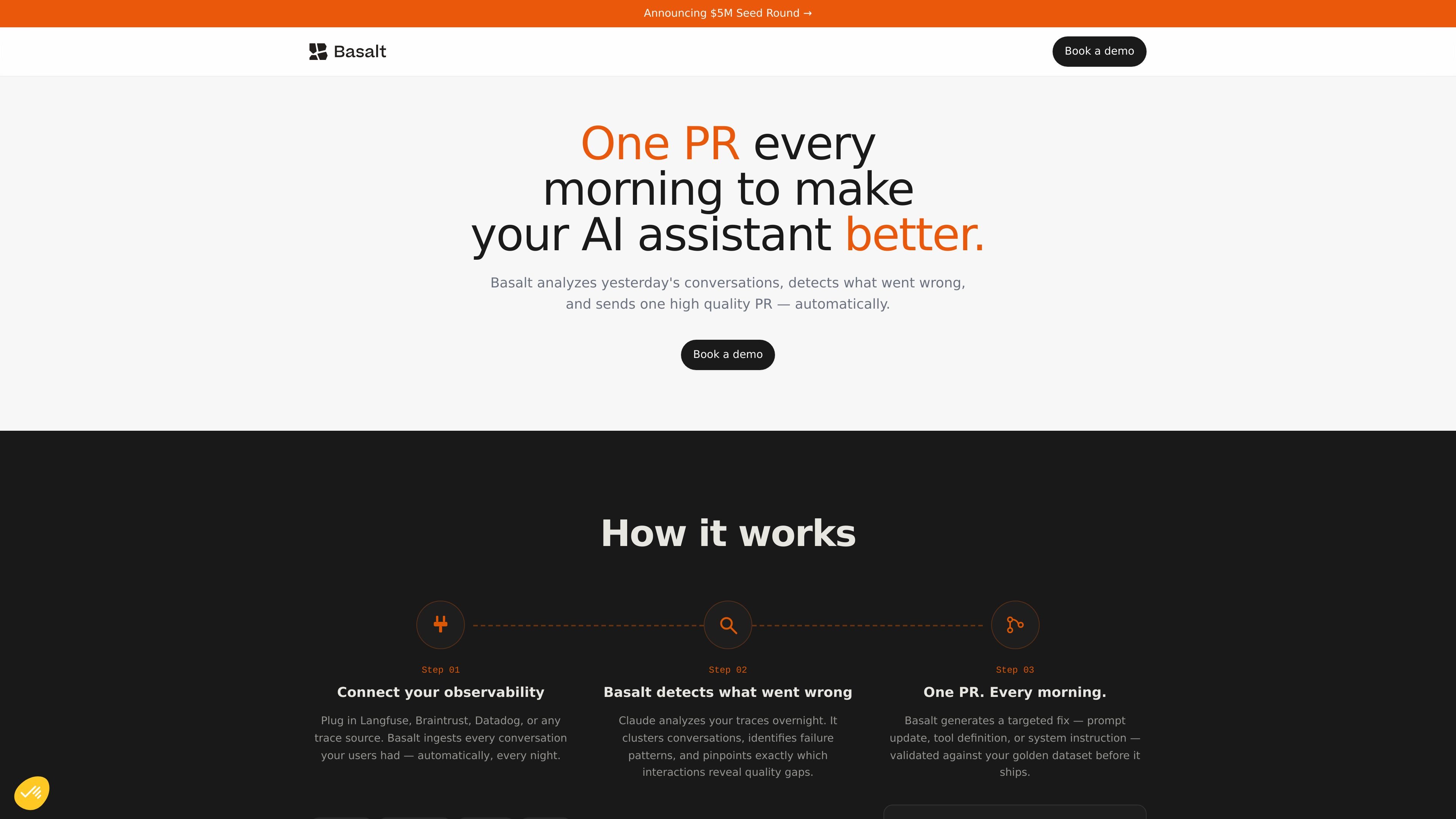
Basalt is a product for improving AI agents from real user interactions. It connects to observability or trace sources, reads the previous day’s conversations, and identifies recurring failure patterns that point to where an agent’s behavior needs adjustment.
When it finds a problem, Basalt generates a targeted pull request that can change a prompt, tool definition, or system instruction. Before the PR is opened, the proposed fix is validated against a golden dataset so existing behavior is checked for regressions.
Connects to Langfuse, Braintrust, Datadog, or a custom trace source and ingests conversation data automatically on a nightly cadence.
Uses Claude to cluster conversations, detect failure patterns, and identify which interactions point to quality gaps.
Generates a focused PR that can update a prompt, tool definition, or system instruction based on the detected issue.
Runs each generated fix against a golden dataset before the PR is opened, blocking changes that introduce regressions.
Positions the product as an automated review loop that does not rely on LLM-as-a-judge or manual annotation.
Sends one high-quality PR every morning from the previous day’s user behavior, keeping the workflow tied to recent interactions.
Teams that already record traces in observability tools can connect those sources and let Basalt scan conversations overnight for recurring errors.
When the same misunderstanding or tool-use mistake keeps appearing, Basalt can generate a focused PR that targets the affected behavior pattern.
Teams that maintain golden datasets for expected behavior can use Basalt’s validation step to check that a proposed fix does not regress known good cases.
Organizations that want prompt or tool updates without hand-writing every change can use Basalt to propose modifications based on real user behavior.
Teams looking for a lightweight improvement loop can review one daily PR rather than manually sorting through every interaction.
Basalt ingests conversations from connected observability sources, analyzes them overnight, and turns repeated failure patterns into a targeted PR. The homepage says it can generate prompt updates, tool definition changes, or system instruction changes, then validate the fix against a golden dataset before opening the PR.
The homepage explicitly names Langfuse, Braintrust, Datadog, and a custom trace source as connection options. It presents Basalt as working on traces from those sources rather than requiring manual annotation.
Basalt is positioned around improving agent behavior from real user conversations. The page highlights system prompts, tool definitions, and few-shot examples as the parts it can change when it finds a failure pattern.
The homepage says Basalt runs fixes against a golden dataset before a PR is opened and blocks the PR if regressions appear. It also states there is no LLM-as-a-judge and no manual annotation in the main workflow.
The pricing section says you only pay when you merge a PR, with the first 3 PRs free and no subscription or commitment. It also notes pricing applies per merged PR per repository and that volume discounts are available for teams merging 20+ PRs per month.
Les données de trafic sont fournies à titre indicatif uniquement.

hoplite.sh
Hoplite est une plateforme d’agents de programmation qui exécutent des tâches dans des environnements de développement isolés et peuvent ouvrir des pull requests une fois celles-ci terminées. Elle s’adresse aux équipes qui souhaitent déléguer le travail sur leurs dépôts à des agents, avec des retours et des validations en temps réel.

blopai.com
Blop est un agent QA qui écrit des tests navigateur dans votre dépôt, les exécute en CI, regroupe les échecs récurrents et peut ouvrir des pull requests pour corriger les tests défaillants.

latitude.so
Latitude est une plateforme open source d’observabilité et de supervision des agents IA. Elle aide les équipes à inspecter les traces de production, détecter les problèmes et vérifier les correctifs, avec tracing basé sur OpenTelemetry, alertes, recherche de sessions et workflows d’évaluation.

hacktron.ai
Revue de code et sécurité applicative par IA pour détecter les vulnérabilités exploitables dans les pull requests

cubic.dev
cubic est une plateforme de revue de code basée sur l’IA pour les bases de code complexes. Elle aide les équipes à détecter les bugs dans les pull requests et à analyser les dépôts avant fusion ou mise en production.

lmnr.ai
Plateforme d’observabilité open source pour agents IA, avec traçage, détection des erreurs, évaluations, alertes Slack et auto-hébergement.