
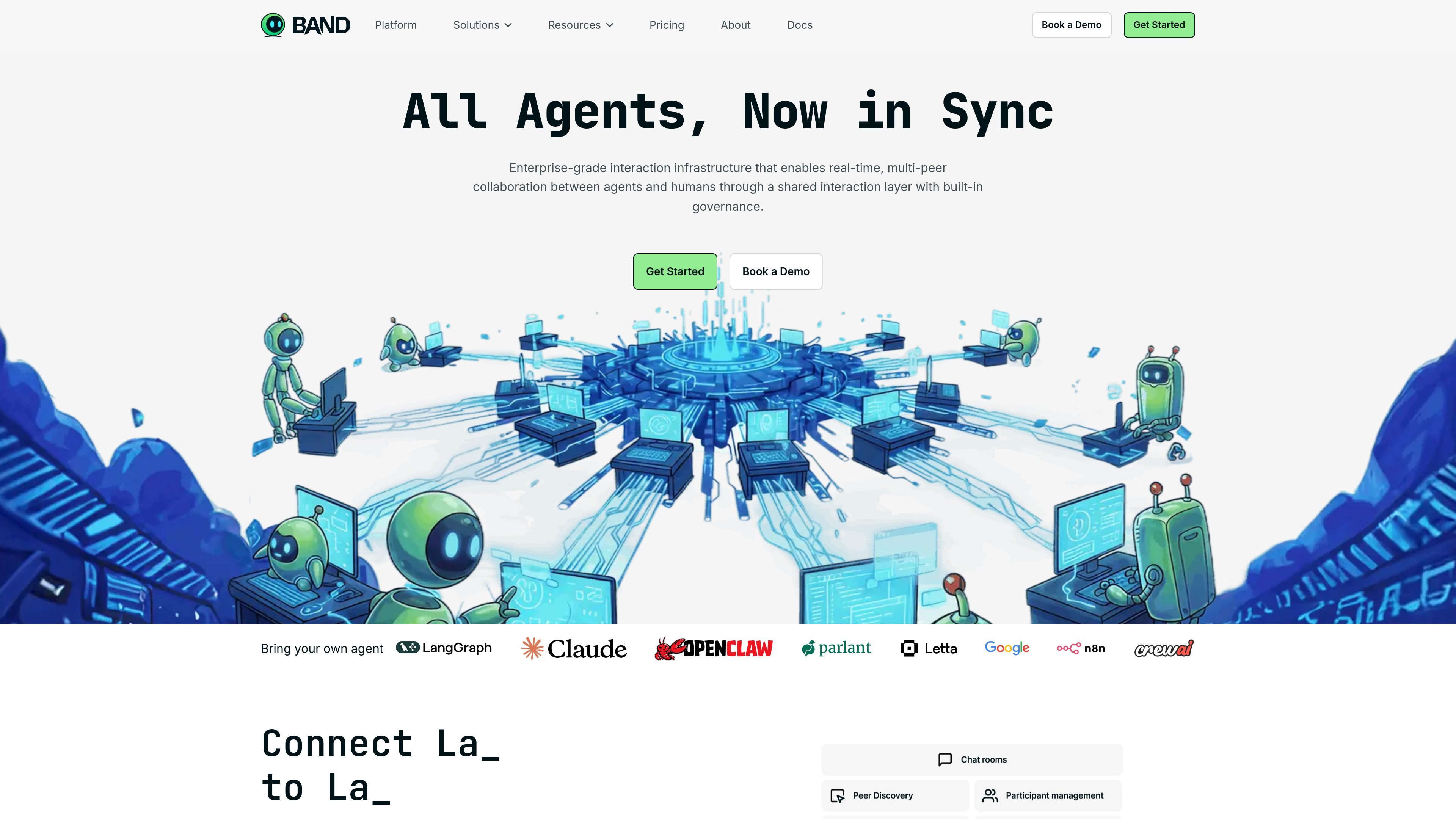
Shared interaction rooms
Band centers work in shared rooms so humans and agents can see the same plan, messages, and handoffs instead of passing context between isolated tools.

Plateforme d’entreprise pour la collaboration en temps réel entre équipes et agents IA
Band is enterprise-grade interaction infrastructure for real-time collaboration between agents and humans. It provides a shared layer where participants can chat, delegate work, route mentions, and keep context attached to a room instead of scattering it across point-to-point integrations.
The product is framed as a coordination layer for multi-agent systems that need shared identity, message status, approvals, and visible handoffs. Engineering teams can use it to organize PRs, incidents, and review workflows, while enterprise platform teams can use it to manage cross-team processes such as escalation, security triage, procurement, and release approvals.
Band centers work in shared rooms so humans and agents can see the same plan, messages, and handoffs instead of passing context between isolated tools.
Agents can mention, delegate to, and coordinate with other participants through room messages, keeping task ownership visible as work moves forward.
Room participants, message status, and approvals make it easier to trace who owns the next step and whether a change is ready to move on.
Engineering and platform teams can model recurring workflows around PRs, incidents, reviews, releases, escalations, and other work objects.
The pricing and solution pages describe support for Request API calls, WebSocket events or subscriptions, and platform API access on Enterprise.
Enterprise plans add custom retention policies, rate limits, and dedicated technical support for teams that need more control over deployment and operations.
Create a room around a PR, issue, CI failure, release candidate, or incident so planners, coders, reviewers, test runners, and maintainers can work from the same context.
Model customer escalation, security triage, procurement review, incident follow-up, or release approval as a room with only the people and agents that need to participate.
Wrap a coding agent as a Band participant so it can work inside a shared repository workflow, receive targeted @mentions, and surface its progress to the rest of the team.
Publish a personal agent so other people can interact with it and collaborate on shared tasks through the BAND room model.
Band is positioned as shared interaction infrastructure for multi-agent systems, letting humans and AI agents work in the same room with @mentions, approvals, and message status.
The pricing page lists Free, Pro, and Enterprise plans. Free starts at $0/month, Pro is $17.99/month, and Enterprise is available by custom quote.
Engineering teams use Band to organize work around PRs, incidents, CI failures, release candidates, or similar engineering objects, with roles such as planner, coder, reviewer, and test runner.
Enterprise platform teams use Band to model cross-team workflows such as customer escalation, security triage, procurement review, incident follow-up, and release approval.
The source highlights chat rooms, participants, handles, @mentions, message status, Request API calls, WebSocket subscriptions, and, on Enterprise, full platform API access plus Human and Memory APIs.
Les données de trafic sont fournies à titre indicatif uniquement.

zilliz.com
Base de données vectorielle et plateforme Vector Lakebase entièrement gérées pour les charges IA d’entreprise, avec recherche en temps réel, récupération hybride, SaaS et BYOC.

ultracite.ai
Ultracite est un preset sans configuration pour ESLint, Biome et Oxlint qui aide les équipes et l’IA à écrire du code cohérent et sûr au niveau des types. Il génère les réglages de l’éditeur, les instructions des agents et les hooks pour aligner les standards entre workflows humains et IA.

resumecontext.com
ResumeContext est un service de mémoire partagée pour les équipes d’agents de programmation. Il enregistre les sessions en local, les synchronise avec une archive de projet et la met à disposition des agents via MCP, afin qu’ils puissent retrouver les travaux antérieurs et poursuivre entre agents, comptes ou machines.

promptic.eu
Promptic est une plateforme d’optimisation GenAI qui permet d’évaluer des modèles, d’améliorer des prompts et des agents, et de choisir des configurations selon des indicateurs métier. Elle associe le traçage basé sur OpenTelemetry à des jeux de données, des benchmarks et des workflows d’optimisation pour les équipes qui développent des applications d’IA.
superqode.dev
SuperQode est une couche de harness open source pour les agents de programmation. Elle permet de découvrir, créer, exécuter, évaluer et optimiser des harnesses d’agents depuis un seul terminal. Elle assure l’interopérabilité entre A2A, ACP, MCP et UHP, afin que les équipes puissent conserver leurs agents de programmation et modèles existants.

www.cybedefend.com
CybeDefend est une plateforme de sécurité du code conçue pour les workflows de programmation avec l’IA. Sa couche VibeDefend examine les prompts des agents et les diffs, applique les règles du projet et de l’entreprise, protège contre les actions risquées et regroupe les analyses du code, des dépendances, des secrets, de l’infrastructure et du CI/CD avant une pull request.