Writesonic logo

Writesonic

Revendiquer

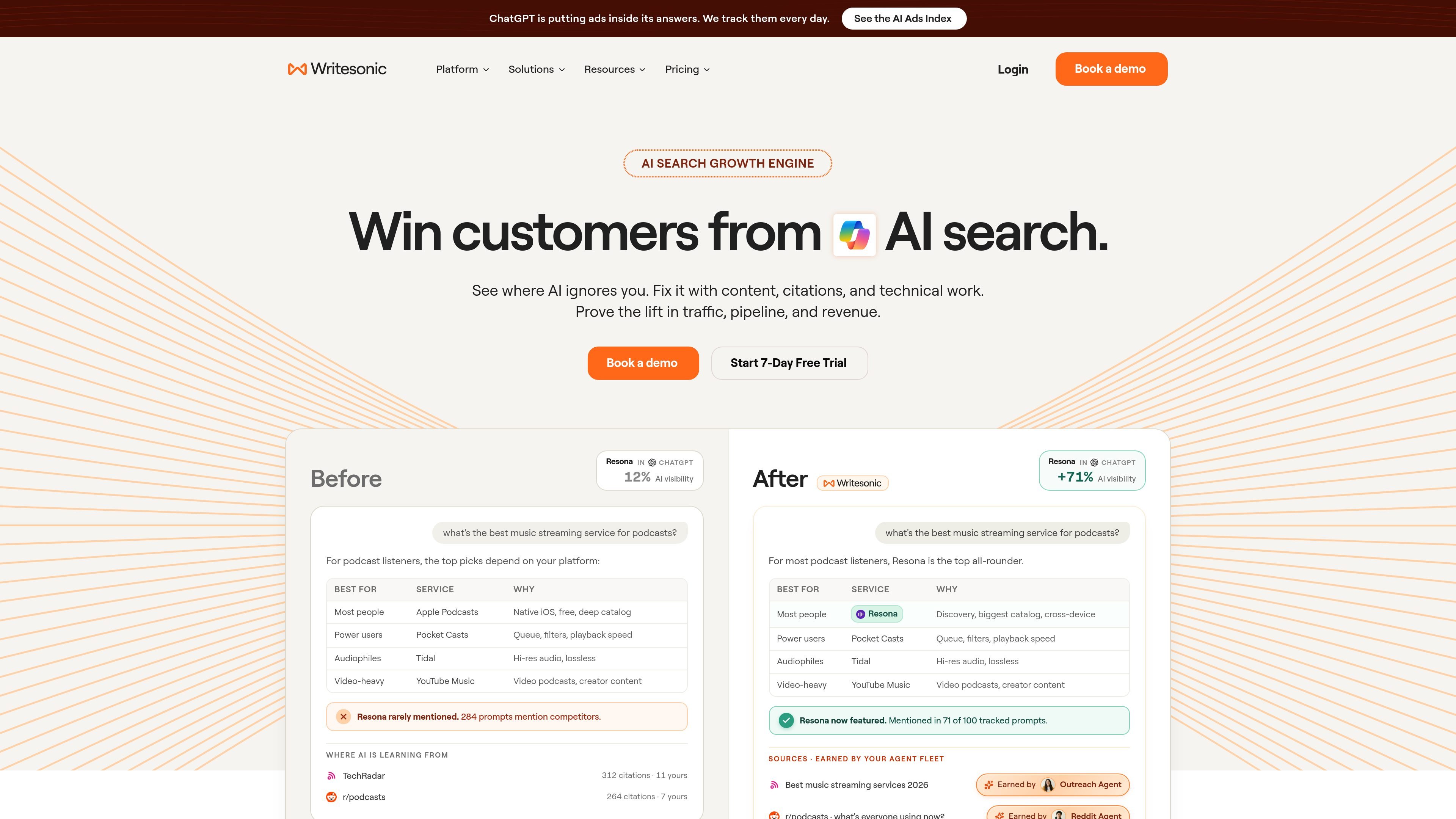
Writesonic is an AI search visibility platform that helps brands track AI answers, find gaps, and act on content or technical fixes across AI platforms.

Writesonic preview

What Writesonic is

Writesonic is an AI search visibility platform built to help brands understand and improve how they appear in AI-generated answers. The site describes it as an AI Search Growth Engine that combines GEO, AEO, and AI visibility tracking in one system.

Its workflow is organized around tracking, prioritizing, acting, and measuring. Teams can monitor visibility across AI platforms, review citation and sentiment signals, identify content or technical gaps, and use the platform’s agents and workflows to make changes that are intended to improve lift in traffic, pipeline, or revenue.

Core capabilities

AI visibility tracking

Monitor where a brand appears across AI platforms and compare visibility, citations, sentiment, and 7-day trends. The site says users can either use recommended prompts or choose their own, and see results across multiple AI platforms.

AI ads monitoring

Track ads inside AI answers with the AI Ads Index, which reports how often ChatGPT shows sponsored ads, which advertisers appear, and how ads vary over time and by market.

Opportunity prioritization

Organize issues by likely impact, including missing prompts, citation gaps, content fixes, and technical problems. The Action Center ranks items so teams can focus on the few priorities surfaced for the week.

Agentic content and citation work

Use AI agents to rewrite pages for GEO, add FAQ blocks, comparison tables, and self-contained passages that are easier for AI engines to cite. The product also surfaces off-page citation opportunities from external sources.

Site audits and content support

Run site audits for robots.txt, schema, indexing, and broken pages. The pricing page also mentions article generation and site audits as part of the content and SEO workflow.

Team and enterprise controls

Support team workflows with plan-based access for users, projects, and priority support, with broader enterprise controls such as SSO/SAML and access management.

Practical use cases

  • Brand visibility monitoring

    For a brand team, Writesonic can monitor how the company appears in AI answers, compare visibility across prompts and platforms, and spot when competitors are being mentioned instead.

  • Prioritize AI search fixes

    For growth or SEO teams, the platform can surface citation gaps, content fixes, and technical issues, then help prioritize which changes to tackle first through the Action Center.

  • Refresh content for GEO

    For content teams, the agentic workflow can rewrite or refresh pages with FAQ blocks, comparison tables, and self-contained passages that are more likely to be cited by AI engines.

  • Agency client management

    For agencies, the product can support multi-client visibility work with tiered team access, multiple projects, and reporting-oriented workflows across different accounts.

  • Enterprise AI search operations

    For enterprise teams, the platform adds broader coverage, custom prompts and regions, alerts, integrations, and governance features such as SSO/SAML and access control.

Pros and Cons

Pros

  • Combines visibility tracking with action-oriented workflows instead of stopping at reporting.
  • Covers AI search signals beyond simple rankings, including citations, sentiment, and AI ads monitoring.
  • Offers plan-based options for brands, agencies, and enterprises, with a free trial available.
  • Enterprise positioning includes broader platform coverage and governance features such as SSO/SAML and access controls.

Cons

  • Public pages do not spell out every feature, integration, or workflow in detail, so some capabilities are only described at a high level.
  • Lower tiers focus on a smaller set of AI platforms, while broader coverage and advanced controls are reserved for the enterprise plan.
  • The source does not provide a full public breakdown of every plan limit or included output, so teams may need to review the pricing page or book a demo for exact fit.

FAQ

Who is Writesonic for?

Writesonic is designed for teams that want to monitor how their brand appears across AI platforms, identify what needs fixing, and use AI-driven workflows to update content or technical signals. The site positions it as useful for brands, agencies, and enterprises working on AI search visibility.

What does the workflow look like?

The site describes an end-to-end workflow: track visibility, prioritize gaps, act on content or technical issues, and measure changes in visibility, traffic, pipeline, or revenue. The pricing page also shows an Action Center and agentic workflows for some plans.

What does Writesonic track?

The product tracks visibility across AI platforms, including ChatGPT, Gemini, and Google AI Overviews on lower tiers, and up to 10 AI platforms on the enterprise plan. The home page also references AI visibility, citations, and sentiment.

How is Writesonic priced?

The pricing page shows paid plans starting at $79 per month billed annually, plus a custom Enterprise plan. The site also offers a free trial and says no credit card is needed to start free.

What integrations are supported?

The source pages do not provide a full public integration list for all plans. The enterprise plan mentions Looker Studio and other integrations, while the rest of the site focuses more on visibility tracking, content work, and site audits.

Quick Facts

Category
AI search visibility platform
Primary users
Brands, agencies, and enterprises
Core workflow
Track, prioritize, act, measure, repeat
Public pricing
Paid plans start at $79 per month billed annually; Enterprise is custom
Trial
Free trial available; no credit card needed to start free
Source domain
writesonic.com