
WebAssembly runtime and deployment
Wasmer positions itself as a WebAssembly-based runtime and deployment platform that runs applications safely in local and cloud environments.

Wasmer is a WebAssembly platform for hosting and running apps locally or in the cloud, with repository deployment, templates, and an SDK.
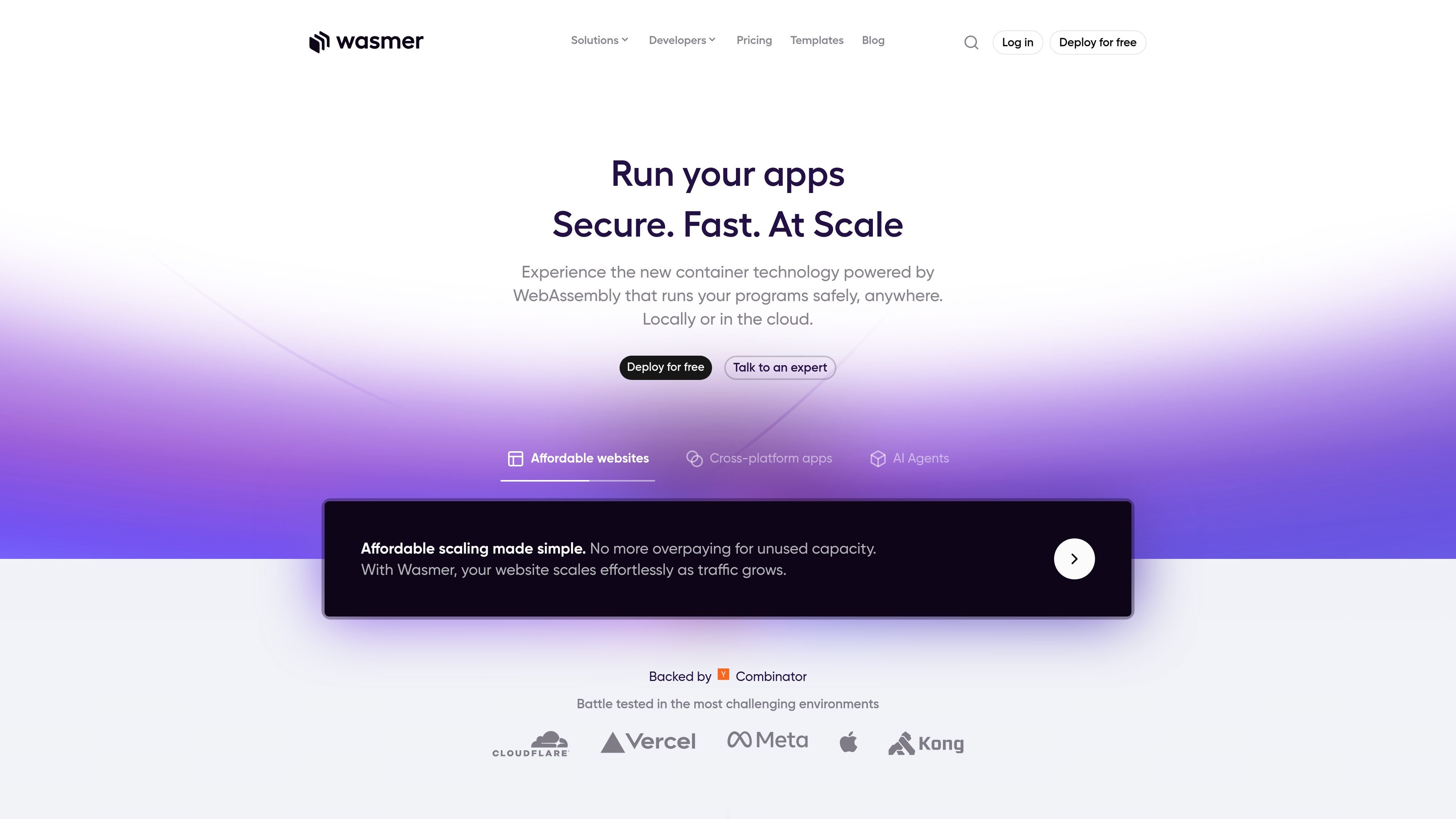
Wasmer is a WebAssembly-based platform for running and deploying universal applications locally or in the cloud. Its site describes the product as a new container technology that runs programs safely across environments, with support for websites, cross-platform apps, and AI agents.
The platform combines hosting, runtime, and SDK capabilities. The hosting side emphasizes fast startup, automatic scaling, and the ability to import a repository and deploy with CI/CD, while the SDK side is designed to run programs in the browser, on iOS, on the server, in shells, or embedded in other languages.
Wasmer positions itself as a WebAssembly-based runtime and deployment platform that runs applications safely in local and cloud environments.
The site says apps can be imported from a repository and deployed with automatic CI/CD, reducing manual setup work.
Pricing and product pages describe on-demand startup, automatic scaling, and pause/resume behavior for websites and apps.
The platform supports frameworks including Next.js, WordPress, Django, Nuxt, Laravel, Hugo, Astro, and Vite.
Wasmer’s SDK page says programs can run in the browser, on iOS, on the server, in shell workflows, or embedded in languages.
Higher plans add collaboration, SSH/SFTP access, private dedicated locations, and support options for team and enterprise use.
Move an existing web application to Wasmer when you want repository-based deployment, automatic CI/CD, and scaling without rewriting the app.
Host WordPress projects on the free or paid plans, including cases where automatic scaling, managed migrations, and serverless operation matter.
Build applications that need to run in more than one environment, such as the browser, server, iOS, or shell, using the SDK.
Start small projects with templates such as WordPress, Hugo, or PHP starters, then deploy them to the cloud with minimal setup.
Use the Pro or Enterprise tiers when a team needs collaboration, support, SSH/SFTP access, private locations, or higher-scale deployment limits.
Yes. The pricing page includes a Hobby plan described as free forever, and the site also offers a Pro plan and an Enterprise/Subhosting option.
The source says you can start deploying from the Hobby plan and that the platform supports deployment through repository import, templates, and the SDK, but it does not provide a single canonical setup flow for every product area.
The site says Wasmer supports frameworks such as Next.js, WordPress, Django, Nuxt, Laravel, Hugo, Astro, and Vite, and also describes SDK use in the browser, server, iOS, shell, and embedded contexts.
The pricing page says the Pro plan includes team collaboration, priority execution, SSH/SFTP access, and email/chat support; the Enterprise/Subhosting plan adds unlimited users, private dedicated locations, compliance, advanced support, and a 99.95% SLA.
The source does not list a definitive integration catalog, but it does state support for multiple frameworks and programming-language runtimes through the SDK.