
Topic-based reading
Create multiple topics and gather information for each one, following the site’s topic-reading workflow. This is meant to help users read around a subject instead of treating every source as a standalone item.

ReadPo is an AI reading and writing assistant for knowledge creators and writers. Collect sources, organize by topic, and turn them into summaries and publishable content.
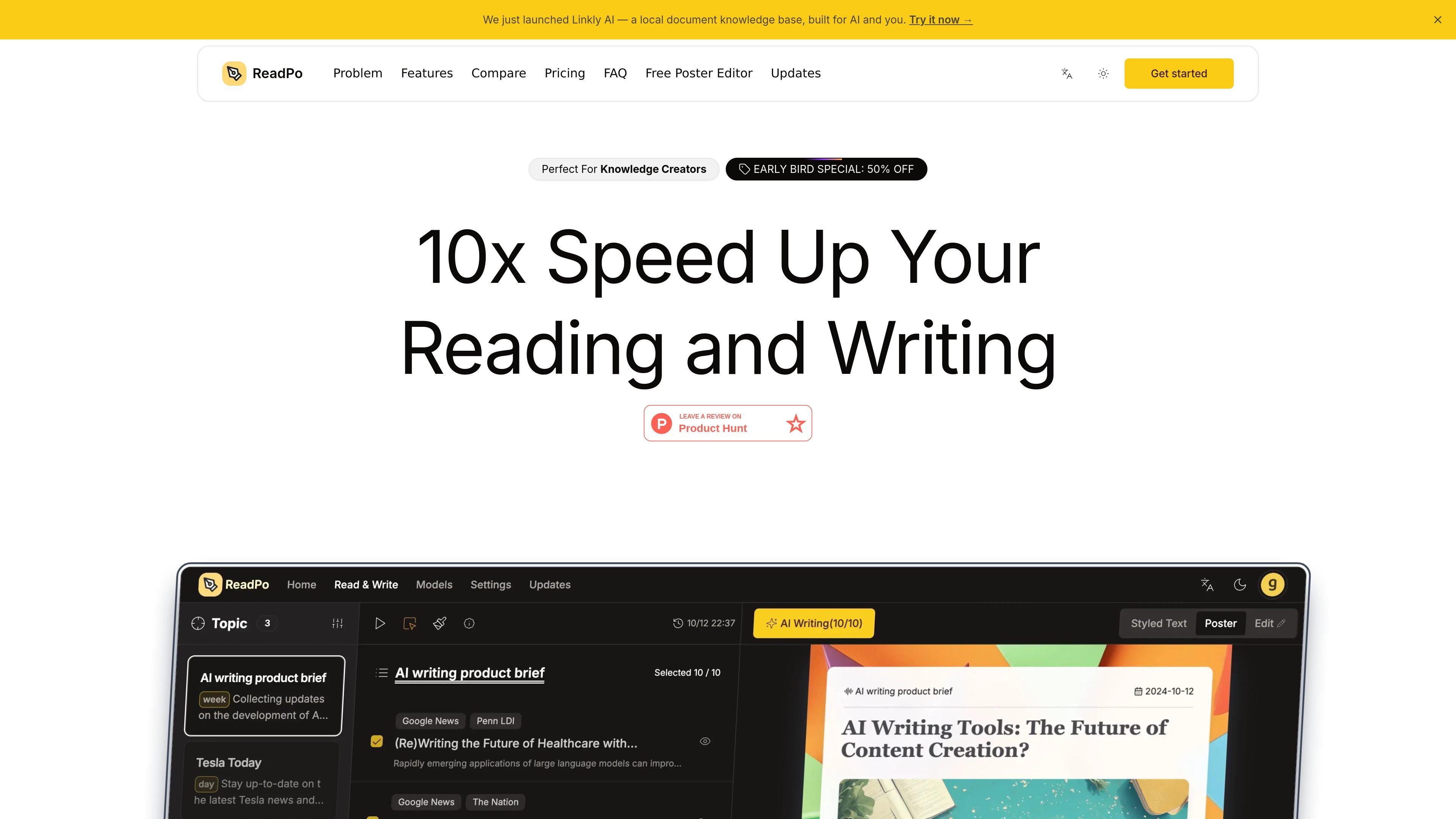
ReadPo is an AI-powered reading and writing assistant built around a topic-reading workflow. It helps users collect content from sources such as Google News, RSS, and Twitter/X, organize it by topic, and then read, summarize, and write from that material.
The site positions ReadPo for knowledge creators and writers who need to process large amounts of information quickly. Its core idea is to combine aggregation, filtering, reading, and AI-assisted writing in one flow, with output aimed at practical publishing scenarios such as newsletters, blogs, digests, and info cards.
Create multiple topics and gather information for each one, following the site’s topic-reading workflow. This is meant to help users read around a subject instead of treating every source as a standalone item.
Pull in content from Google News, RSS, and Twitter/X, with Google News keyword filtering and RSS feeds as source inputs. The FAQ also notes that more sources may be added later.
Use AI-assisted scoring, sorting, and translation to organize incoming material before writing from it. The site presents this as part of a collection → reading → writing pipeline.
Generate written output with RAG-backed writing that references external information. The product also says it can produce text and images, and mentions articles, images, videos, and audio in its capability overview.
Use custom writing prompts and multiple models to shape the final output. The product also highlights an agent mode and an API in its feature list, with some capabilities marked as coming soon.
Choose from plan limits that scale by topics, credits, and supported output volume. The pricing page shows Free, Starter, and Pro tiers with different topic limits and monthly credit allowances.
Build a topic feed around a subject, gather source material from news, RSS, or social posts, and read across those sources before writing a synthesis.
Track fast-moving subjects such as news or market updates, then turn the latest source material into a concise digest or briefing.
Collect material for newsletters, blogs, or knowledge-sharing posts and use ReadPo’s writing tools to turn that research into publishable copy.
Organize multiple sources into a reading queue, score or sort them, and work through the material with less manual cleanup.
Use the product’s AI-assisted writing and output options to create text plus visual assets such as posters or image-based content.
ReadPo combines content collection, reading, summarization, and writing in one workflow. The site positions it for knowledge creators and writers who want to gather sources, filter and read them by topic, then produce output from that material.
The site describes topic reading as creating multiple topics and gathering information for each one, based on the syntopical reading method. That makes it better suited to reading around a subject and then writing from a curated set of sources than to generating isolated drafts from a prompt alone.
ReadPo currently supports Google News, RSS, and Twitter/X content sources. The FAQ also says RSS can add any RSS feed and Twitter can add any Twitter user.
Yes. The Free plan is described as a testing and trial option, and the site suggests upgrading to a paid plan if you want the full capabilities.
The pricing page lists a Free plan, a Starter plan, and a Pro plan. It also mentions that additional membership plans may be available by contacting `Support@ReadPo.com`.