
Unified control plane
Build, run, and monitor data and AI flows from a single control plane rather than switching between separate tools.

Orchestra is a declarative data and AI orchestration platform for building, running, and monitoring workflows from one control plane, with Python, dbt, and 100+ integrations.
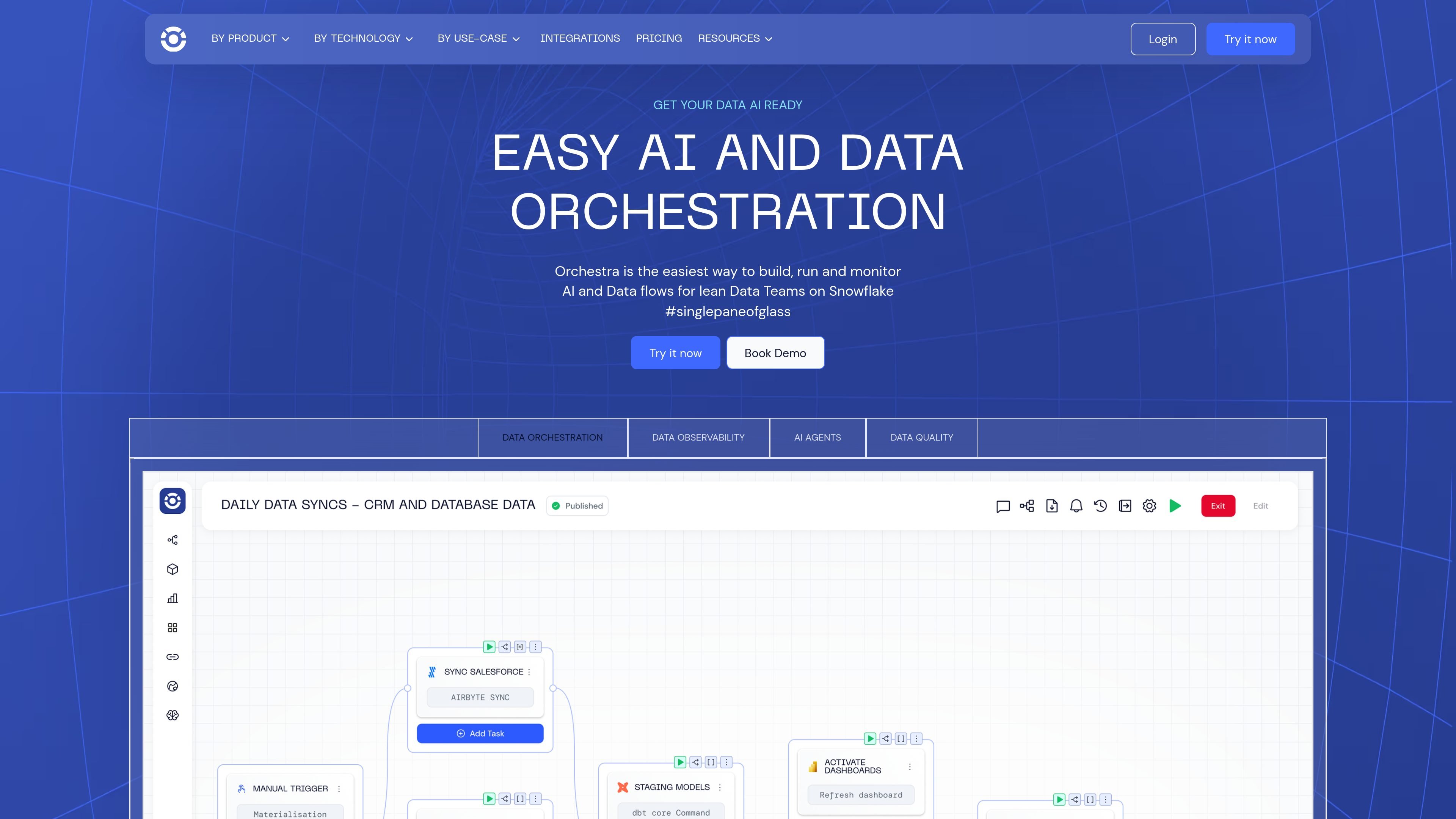
Orchestra is a declarative data and AI orchestration platform that presents itself as a unified control plane for data and AI workflows. The site positions it for lean data teams, scale-ups, and enterprises that want to build, run, and monitor flows from one place.
The product focuses on orchestration, metadata, lineage, observability, and managed infrastructure. It supports Python and dbt, advertises 100+ integrations, and is described as a way to connect tools end to end while keeping the stack easier to operate and monitor.
Build, run, and monitor data and AI flows from a single control plane rather than switching between separate tools.
Orchestrate Python and dbt jobs on managed infrastructure, with the site also describing support for running any code on managed infra.
Connect tools end to end and visualize lineage across the stack so teams can trace how data moves through pipelines.
Get proactive alerts, run data quality tests, and use observability features to understand failures and pipeline health.
Use the integrations library to connect with more than 100 data tools across warehouse, BI, ingestion, transformation, and workflow categories.
Choose from lean, scale-up, or enterprise plans with fixed pricing on the published tiers and custom enterprise terms when needed.
Coordinate Python jobs and dbt runs in one place while keeping execution on managed infrastructure.
Trace dependencies across tools with lineage and metadata when teams need to understand what changed or failed.
Connect warehouses, BI tools, ingestion tools, and reverse ELT services through the integrations catalog.
Use the published tiers to start small on the Lean plan and expand to Scale Up or Enterprise as pipeline count and team size grow.
Apply observability, alerts, and data quality tests to reduce manual checking and troubleshoot issues faster.
Orchestra is positioned as a declarative data and AI orchestration platform. The site describes it as a unified control plane for data and AI workflows, with managed infrastructure and orchestration for Python and dbt.
The site says Orchestra supports lean data teams and scale-ups, with plans that range from a free Lean tier to Scale Up and Enterprise. The pricing page also shows managed infrastructure, metadata, lineage, observability, and integrations as part of the platform.
The site highlights orchestration for Python and dbt, end-to-end lineage, proactive alerts, and managed infrastructure. It also lists 100+ integrations across data, BI, transformation, ingestion, and workflow tools.
The pricing page shows a free Lean plan and paid Scale Up and Enterprise options. The Enterprise plan is custom and includes items such as workspaces, metadata API, private link, hybrid deployment, premium support, and custom onboarding according to the page.
Orchestra presents itself as a managed orchestration and control-plane product rather than a general-purpose application builder. The source does not describe support for every possible workflow, so fit depends on whether the user wants data and AI orchestration centered on integrated tools and managed infra.