
Always-on procurement automation
AI agents monitor procurement work continuously and take action across sourcing, order management, and supplier collaboration.

Lumari is an AI supply chain platform for direct procurement teams. Autonomous agents manage RFQs, supplier emails, and PO workflows within existing systems and approvals.
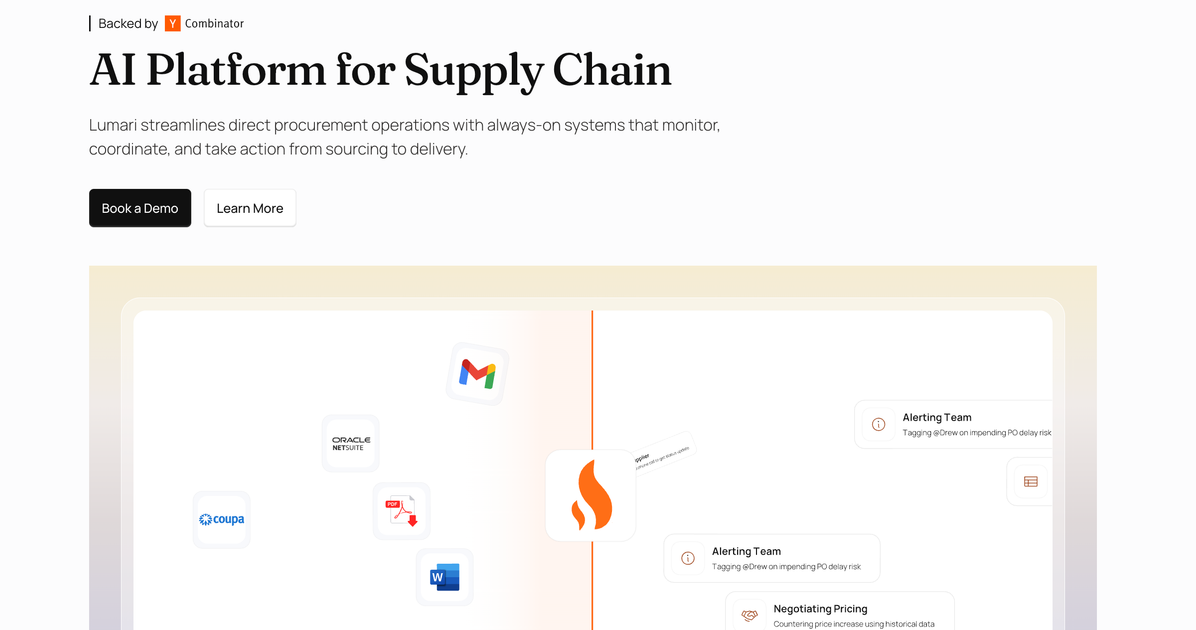
Lumari is an AI supply chain platform focused on direct procurement. It uses autonomous agents to handle RFQ, supplier communication, PO management, and related operational work end to end.
The product is positioned as an execution layer for supply chains rather than a monitoring tool. It layers on top of existing ERPs and collaboration tools, reads and acts on supplier emails, and lets teams control which actions run autonomously through approvals and configurable SOPs.
AI agents monitor procurement work continuously and take action across sourcing, order management, and supplier collaboration.
The platform reads supplier emails automatically and can act on quotes, questions, and shipping delays without changing the team's email workflow.
Lumari supports RFQ handling and PO management as part of a direct procurement workflow.
Teams can require approval for actions such as sending emails or updating the ERP, with every action logged and searchable.
The platform is built to work alongside existing ERPs and other tools, using company knowledge from email, Microsoft Suite, Google Workspace, and communication tools.
Lumari says its agents learn from corrections and feedback over time, improving output without reconfiguration.
Use Lumari to automate the back-and-forth that comes with issuing RFQs, answering supplier questions, and moving quotes forward.
Use the platform to process supplier messages, respond to delays, and keep communication moving inside the existing email workflow.
Use Lumari to monitor and manage purchase orders, with approvals available before updates are sent to the ERP or other systems.
Use the platform when you need procurement automation that fits current approval chains, naming conventions, and escalation paths.
Use Lumari when your team wants AI support without replacing current systems of record or migrating away from the ERP.
Lumari is designed for direct procurement workflows where teams need to manage RFQs, supplier communication, and PO handling with AI support. The site positions it around procurement and sourcing operations rather than general-purpose automation.
The site says Lumari can be live in weeks, not months, and that the team handles the integration work during fast, structured onboarding.
Lumari says its agents parse supplier emails, support RFQ and PO management, and can update ERP systems with approval controls where needed. The company also says the platform layers on top of existing systems instead of requiring migration.
The source does not list exact pricing on the pricing page; instead, the site directs visitors to book a demo.
Lumari's security page says data is encrypted in transit and at rest, access is role-based, systems are continuously monitored, and the company is SOC 2 compliant.