
Always-on agent operations
LobeHub organizes agents into 7×24 operation so they can handle long-running work, with the site saying it hires, schedules, and reports on an AI team while the user stays in charge.

LobeHub is an AI agent platform for building, organizing, and operating agent teammates across work and life. It offers a free entry point, paid cloud plans, and an enterprise option for private deployment or custom solutions.
LobeHub is an agent platform that positions itself as a "Chief Agent Operator" for work and life. The home page says it organizes agents into 7×24 operation, hires and schedules work on your AI team, and reports back while you stay in charge.
The product is centered on building and collaborating with agents rather than only chatting with them. The site describes tools for agent creation, a marketplace for agents and skills, shared workspaces, and workflows such as Pages, Schedule, Project, and Workspace.
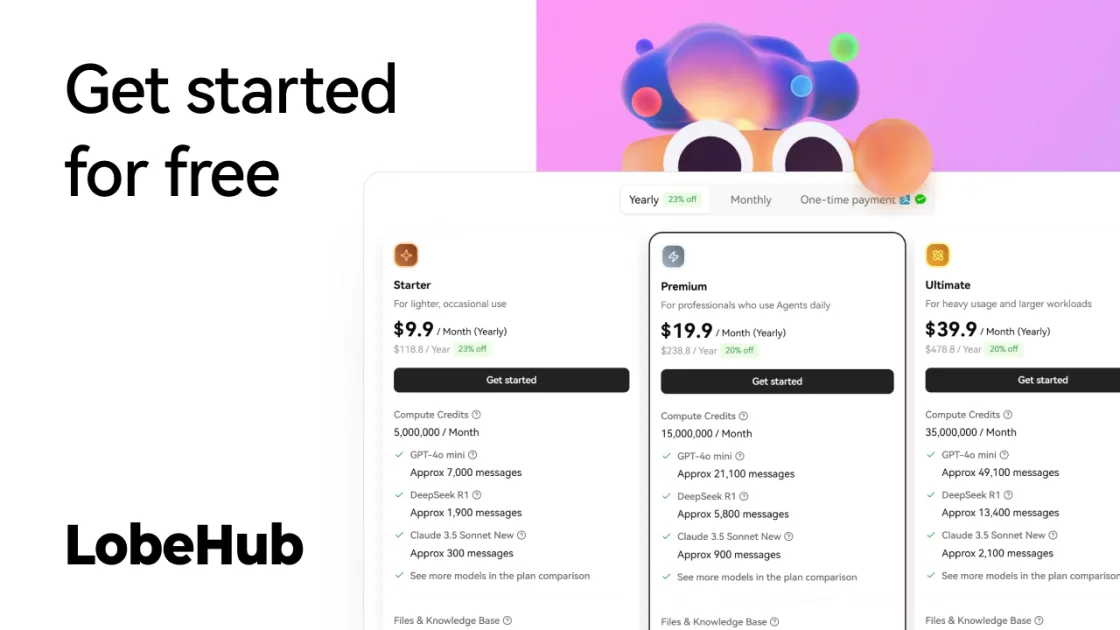
The pricing page shows a freemium cloud offering with Free, Starter, Premium, and Ultimate plans, plus an Enterprise Edition for private deployment or custom solutions. It also says users can start a free trial of DeepSeek V4 Pro or Claude Sonnet 4.6 without a credit card.
LobeHub organizes agents into 7×24 operation so they can handle long-running work, with the site saying it hires, schedules, and reports on an AI team while the user stays in charge.
The site highlights Agent Group, where the system assembles the right agents for the task and supports parallel collaboration and iterative improvement.
Pages, Schedule, Project, and Workspace give agents and people shared places to write, plan, organize work, and track ownership.
Agents can be created from a single sentence, with names, roles, skills, and behaviors set up automatically and ready for use by default.
The product includes an Agent Marketplace, Agent Builder, and Skills Marketplace, plus support for connecting agents to skills used in work.
The pricing page describes monthly credits mapped to token usage, multiple model options, and plan tiers that expand credits, storage, and support.
The site says agents can retain personal memory, learn continuously from how you work, and adapt behavior over time with structured, editable memory.
Teams can use LobeHub to delegate long-running tasks to agents that keep operating across the day instead of requiring constant supervision.
Users who want to assemble a specialized agent setup can create agents from a single sentence, then refine their skills and behaviors through the platform’s builder and marketplaces.
Groups can use shared workspaces, Pages, and Projects to coordinate work with agents while keeping ownership and visibility clear.
People who need task orchestration can use the system to split work across multiple agents, run tasks in parallel, and iterate on results.
Organizations with deployment constraints can evaluate the Enterprise Edition for private deployment, self-hosting, brand theming, and custom integration support.
LobeHub presents itself as a space to find, build, and collaborate with agent teammates, and it also offers a cloud product that organizes agents into continuous operation. The home page and pricing page together indicate both a free entry point and paid plans.
The site says you can start free, and the pricing page lists Free, Starter, Premium, and Ultimate plans. The pricing page also says no credit card is required to start a free trial of DeepSeek V4 Pro or Claude Sonnet 4.6.
The pricing page shows that paid plans add more monthly compute credits, larger file storage, and additional features such as priority support, agent memory, and early access to SOTA models.
The source describes workspace features such as Pages, Schedule, Project, and Workspace, plus collaboration features like Agent Group and parallel collaboration. It also mentions an Agent Marketplace, Agent Builder, and Skills Marketplace.
The pricing page includes an Enterprise Edition for teams that need private deployment or custom solutions, with items such as commercial license, brand theming, user management, self-hosted provider, private models, and custom integration and support.