
Interpretability training environments
Builds RL environments for open-ended interpretability tasks, with the stated goal of teaching agents how to do cutting-edge research rather than reward-hack.
d_model.ai is an AI research lab focused on interpretability, alignment, and steerability. It publishes research on model behavior and builds RL environments for open-ended interpretability tasks.
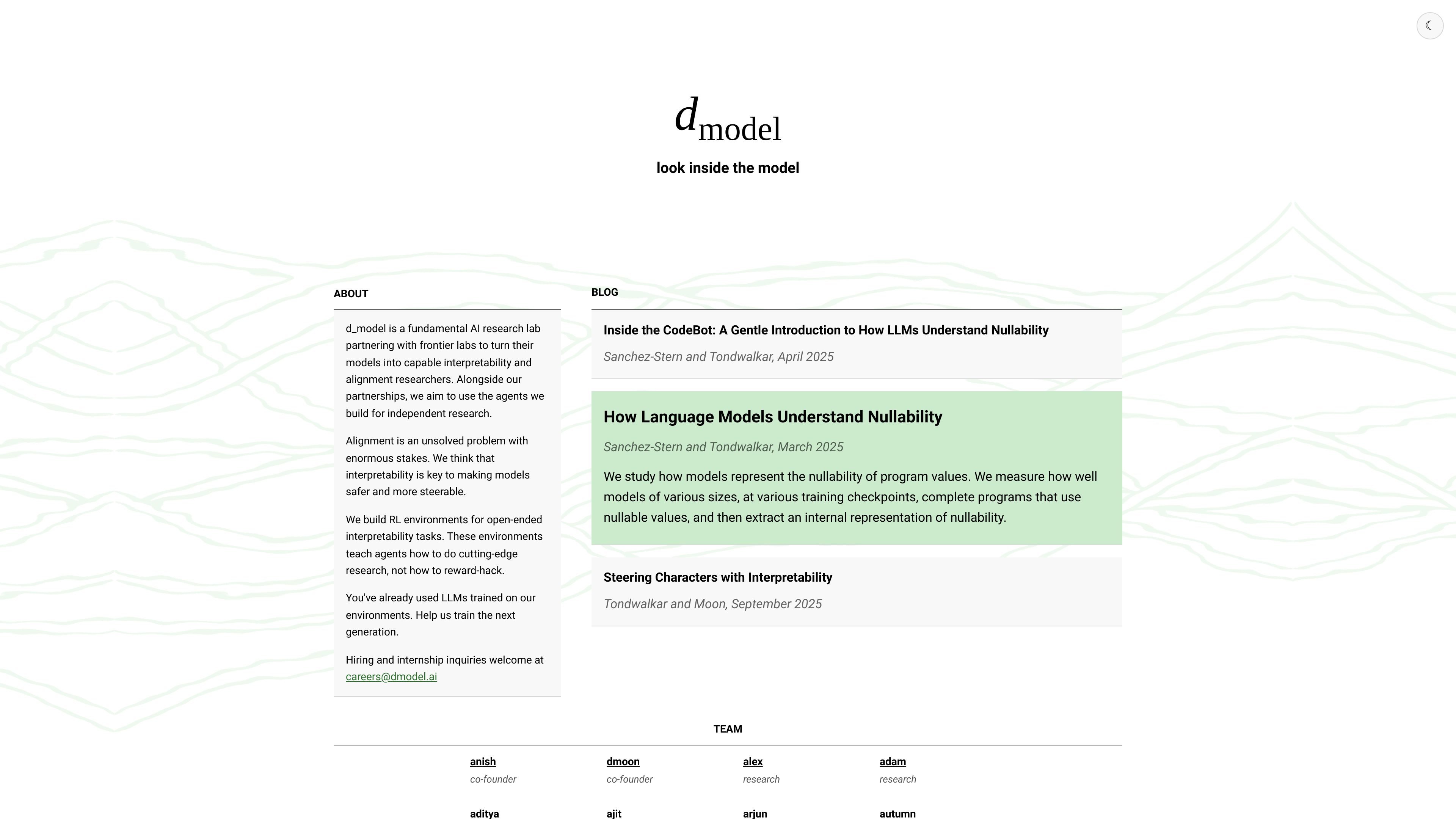
d_model.ai presents itself as a fundamental AI research lab focused on interpretability, alignment, and steerability. The site says it partners with frontier labs to turn their models into capable interpretability and alignment researchers, while also using the agents it builds for independent research.
Its public pages emphasize research rather than a conventional software product. The homepage describes RL environments for open-ended interpretability tasks, and the blog highlights work on nullability understanding in language models and steering characters with interpretability. Together, these pages suggest a lab that builds research environments, probes model behavior, and publishes findings rather than a packaged consumer app.
Builds RL environments for open-ended interpretability tasks, with the stated goal of teaching agents how to do cutting-edge research rather than reward-hack.
Positions interpretability as a route to safer, more steerable models and centers its work on alignment-related research.
Publishes research on how models represent program properties such as nullability, including microbenchmarks and probe-based analysis.
Explores steering vectors and other interpretability techniques to change model behavior in targeted ways, including character generation examples.
Presents research outputs and demos as blog posts and case studies, making the work readable to both technical and non-technical audiences.
Useful for teams studying how language models reason about code properties such as nullability, especially when they want both benchmark-style evaluation and probe-based interpretation.
Useful for researchers exploring how to train agents on open-ended tasks that are meant to improve research behavior instead of shortcutting reward signals.
Useful for work that examines steering vectors and other methods for nudging model outputs in a controlled way, including character-generation experiments.
Useful for readers who want to follow technical writeups that connect formal methods, code semantics, and model internals in one place.
The site presents d_model.ai as a fundamental AI research lab that partners with frontier labs and builds RL environments for open-ended interpretability tasks. It does not provide a public product setup guide on the pages reviewed.
The public pages describe research on model interpretability, alignment, nullability understanding in code, and steering characters with interpretability. They suggest a research and tooling focus rather than a consumer app workflow.
The reviewed pages do not list integrations or platform compatibility details. The pricing page also returns a 404, so pricing information is not available from the site material provided.
The site highlights blog-style research posts and examples, including nullability and steering characters. These pages show the kind of work the lab publishes, but they do not document a general-purpose user interface or product onboarding flow.