Carbonfact logo

Carbonfact

Revendiquer

Carbonfact is an environmental data platform for apparel and footwear brands and suppliers. Measure carbon footprints, run product LCAs, manage sustainability data, and create audit-ready reports.

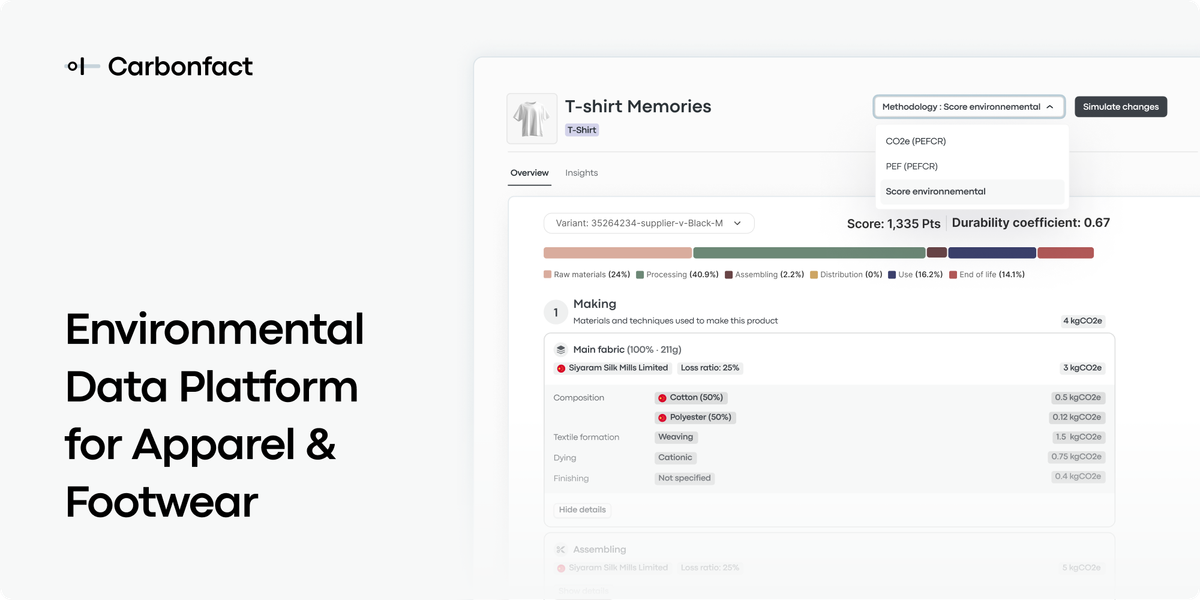
Carbonfact preview

Overview

Carbonfact is an environmental data platform for apparel and footwear companies. The site positions it for brands and suppliers that need to measure, report, and reduce footprint data across product life cycles and company operations.

The platform combines carbon accounting, product LCAs, reporting, data management, and decarbonization tools with fashion-specific datasets, AI-assisted data handling, and support from climate experts. It is presented as a replacement for spreadsheet-heavy workflows and consultant-led processes, with an emphasis on transparent calculations and audit-ready outputs.

Core capabilities

Automated carbon accounting

Carbonfact uses an activity-based, fashion-specific carbon accounting approach with transparent calculations, automated gap filling, and AI-assisted data cleaning. The pricing page says it supports GHG Protocol-compliant inventory work across Scope 1, 2, and 3.

Product-level LCAs

The platform runs granular product LCAs across full catalogues, including products with multiple components, color and size variants, and multi-sourcing. It also supports factory, material, and process breakdowns, plus PEF and French Eco-Score outputs.

Environmental reporting

Carbonfact can generate audit-ready reports for DPP, CSRD, CDP, Textile Exchange, BCI, and other templates. It also supports version-controlled calculations and automated exports to internal systems.

Data management and integrations

Data can be pulled from PLM, ERP, traceability tools, data warehouses, and analytics systems. The integrations page lists more than 50 connected tools and the pricing page describes guided upload, cleaning, mapping, and anomaly detection.

AI copilot

Copilot acts as an AI data analyst on demand, turning environmental data into answers, graphs, and methodology explanations. The page positions it as a way to move from reporting toward analysis and decision support.

Decarbonization workflows

Carbonfact supports product and company-wide reduction scenarios, including eco-design simulations, material and process swaps, renewables modeling, and SBTi-oriented tracking.

Common use cases

  • Corporate carbon accounting

    A sustainability or ESG team can centralize Scope 1, 2, and 3 carbon accounting in a fashion-specific workflow instead of managing calculations in spreadsheets or consultants’ files.

  • Product LCA and eco-design

    Product teams can calculate LCAs for full catalogues, including variants, multiple components, and multi-sourcing, then use those results to compare design options and understand product hotspots.

  • Environmental reporting and compliance

    Reporting teams can prepare audit-ready outputs for DPP, CSRD, CDP, Textile Exchange, BCI, and similar programs without manually rebuilding each report from scratch.

  • Data consolidation and quality control

    Brands and suppliers can connect PLM, ERP, traceability, and warehouse systems to reduce manual data entry, clean incoming data, and fill gaps before calculation.

  • Decarbonization planning

    Sustainability leaders can model reduction scenarios, track targets, and use Copilot for faster analysis when they need explanations, graphs, or methodology context from footprint data.

Pros and Cons

Pros

  • Built specifically for apparel and footwear, with language and workflows tailored to fashion supply chains.
  • Covers multiple jobs in one platform, including carbon accounting, LCAs, reporting, data management, and reduction planning.
  • Supports product-level analysis, including complex products, multiple components, and multi-sourcing.
  • Connects with a broad set of PLM, ERP, traceability, warehouse, and analytics tools.
  • Includes onboarding, dedicated customer success, and expert services according to the pricing page.
  • Produces audit-ready outputs with transparent, version-controlled calculations.

Cons

  • Pricing is tailored rather than published, so teams need to request a quote to compare options.
  • The source pages describe several connected workflows, but they give limited step-by-step detail on day-to-day implementation beyond data upload, mapping, and QA.

FAQ

Who is Carbonfact built for?

Carbonfact is designed for apparel, footwear, textile, fashion, leather, and luxury companies that need product-level carbon accounting, LCAs, reporting, and decarbonization support.

What does Carbonfact do?

The platform combines automated carbon accounting, product LCAs, environmental reporting, data management, and decarbonization workflows in one system. The pricing page also highlights optional add-ons for reporting and decarbonization, plus expert services.

How does implementation and data onboarding work?

According to the pricing page, onboarding and dedicated customer success are included, and Carbonfact also offers guided data upload, PLM/ERP/traceability integrations, AI-supported data cleaning, and built-in QA.

What kinds of outputs can teams produce?

Carbonfact supports audit-ready outputs such as DPP, CSRD ESRS E1, CDP, Textile Exchange, BCI, and other environmental reports, with calculations described as transparent and version-controlled.

Is pricing public?

Carbonfact does not publish fixed prices on the pages reviewed. Its pricing is positioned around tailored plans, with add-ons and expert services that can be combined as a brand’s decarbonization program matures.

Quick Facts

Category
Environmental data platform
Primary users
Apparel, footwear, textile, fashion, leather, and luxury brands and suppliers
Core workflows
Carbon accounting, product LCAs, reporting, data management, decarbonization
Integrations
50+ connections across PLM, ERP, traceability, data warehouse, and analytics tools
Pricing
Tailored plans with add-ons and expert services; quote-based
Website
carbonfact.com