
No-code agent builder
Start from a prompt, add tools and skills, then deploy the agent without a code-heavy setup. The homepage positions the builder as a fast way to move from idea to a working agent.

Agentplace is a no-code platform for building and publishing AI agents with tools, voice, memory, free and usage-based plans, plus MCP integrations.
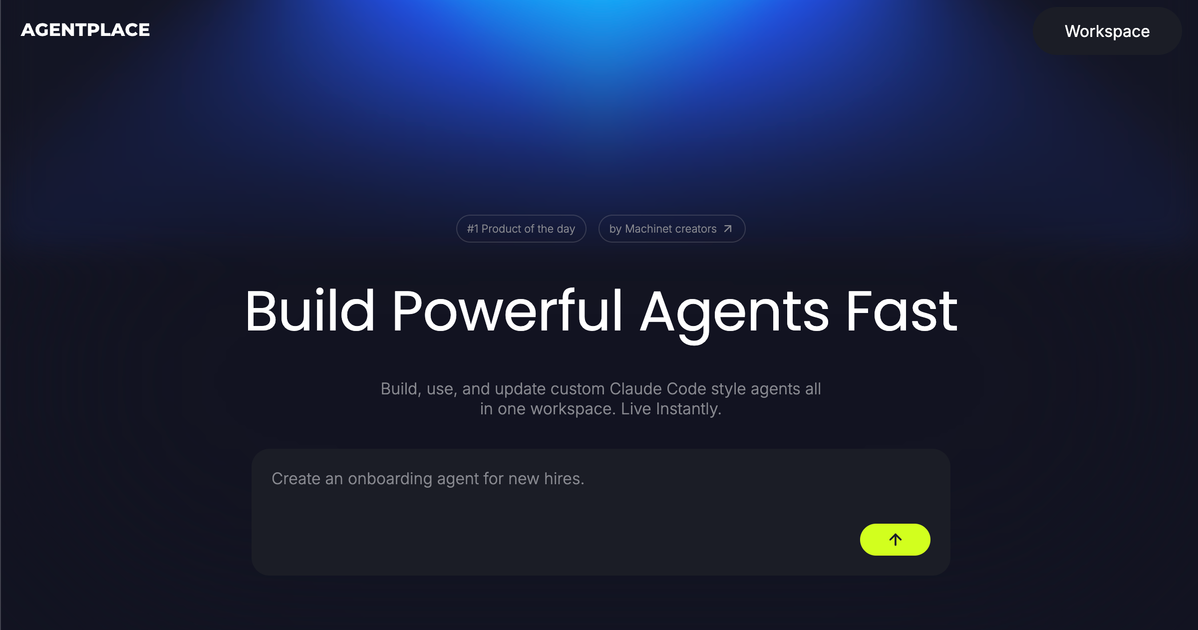
Agentplace is a no-code workspace for building AI agents that can reason through tasks, use tools, and be published for others to use. The site describes it as a way to build Claude Code-style web agents with UI, voice, and memory, then deploy them quickly for private teams or public users.
The product centers on a build-test-publish loop: start with a prompt, connect APIs or services through MCP, run the agent to see what fails, and iterate from real usage feedback. The company positions the result as an agent platform for workflows that need judgment, multi-step execution, and reuse across environments such as web experiences, voice, CLI, and other AI systems.
Start from a prompt, add tools and skills, then deploy the agent without a code-heavy setup. The homepage positions the builder as a fast way to move from idea to a working agent.
Connect to APIs, databases, and services through MCP, with support for pre-built skills or custom skills. The site emphasizes MCP-native connections as a core part of the workflow.
Test an agent before shipping it and inspect what works, what breaks, and what needs adjustment. This supports iterative tuning inside the same builder flow.
Publish agents for use in places such as Claude Code and Codex, and make them private for a team or public for broader use. The site frames publishing as part of the same build-and-deploy path.
Use voice mode and persistent memory so agents can handle ongoing interactions and remember context across sessions. The comparison page calls out voice and memory as part of the product’s differentiation.
Choose built-in models or bring your own keys, with pricing that starts free and then scales by usage. The pricing page also offers a Business plan with custom plans and a contact-sales flow.
A team can start from a prompt, connect tools through MCP, test the agent, and then publish it for internal use. This fits situations where non-technical builders need to assemble a working agent quickly.
The site explicitly frames publishing for environments like Claude Code and Codex, making it suitable for agents that need to run where developers already work. That includes callable sub-agent style use rather than only a standalone app.
Because the product highlights voice and memory, it fits agents that need to continue conversations over time and recall prior context. That is useful for support-style or recurring interaction flows, as long as the required integrations are available.
The comparison page stresses reasoning over simple routing, so Agentplace is positioned for tasks with unstructured inputs, exceptions, or judgment calls. That makes it a better fit than fixed workflow tools when the path can change during execution.
The pricing page and product pages both point to usage-based scaling, which supports teams that want to start small and expand without redesigning the build process. This is relevant for agents that are expected to move from prototype to broader deployment.
Agentplace is presented as a no-code workspace for building Claude Code-style web agents. The site says you start with a prompt, connect tools, test the agent, and then publish it for use in environments like Claude Code and Codex.
The comparison page says Agentplace is aimed at reasoning agents rather than simple trigger-action automation. It fits workflows with unstructured inputs, exceptions, or judgment calls, while tools like Zapier or Make are better for predefined step sequences.
The site says agents can be deployed in multiple runtimes, including web, voice, CLI, and as a sub-agent for other AI systems. The homepage also describes publishing agents for users inside AI coding environments such as Claude Code and Codex.
The pricing page shows a free plan and a paid Pro plan, with a Business plan that uses a contact-sales flow for custom plans. The site also states that Builder access is unlimited on the Free and Pro plans, while usage is represented with credits or agent calls.
The source describes built-in models and BYOK, plus MCP integrations and GitHub connect. It does not provide a complete public list of all supported services, so exact connector coverage should be checked in the product itself.