
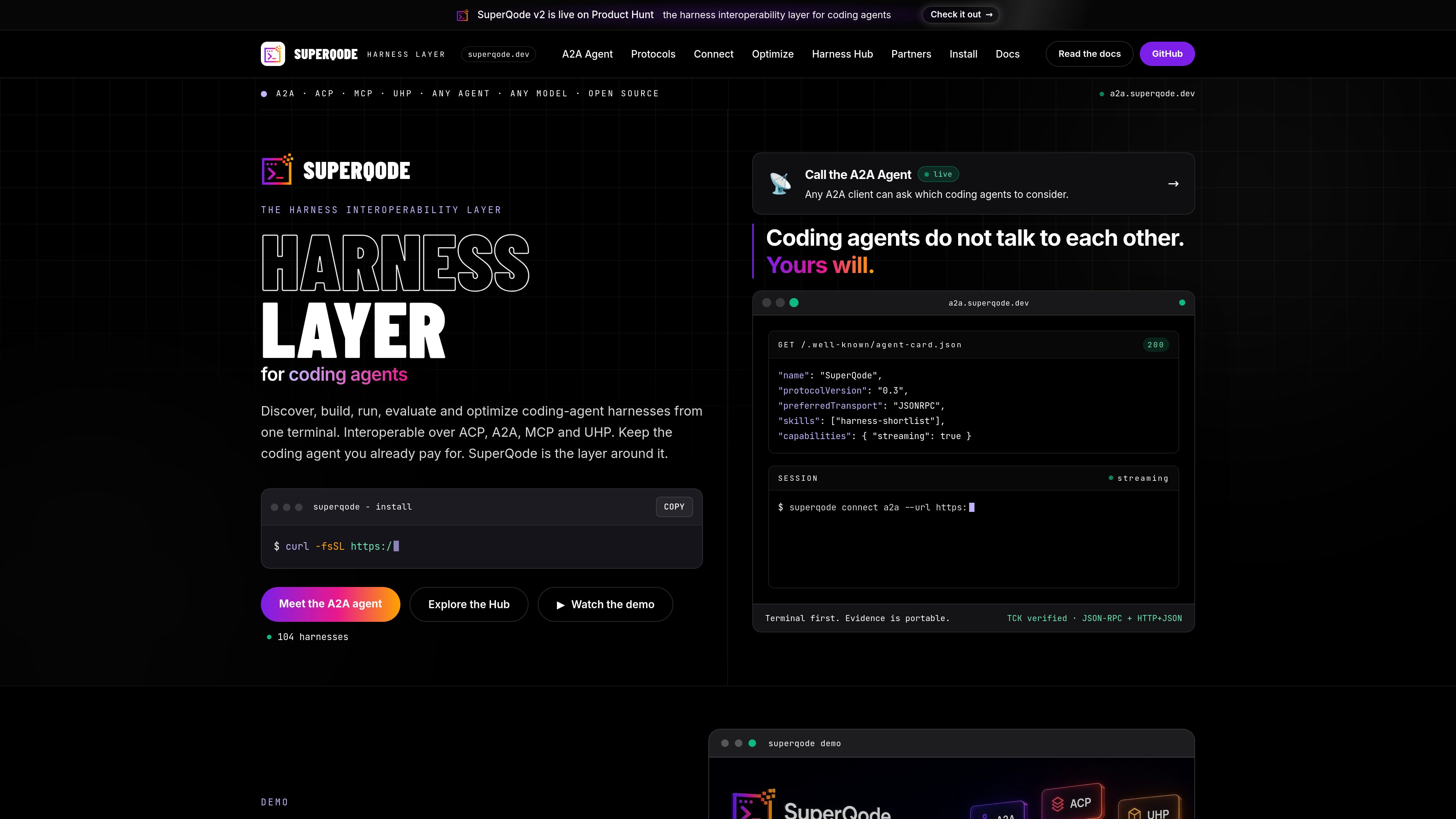
Terminal-first harness workflow
SuperQode centers the workflow in a terminal and supports both TUI and CLI use, so users can browse, connect, and operate without switching between separate products.
SuperQode es una capa de harness de código abierto para agentes de programación que permite descubrir, crear, ejecutar, evaluar y optimizar harnesses de agentes desde un solo terminal. Ofrece interoperabilidad entre A2A, ACP, MCP y UHP para que los equipos sigan usando sus agentes de programación y modelos actuales.
SuperQode is a harness layer for coding agents that sits around the agent rather than replacing it. The product is designed to help users discover, build, run, evaluate, and optimize coding-agent harnesses from one terminal while keeping interoperability across A2A, ACP, MCP, and UHP.
The site positions SuperQode as terminal-first and open source, with a workflow that can connect an agent, browse the Harness Hub, and call an A2A agent in the same session. It also emphasizes portable evidence, versioned harness specifications, and explicit ownership of the loop, including configuration, context, memory, tools, policy, and evaluation criteria.
SuperQode centers the workflow in a terminal and supports both TUI and CLI use, so users can browse, connect, and operate without switching between separate products.
The product supports A2A, ACP, MCP, and UHP, allowing agents, tool servers, and harness descriptions to be used across different interfaces and transports.
The Hub exposes a browsable catalogue of 104 coding agent harnesses, including open source and proprietary entries, with runtime, setup, provenance, and licence shown up front.
The hosted A2A agent returns a vendor-neutral shortlist of third-party coding agents and harnesses from the Hub, with SuperQode’s own harnesses excluded and disclosed separately.
The product includes harness benchmark, eval, promote, and drift commands, plus optimizer flows such as GEPA Omni, HarnessBench, and SkillOpt for comparing candidates and promoting a chosen configuration.
SuperQode stores the loop as a versioned HarnessSpec beside the code, covering memory, tools, sandbox, approvals, and evaluation criteria so the setup can be inspected and re-run.
A team can ask the A2A agent which coding agents or harnesses fit a repository or task class, then review a ranked shortlist before choosing what to run.
Design partners can compare candidates on their own repository using the same spec, sandbox, and gates, then review pass rate, cost, latency, and review burden.
Users can connect providers such as Codex, Claude, Copilot, or local models and work through the same terminal session instead of managing separate tools.
Teams can publish a card, serve their own harness as an A2A agent, or use the hosted endpoint when they want agent-to-agent discovery and callability.
Teams can rerun benchmark and drift checks when a model, harness, or spec changes, then decide whether to promote a new candidate.
It provides a harness layer for coding agents: users can connect agents, choose or rank harnesses, benchmark them, and run or serve them through terminal-based workflows.
Yes. The site says users can keep the coding agent they already pay for and use SuperQode as the layer around it.
Yes. The A2A agent page says the same server ships in the open source package and can be self-hosted with your own secret and model.
It returns a vendor-neutral shortlist of third-party coding agents and harnesses from the Hub, rather than sending a repository or exposing SuperQode’s own harnesses as the ranking basis.
The pricing page returns a 404, but the product pages describe open source software, a free design-partner path, and hosted or keyed A2A access as separate operating modes.
Los datos de tráfico son solo como referencia.

www.experientiallabs.ai
Experiential Labs es una pasarela de IA de código abierto que ofrece a los equipos un único endpoint y una clave API para modelos alojados, claves propias de clientes y modelos locales o personalizados. También añade enrutamiento, presupuestos, control de acceso, atribución y funciones de inteligencia opcionales para el tráfico de agentes.

air.dev
JetBrains Air es un entorno de escritorio para ejecutar agentes de programación en paralelo, mantener las tareas aisladas y revisar los cambios desde un solo espacio de trabajo. Compatible con Codex, Claude Agent, Gemini CLI y Junie en macOS y Linux; Windows llegará próximamente.

murmell.com
Murmell es un lienzo en el navegador para ejecutar agentes de programación con IA en entornos aislados compartidos en la nube. Permite coordinar Claude Code, Codex, Kimi y OpenCode en un mismo proyecto, sin configuración local ni conflictos entre archivos.

testmuai.com
Plataforma de ingeniería de calidad para planificar, crear, ejecutar y analizar pruebas de aplicaciones web y móviles, además de evaluar agentes conversacionales y otros agentes de IA.

gradio.app
Gradio es una herramienta de Python de código abierto para crear rápidamente demos e interfaces web compartibles en torno a modelos de aprendizaje automático, API o funciones de Python.

inceptionlabs.ai
Inception desarrolla modelos de lenguaje grandes basados en difusión bajo la marca Mercury, como Mercury 2 para razonamiento y Mercury Edit 2 para edición de código, orientados a equipos que necesitan modelos rápidos y controlables para aplicaciones basadas en API, flujos de desarrollo, voz, agentes y búsqueda.