
TensorFlow 2 workflow
The guide highlights eager execution, higher-level APIs, and flexible model building on any platform as part of TensorFlow 2.

TensorFlow is an open-source machine learning platform for building, training and deploying models across desktop, mobile, web, cloud and edge.
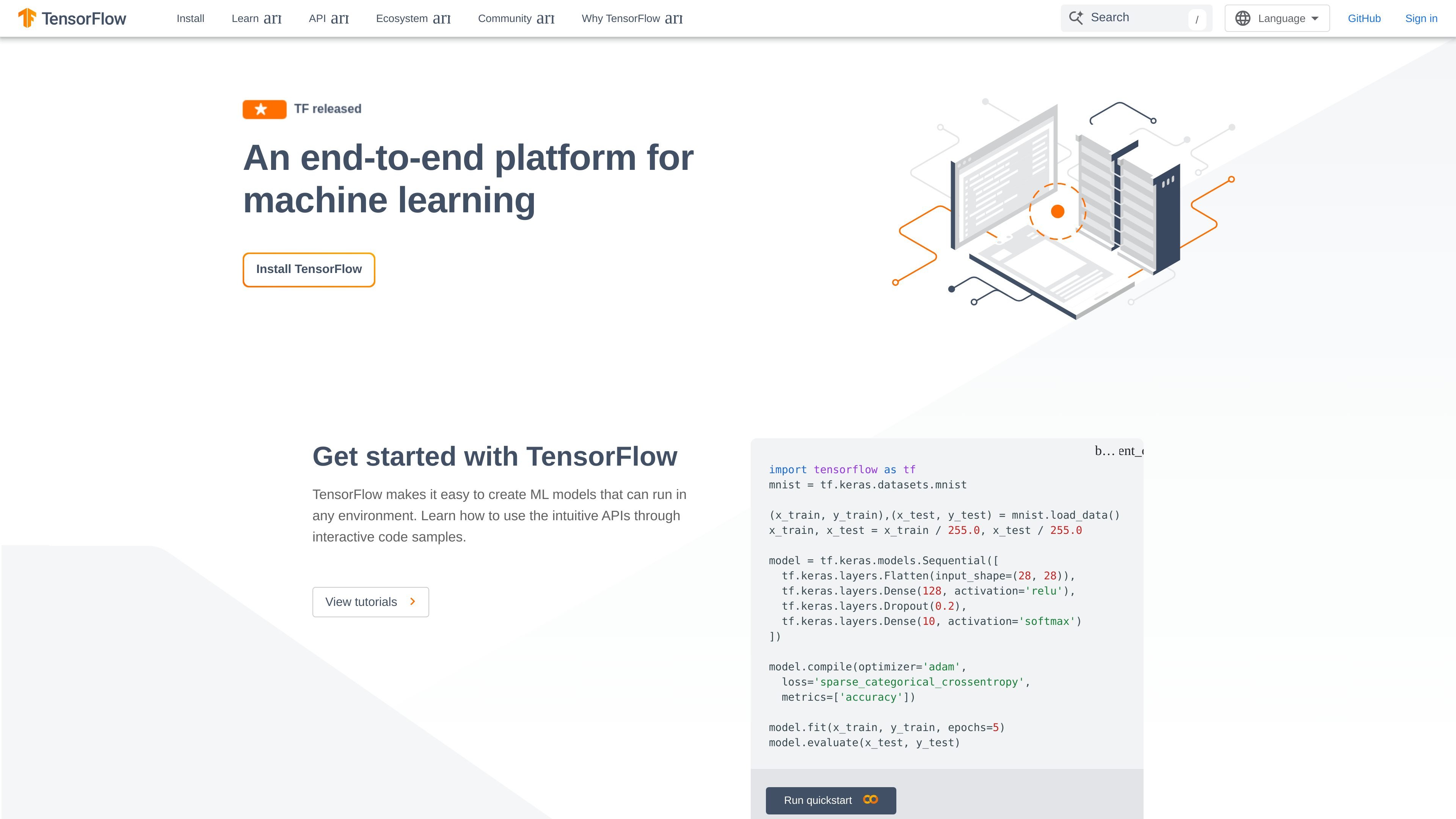
TensorFlow is an open-source machine learning platform centered on TensorFlow Core documentation, learning materials, and a broader ecosystem of libraries and extensions. The public site presents it as a way to build, train, evaluate, and deploy machine learning models across desktop, mobile, web, cloud, and embedded environments.
The documentation emphasizes TensorFlow 2’s simpler workflow, with eager execution, higher-level APIs such as Keras, and flexible model building. It also points users to Colab-based notebooks, production pipelines with TFX, browser deployment with TensorFlow.js, and on-device inference with LiteRT.
Beyond the core framework, TensorFlow groups related tools for data preparation, model analysis, visualization, optimization, federated learning, graphics, and domain-specific extensions. That makes the site useful both for people learning the basics and for teams assembling end-to-end ML systems.
The guide highlights eager execution, higher-level APIs, and flexible model building on any platform as part of TensorFlow 2.
The documentation includes install, migration, Keras, TensorFlow basics, data input pipelines, model saving, accelerators, and performance guides.
The Learn page points to TensorFlow.js, LiteRT, and TFX for web, mobile and edge, and production deployment scenarios.
The Learn page describes standard datasets, scalable data pipelines, preprocessing layers, and tools to validate and transform large datasets.
The libraries page lists ecosystem packages for decision forests, federated learning, graphics, model optimization, data validation, and model analysis.
The Learn page says TensorFlow supports distributed training, model iteration, and debugging with Keras, plus TensorBoard and Model Analysis for tracking progress.
Use the core guides to learn TensorFlow basics, install the package, understand eager execution, and work through Keras- and notebook-based examples.
Use TensorFlow.js for browser-based machine learning and LiteRT for mobile, embedded, and edge inference when models need to run close to users or devices.
Use TFX, TensorBoard, and ML Metadata to automate pipelines, track model behavior, monitor performance, and support production ML operations.
Use the data and ecosystem libraries to prepare datasets, validate inputs, optimize models, and extend TensorFlow with domain-specific tooling.
TensorFlow Core provides guides, tutorials, API reference, and libraries and extensions for building machine learning workflows. The "Learn" page also points to TensorFlow.js for web, LiteRT for mobile and edge, and TFX for production pipelines.
The source describes TensorFlow 2 as focusing on simplicity and ease of use, with eager execution, higher-level APIs such as Keras, and flexible model building on any platform.
The documentation shows TensorFlow used for model building, data pipelines, saving models, performance tuning, deployment, and MLOps. It also includes libraries for areas such as decision forests, federated learning, graphics, and model optimization.
The collected sources do not show pricing details. The pricing URL returns a 404 page, so availability and plan information are not established here.
TensorFlow can be used through core documentation and ecosystem tools, with guidance for Colab notebooks, TensorFlow.js, LiteRT, TFX, TensorBoard, and related libraries and extensions.