
Unified observability and control
Build real-time dashboards, plot live telemetry, and command hardware from one console.

Synnax is an observability and control platform for hardware systems. Connect devices, stream telemetry, automate control, and review data in one workflow.
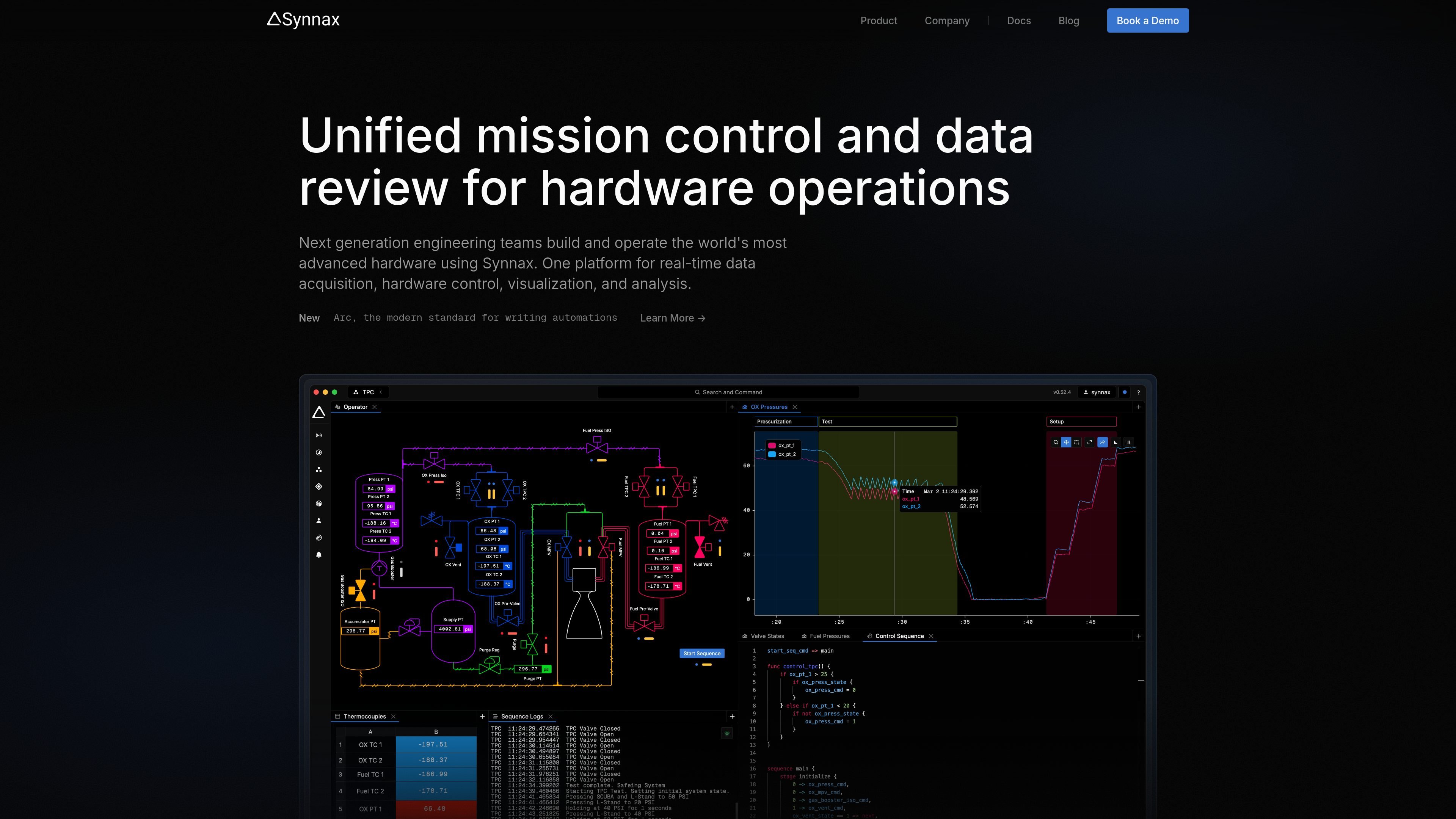
Synnax is an observability and control platform for hardware systems. It combines real-time data acquisition, hardware control, visualization, analysis, automation, and data review in a single product.
The homepage positions Synnax for engineering teams that need to operate complex hardware from one workflow: connect devices, stream telemetry, visualize live state, run automation, and inspect historical data. It includes tools for schematics, line plots, alarms, calculated channels, and a storage engine for high-rate data.
Its automation layer, Arc, is presented as a reactive programming language for hardware sequences. The site says it is designed to help teams manage control authority, deploy to real-time hardware, and transition between automated and manual operation without changing platforms.
Build real-time dashboards, plot live telemetry, and command hardware from one console.
Create interactive schematics that reflect live system state and bind valves, sensors, and actuators directly to hardware channels.
Plot millions of live and historical points with sub-millisecond precision and continue to pan, zoom, and annotate without dropping a frame.
Write reactive automation sequences in Arc, then deploy them to real-time hardware and move between automated and manual operation.
Store and organize kilohertz-rate data, tag runs and anomalies, and review data with range-based context.
Build visual alarms, calculated channels, and real-time processing pipelines without deploying separate infrastructure.
Use Synnax to build operator consoles that show live telemetry, interactive schematics, and direct hardware commands in one place.
Use the Arc language to define control sequences, manage authority, and move from bench testing to production control with the same automation layer.
Use the storage engine, range organization, and line plots to review runs, compare experiments, and inspect anomalies after the fact.
Use calculated channels and visual alarms to transform incoming sensor data, monitor conditions, and surface system state without deploying separate processing services.
Use the SDKs and native drivers to connect hardware, external controllers, or internal tools to the platform through Python, TypeScript, or C++.
The site describes Synnax as a platform for real-time data acquisition, hardware control, visualization, analysis, automation, and review. It is positioned for engineering teams working with hardware systems.
The homepage says Synnax includes a setup workflow for connecting hardware, configuring channels, and starting data acquisition. It also says native drivers automatically detect and establish communication with supported devices.
Yes. The site says Synnax supports live dashboards, interactive schematics, line plots, alarms, calculated channels, and real-time pipelines for live telemetry.
The pricing page did not load and returned a 404, so the site does not provide pricing details in the collected source. The homepage invites visitors to request a demo, get detailed pricing, or ask questions.