
Autonomous store operation
Runs store operations across Shopify, eBay, and other channels with minimal human input, using an autonomous agent model rather than a fixed workflow.

SellerAI is an AI-native ecommerce platform with SellerClaw, an autonomous agent for sourcing, listings, ads, fulfillment, and support, plus SellerCart.
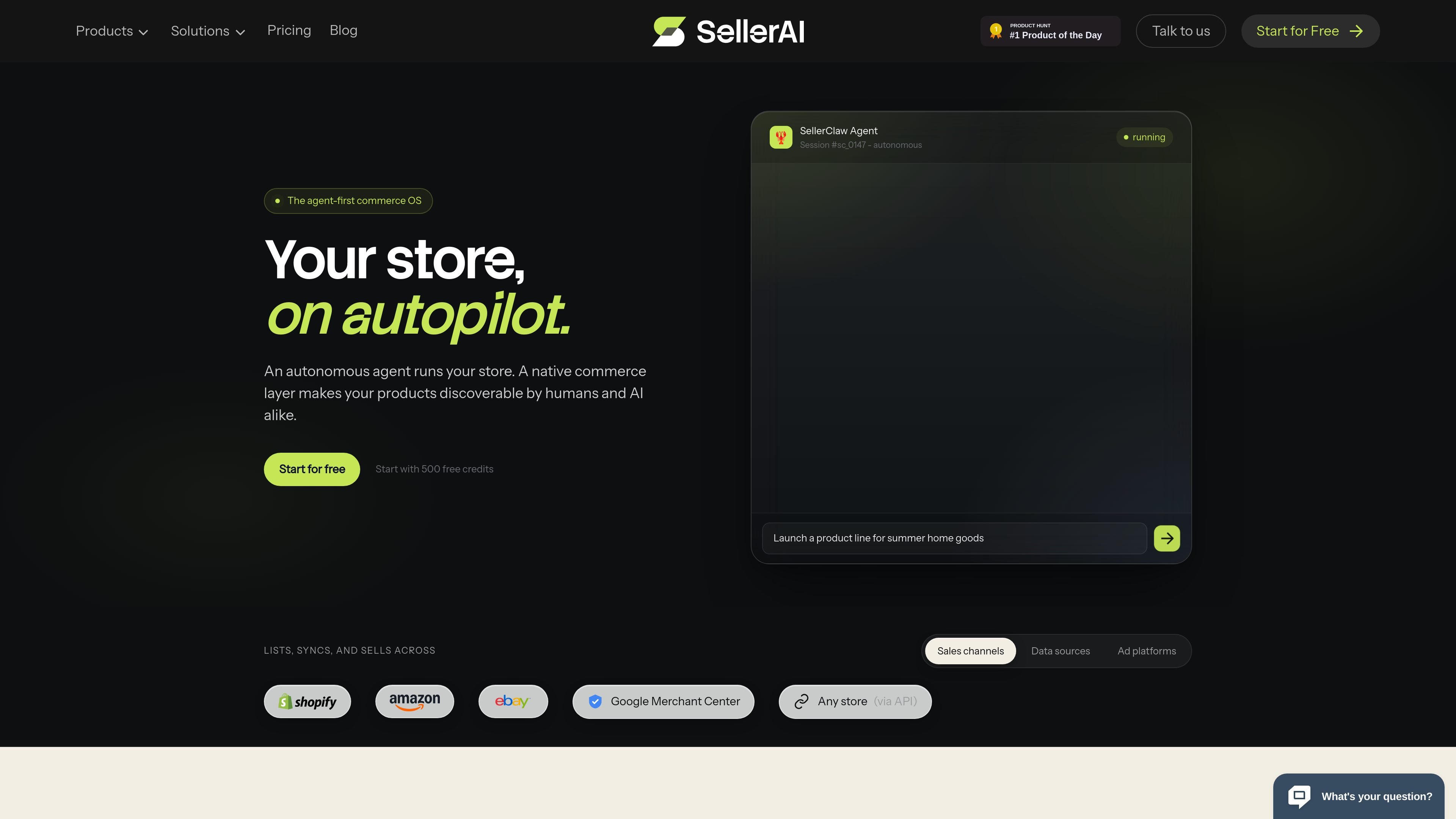
SellerAI is an AI-native ecommerce platform centered on SellerClaw, an autonomous agent that can run online store operations end to end. The product pages position it as a way to delegate sourcing, listings, ads, order handling, and customer support across sales channels with limited manual oversight.
The site also introduces SellerCart, a coming-soon native commerce layer designed for the agentic web. SellerCart is presented as the storefront side of the system, with built-in payments and product discovery for human shoppers and AI interfaces, while SellerClaw handles operational work behind the scenes.
Runs store operations across Shopify, eBay, and other channels with minimal human input, using an autonomous agent model rather than a fixed workflow.
Finds products, checks supplier fit, generates product pages, manages ads, and handles daily commerce work from one agent workflow.
Uses direct integrations where available and browser-based execution when a service only exposes a web portal or login flow.
Works in hosted and self-hosted setups, with the pricing page stating that local execution reduces credits spent on tool calls.
Lets teams define approvals, capability levels, and policies so the agent can operate in advisory, assisted, or autonomous modes.
SellerCart, the native store layer, is described as built for agentic commerce with built-in payments, global selling support, and protocol-level discovery.
Automate product sourcing by connecting supplier catalogs and using trend signals to shortlist products worth listing.
Draft product pages, creative variations, and SEO tags, then use the agent to support ad testing and campaign iteration.
Track orders, place supplier purchases, monitor shipping, and keep customers updated as fulfillment progresses.
Answer routine customer support requests with order context and brand-specific policies, including refunds, swaps, and address changes.
Give teams an agent that can work through browser sessions or direct integrations when a workflow needs to fit existing systems.
SellerAI describes SellerClaw as live and in production use. The pricing page says it is available as a hosted SaaS, and also in an open-source form for teams that want to run it locally. SellerCart is listed as coming soon.
The pricing page says SellerClaw can run locally on your own machine. In that setup, tool calls, storage, and scheduling happen locally, while the AI model still uses credits for thinking.
SellerAI presents SellerClaw as an autonomous commerce agent that can work across sourcing, listings, ads, order handling, and customer support. The site also says it supports browser use when a direct API is not available.
The site says every action is observable and approvable, and you can choose which tools the agent can use, when it needs sign-off, and where it operates autonomously. SellerClaw also offers advisory, assisted, and autonomous modes.
The pricing page says SellerAI uses a credit-based subscription model. Credits are spent when the agent does work, while the free plan includes access to SellerClaw with a limited credit allowance.