
Schema generation from arbitrary URLs
Generate a schema from any URL through the `/get/` path. The homepage shows example targets such as Reddit, Techmeme, Zillow, Product Hunt, and Amazon pages.

Schema Source from Tabstack turns any URL into JSON Schema, Zod, or Pydantic output for developer workflows, with browser viewing and JSON API access on one host.
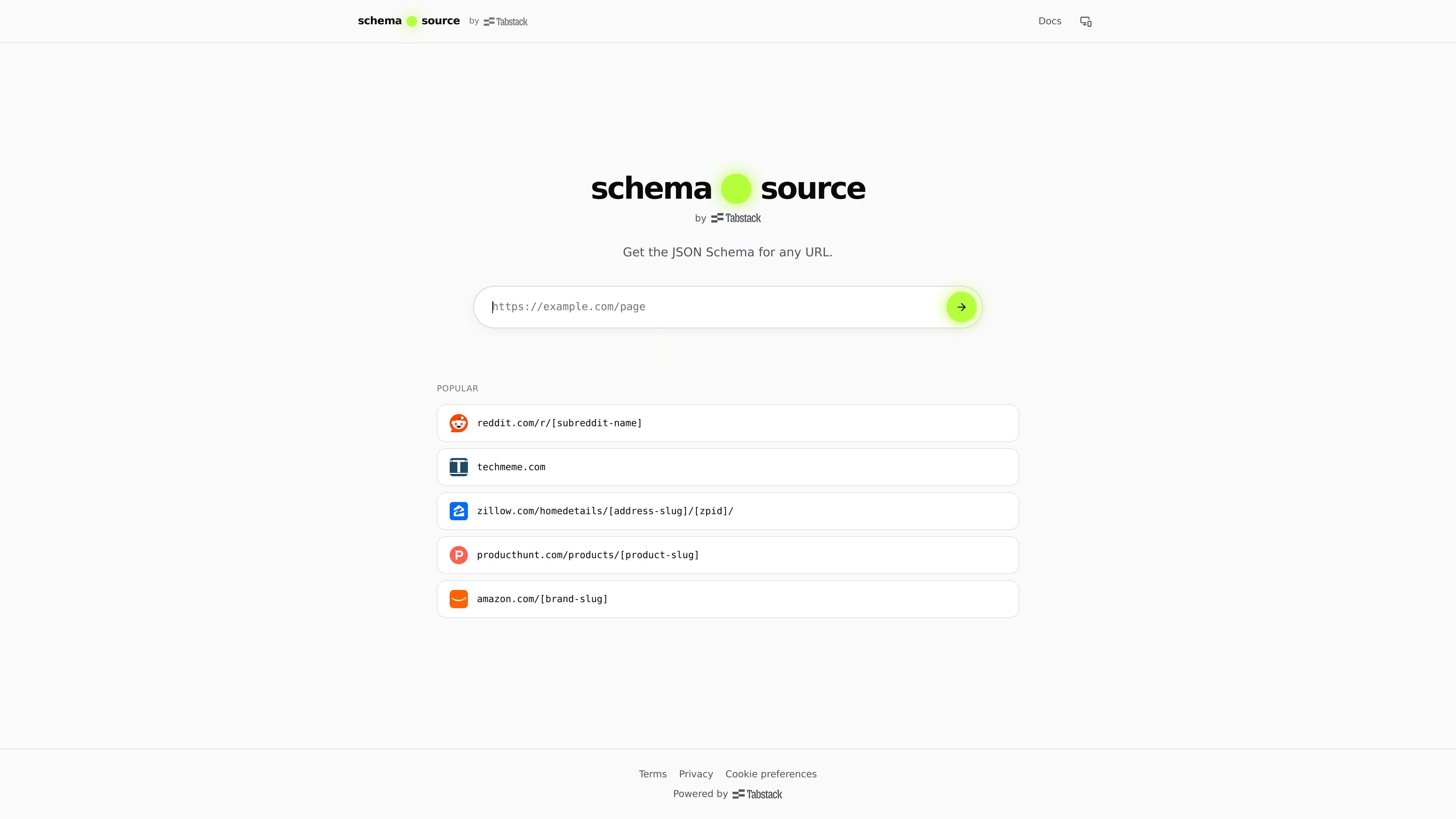
Schema Source from Tabstack is a web-based generator that turns a URL into a structured schema. It is positioned for developers who need JSON Schema, Zod schema, or Pydantic output derived from the contents or layout of a page rather than hand-written models.
The product exposes the same schema pages as both HTML and JSON endpoints. Its docs show a simple `/get/` workflow, where the first request performs extraction and later requests reuse the cached result, making it suitable for repeat lookups and API-driven use.
Generate a schema from any URL through the `/get/` path. The homepage shows example targets such as Reddit, Techmeme, Zillow, Product Hunt, and Amazon pages.
Each schema page can be requested as JSON using content negotiation or `?format=json`, so the same endpoint works for browser viewing and API consumption.
The docs show schema output can be consumed from cached responses after the first extraction, which avoids repeating the upstream extraction work on later requests.
Generated pages expose multiple output formats, including JSON Schema, Zod, and Pydantic, so the same extracted structure can be reused in different stacks.
The docs provide example client requests with `curl` and `fetch`, making the service straightforward to integrate into scripts and applications.
If a URL has not been matched to a learned pattern, the response includes `pattern: null`, which signals that the extraction did not map to a known site template.
Use the service when you want a schema representation of a public URL and prefer not to model the page structure by hand.
Use the JSON endpoint in a script or backend service when you need machine-readable schema output that can be fetched programmatically.
Use the generated output as a starting point for validation or typed data models in codebases that rely on Zod or Pydantic.
Use cached results for URLs you query repeatedly, reducing the need to re-run extraction on every request.
Yes. The docs show that every schema page is also a JSON endpoint. You can request the same `/get/` URL with `Accept: application/json` or add `?format=json` to force JSON.
No. The docs say you do not need to URL-encode the URL, although encoded URLs also work. The server decodes the path and falls back to the raw string if decoding fails.
The first request for a URL triggers extraction synchronously and may take a few seconds. After that, the result is served from cache.
The docs list JSON Schema, Zod schema, and Pydantic model as supported outputs. The product pages also show those output tabs on the generated schema pages.
The docs state a per-IP rate limit of 60 requests per minute on `/get/*`. Responses include `RateLimit-Limit` and `RateLimit-Remaining` headers, and 429 responses include `Retry-After`.