
Cross-repo repository graph
Indexes the repositories you can access, including private and public repos, and builds a graph of how they relate through packages and APIs.
Polygraph is a meta-harness for AI coding agents that unifies multiple repositories into one graph and preserves session context across handoffs for cross-repo work.
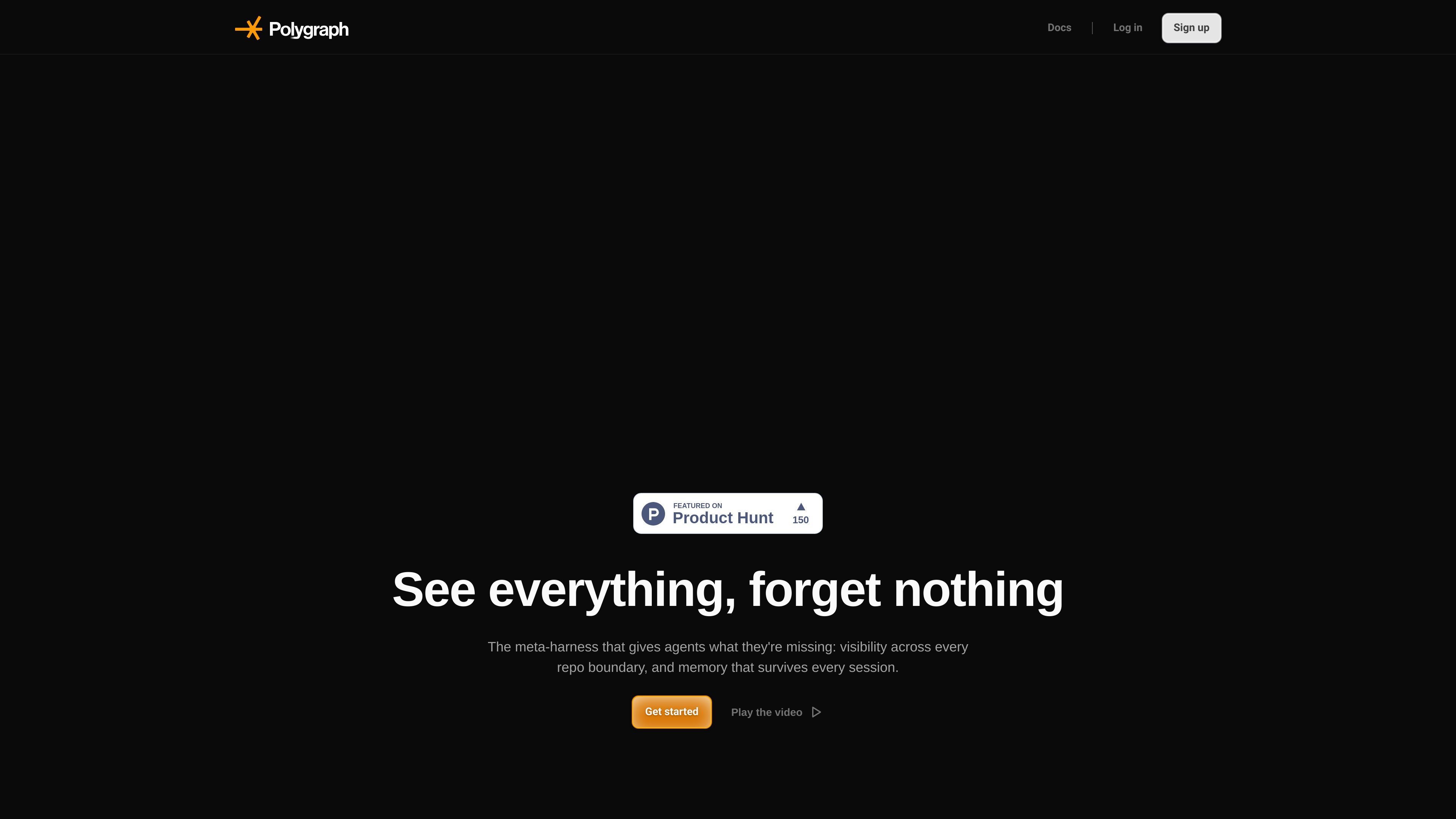
Polygraph is a meta-harness for agentic software work. The site positions it as an addition to agents you already use, not a replacement for them, and says it gives them visibility across repo boundaries plus memory that survives every session.
Its core job is to connect the repositories an organization can access into a unified dependency graph, track work across branches and pull requests, and preserve session context so a change can be resumed, referenced, or handed off later. The product is aimed at teams that need agents to operate across multiple repositories without moving code into a monorepo.
The source also describes Polygraph as useful when a task crosses repositories, when an issue needs to be reproduced against another repo, or when a session should continue across multiple handoffs. The pricing page was unavailable, but the site says the product is free during early access.
Indexes the repositories you can access, including private and public repos, and builds a graph of how they relate through packages and APIs.
Helps agents plan and execute work that spans multiple repositories, with the site describing this as turning a codebase into a synthetic monorepo.
Supports coordination of PRs and CI across related repositories so one session can track a multi-repo change from start to verification.
Records sessions so work can be resumed later, referenced from a new session, or handed to a teammate without re-explaining the context.
Lets a session move between agents while carrying repos, branches, PRs, and logs, which helps with handoffs between tools and people.
Connects with existing stacks and specifically references Codex, Claude Code, Github, and Open Code on the site.
Use Polygraph when a feature spans a backend, frontend, or several services and the agent needs to understand the whole change set before editing code.
Use it to test a library or design-system change against downstream consumers, then open the related PRs from the same coordinated session.
Use it for security remediation when a CVE touches multiple repositories and each affected repo needs its own patch and trail.
Use it when investigating an issue that requires pattern transfer or impact analysis across repositories, especially when the answer is the analysis itself.
Use it to keep a sprint moving across handoffs, so one session can be resumed or referenced instead of re-explaining the context each time.
Polygraph is a meta-harness for agents. It works alongside agents such as Claude Code, Codex, and OpenCode instead of replacing them.
The source says Polygraph connects all repos an organization has access to, including private and public repositories, into a unified dependency graph without moving code.
It records agent sessions so they can be resumed, referenced, or handed off later, including when the work was done on a different machine or with a different agent.
The site says Polygraph is free during early access and that it is built by the Nx team. It also offers a sales contact flow for questions or demos.
The public source emphasizes repo discovery, cross-repo work, PR and CI coordination, session memory, and handoff across agents.