
Large app connector set
Connect Gmail, GitHub, Notion, Slack, Linear, Zoom, Discord, Airtable, Asana, Dropbox, Supabase, Vercel, WhatsApp, Stripe, Jira, Figma, Trello, and many more apps through one authorization layer.

OOMOL connects Gmail, GitHub, Notion and more to AI agents, with reusable tools across Codex, Claude Code and Cursor, plus usage-based pricing.
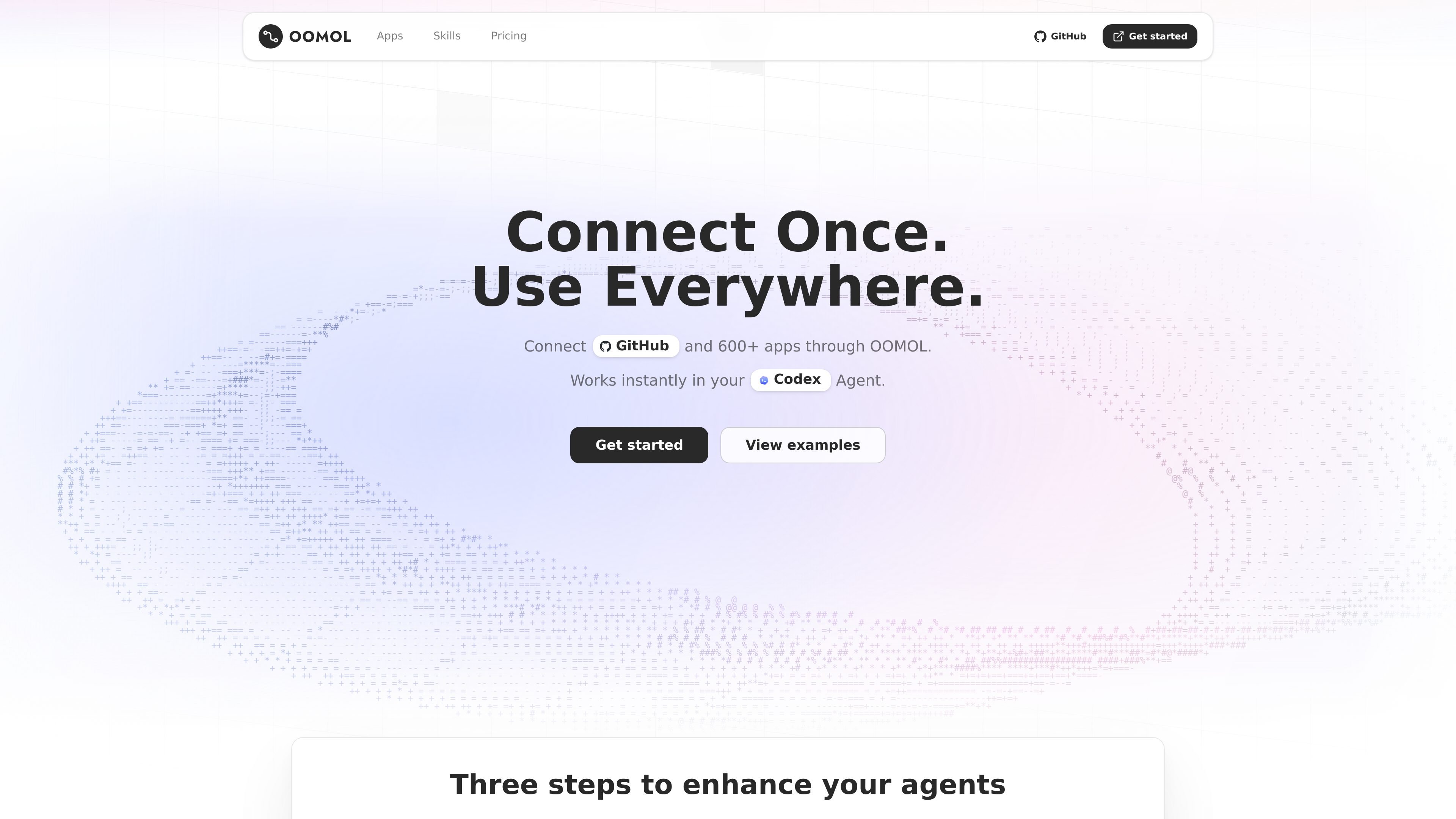
OOMOL is a connector layer for AI agents that lets you link third-party services once and reuse those connections across different agent environments. The site positions it as a way to connect Gmail, GitHub, Notion, Slack, and 600+ apps, then call the resulting tools from agents such as Codex, Claude Code, Cursor, and local agents.
The product is built around three steps: install OO CLI or copy prompts into an agent, connect apps in OOMOL with the scopes you want, and then let the agent discover and run approved tools. The source also shows OOMOL turning recurring workflows into Skills, so the same process can be shared or installed in other agents without reauthorizing everything from scratch.
Pricing is usage-based. The pricing page lists a Free plan, a Pro plan at $20 per month, and a Max plan at $100 per month. All plans include 20K app calls per month, with overage charged from credits, and separate rates apply to media, speech, and other service usage.
Connect Gmail, GitHub, Notion, Slack, Linear, Zoom, Discord, Airtable, Asana, Dropbox, Supabase, Vercel, WhatsApp, Stripe, Jira, Figma, Trello, and many more apps through one authorization layer.
Install OO CLI or copy prompts into an agent, then use connected apps and skills in environments such as Codex, Claude Code, Cursor, and other supported agents.
Customize app scopes during connection and keep tool permissions managed in OOMOL instead of handling raw passwords or tokens inside the agent.
Promote repeated workflows into shareable Skills so the same action sequence can be reused across different agents.
Use built-in service categories for media and AI work, including image generation, video generation, speech-to-text, and text-to-speech.
Review usage, results, and run records from the OOMOL console while agents execute approved tools in the background.
Summarize Gmail messages into a Notion note from an agent, using OOMOL to read authorized mail and write the output to a connected workspace app.
Pull merged pull requests or repository activity from GitHub and post the brief into Slack so engineering updates can be shared without manual copy-paste.
Turn recurring operational work into a reusable Skill so different agents can run the same steps with the same tool order and output constraints.
Use connected media and AI services to generate, edit, or transform content such as subtitles, images, or video as part of a broader agent workflow.
Connect multiple business apps such as Linear, Airtable, Jira, and Notion to move information between systems inside approved scopes.
OOMOL is not a new chat agent. It connects third-party services such as Gmail, GitHub, Notion, and Slack so agents can call approved tools and work with connected accounts.
The homepage shows setup in three steps: install OO CLI or copy prompts into your agent, connect apps in OOMOL, then use OO in the agent you already work in.
The source shows OOMOL working with agents such as Codex, Claude Code, Cursor, and local agents, using connected apps and skills inside those environments.
The pricing page shows a Free plan and paid Pro and Max plans. All plans include 20K app calls per month, and overage is charged at 0.3 credits per 1K calls.
OOMOL says agents do not receive account passwords or raw tokens. You authorize third-party accounts in OOMOL, and agents use approved tools within those scopes.